
Xiaomi’s humanoid assembles EVs autonomously for 3 hours
PLUS: Agibot launches $1k rental + Vision-only robots ace tests
Welcome back to your Robot Briefing
Xiaomi just crossed a critical threshold: its humanoid robot worked autonomously on an actual EV production line for three straight hours, hitting a 90.2% success rate on complex assembly tasks. This isn't another controlled demo—it's a live manufacturing environment with real cycle time requirements and variable conditions.
With Tesla, BMW, and Xpeng all racing toward similar deployments, the question facing automation leaders is whether 90% reliability represents the tipping point for investment—or whether the jump to 95%+ success rates will take longer and cost more than current timelines suggest.
In today's Robot update:
Xiaomi's humanoid clocks in: 3 hours of autonomous EV assembly
Snapshot: Xiaomi deployed its humanoid robot on an actual EV production line for three consecutive hours of autonomous work, achieving a 90.2% success rate on complex assembly tasks—a meaningful step beyond controlled demos toward real manufacturing applications.
Breakdown:
Takeaway: The 90.2% success rate signals we're still 1-2 years from production-ready humanoid manufacturing, but three-hour autonomous runs represent a substantial leap from scripted demos. Companies evaluating automation roadmaps should track whether success rates cross 95% in the next 12-18 months—that's when the business case shifts from experimental to economically viable.
Vision-only robots ace the 'Humanoid Olympics' years ahead of schedule
Snapshot: Physical Intelligence trained robots to complete complex household tasks using only camera inputs, clearing benchmarks experts thought were years away.
Breakdown:
Takeaway: Roboticist Benjie Holson revised his home robot timeline from 15 years away to [six years away](https://www.scientificamerican.com/article/why-humanoid-robots-are-learning-everyday-tasks-faster-than-expected/) based on these results. Companies evaluating automation investments should note that simpler hardware requirements (cameras vs. complex sensors) could accelerate both development timelines and reduce deployment costs significantly.
Agibot launches $1,000/day robot rental after topping global shipment charts
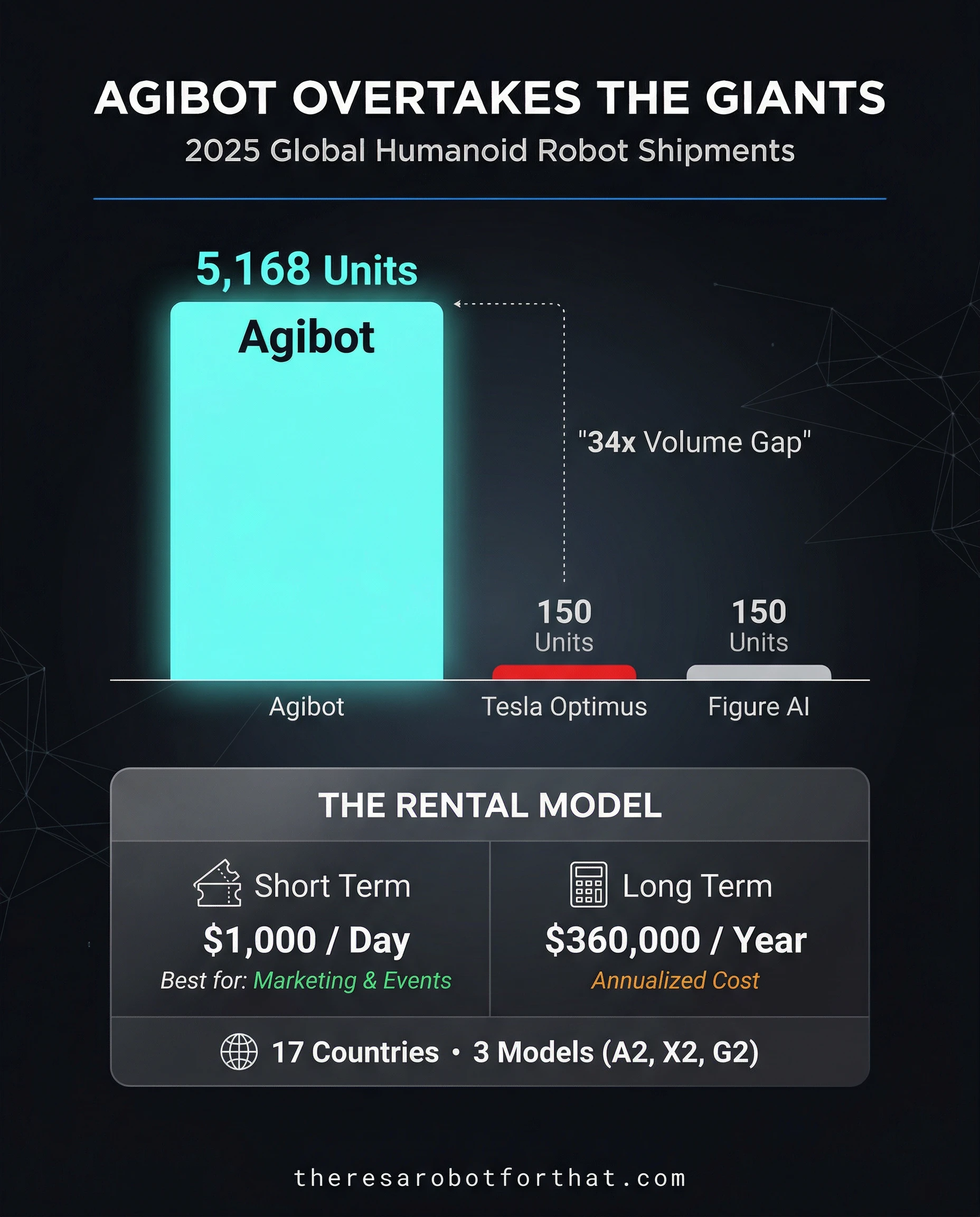
Image Source: There's A Robot For That
Snapshot: Chinese robotics leader Agibot is launching a Robots-as-a-Service model across Europe and North America, letting companies test humanoid robots without committing to six-figure purchases.
Breakdown:
Takeaway: This rental model creates a low-risk entry point for companies to evaluate humanoid robots in real-world settings, but current pricing positions these as marketing tools rather than operational investments. The massive shipment gap between Chinese manufacturers and U. S. rivals signals that accessible testing models may accelerate adoption timelines faster than anticipated.
HII taps 'Physical AI' to automate shipyard welding
Snapshot: Military shipbuilder Huntington Ingalls Industries is partnering with Path Robotics to deploy autonomous welding systems in its shipyards, targeting one of the most labor-intensive bottlenecks in naval construction.
Breakdown:
Takeaway: This signals that physical AI has matured enough for highly regulated, mission-critical defense manufacturing environments. Companies in capital-intensive industries with skilled labor constraints should watch whether HII achieves measurable throughput gains, as that would validate the business case for similar automation investments beyond defense.
Other Top Robot Stories
Deloitte unveiled physical AI solutions built with NVIDIA Omniverse for industrial clients, opening a Shanghai center of excellence focused on manufacturing robotics and announcing early results from Horse Powertrain's automotive plant in Spain where AI-powered anomaly detection is reducing equipment downtime and improving quality assurance decision-making.
Automotive analysts questioned whether humanoid form factors offer real advantages for manufacturing, with PwC and Plante Moran experts suggesting that task-specific robots with wheels or alternative designs may deliver superior performance and ROI compared to bipedal humanoids despite the current media attention around Tesla Optimus and competitors.
Intuitive completed its acquisition of da Vinci and Ion surgical robot distribution operations across Italy, Spain, Portugal and Malta for approximately 319 million euros, bringing 250 employees in-house and expanding direct European presence across a region with over 470 installed systems as the surgical robotics market matures beyond single-vendor dominance.
🤖 Your robotics thought for today:
Xiaomi's humanoid hit 90.2% success over three autonomous hours in actual EV assembly while most manufacturers are still waiting for 99% lab performance before they'll even pilot—so does deploying imperfect robots today beat perfecting demos for tomorrow, or are we watching Xiaomi discover that 10% failure rates cost more than the labor they're replacing?
Until tomorrow,
Uli


