
Unitree's H1 humanoid hits Olympic sprinter speed
PLUS: Panther humanoid now delivering to real homes, US Army's autonomous kitchens deploy, and Ukraine's ground robots hit 9,000 missions monthly

Welcome back to your Robot Briefing
Chinese robotics firm Unitree just clocked its H1 humanoid at 10 meters per second — the same pace as an Olympic sprinter. The catch? It's using wheeled legs, not feet.
The speed milestone raises a strategic question: Are manufacturers abandoning the bipedal dream because human-like walking is too hard, or because wheels-plus-legs simply makes more business sense for real-world deployment?
In today's Robot update:
Unitree's humanoid smashes speed record, hits 10 meters per second
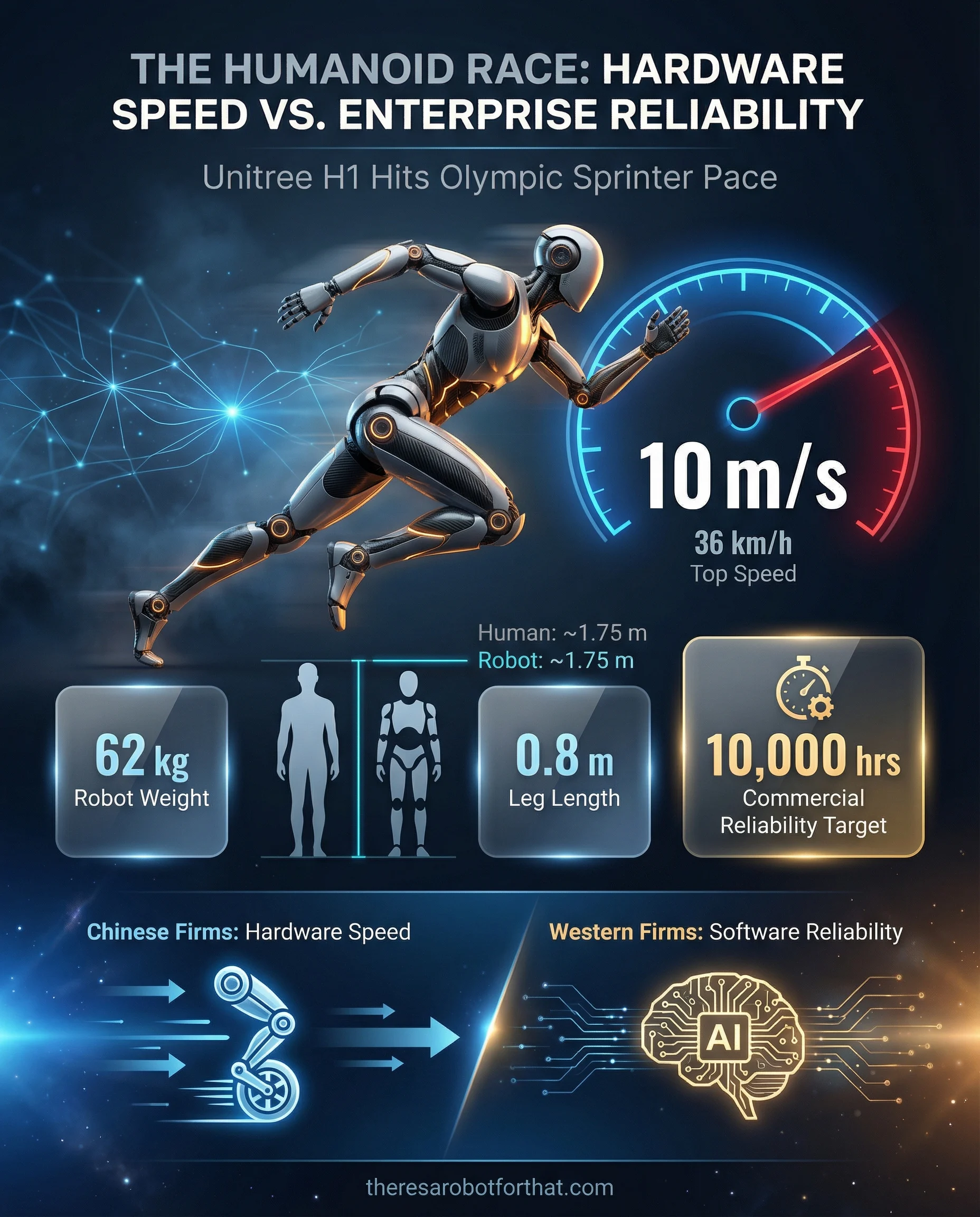
Image Source: There's A Robot For That
Snapshot: Chinese robotics firm Unitree announced its H1 humanoid reached 10 m/s running speed — matching Olympic sprinter pace — using a wheeled-leg hybrid design. The 62kg robot with 0.8m leg length demonstrates how manufacturers are prioritizing speed and agility metrics over traditional bipedal locomotion.
Breakdown:
Takeaway: Speed records make headlines but don't signal near-term business relevance — wheeled humanoids solve different problems than walking robots, and raw velocity matters little in warehouses or factories where precision and reliability drive ROI. The real signal is how aggressively Chinese manufacturers are iterating on hardware capabilities while Western competitors focus on AI and software integration.
Chinese firm claims first mass-produced humanoid for real household deployment
Snapshot: UniX AI began global deliveries of Panther, positioning it as the first service humanoid deployed in unmodified homes rather than labs or staged environments. The robot features 34 degrees of freedom, wheeled mobility, and demonstrated continuous multi-task execution from bed-making to cooking in real residential settings.
Breakdown:
Takeaway: Household deployment claims should be viewed skeptically until independent verification and pricing emerge — controlled demos in "real" homes still differ vastly from reliability across thousands of units in diverse conditions. The Morgan Stanley presentation signals serious investor interest in Chinese home robotics plays, suggesting capital is flowing toward companies prioritizing commercialization over pure research.
US Army tests autonomous robotic kitchens that deploy in shipping containers
Snapshot: The Army's Sustained Autonomous Meals system completed over 9,000 missions in March 2026 alone, using robotic arms and automated cooking equipment inside shipping containers to prepare hot meals. The transportable system now serves 167 military units, demonstrating scaled operational deployment beyond pilot programs.
Breakdown:
Takeaway: The 167-unit deployment and 9,000+ monthly missions indicate this passed proof-of-concept and entered operational integration — a maturity signal relevant for any sector facing labor shortages in remote or high-turnover food service environments. The military's willingness to deploy at scale suggests the technology cleared reliability thresholds that commercial operators in ports, mining, or energy could evaluate for similar applications.
Ukraine's ground robots hit 9,000 missions per month as military integration scales
Snapshot: Ukrainian forces conducted over 9,000 ground robot missions in March 2026 — triple the rate from five months prior — with 167 military units now operating unmanned ground vehicles for supply runs and medical evacuation. One robot transported a wounded soldier 15 miles under active drone fire.
Breakdown:
Takeaway: This represents the largest-scale operational validation of ground robotics under sustained combat conditions — far beyond controlled industrial pilots — with mission volume tripling in five months and commanders projecting robots could replace a third of exposed infantry positions. Companies in logistics, mining, or construction should recognize that Ukraine is proving autonomous ground vehicles work in the most demanding real-world conditions imaginable, collapsing the timeline for commercial applications in less hostile but similarly unstructured environments.
Other Top Robot Stories
Figure charged roughly $1,000 per month per robot under a Robot-as-a-Service subscription model that includes hardware, software updates and maintenance, positioning humanoids as operational expenditure rather than capital investments after the company's valuation jumped 15x to $39 billion in 18 months.
Unitree plans to launch its R1 humanoid robot globally via Alibaba's AliExpress platform next week, targeting North America, Europe, Japan, and Singapore at approximately $4,300—making it one of the lowest-cost humanoid robots capable of dynamic movements including cartwheels and running downhill.
IHMC revealed its disaster-response humanoid Alex through a multimillion-dollar US Office of Naval Research project, weighing 15 kilograms less than its predecessor Nadia while maintaining performance for high-risk environments including hazardous sites and military applications.
Intuitive completed about 3 million robotic surgical procedures in 2025, capturing roughly 30% of the 9 million annual procedures addressable by its da Vinci platform within a global robotic surgery market representing only 5% of the 425 million annual surgical procedures worldwide.
🤖 Your robotics thought for today:
The US Army ran 9,000 autonomous kitchen missions in March. Ukraine ran 9,000 ground robot missions in the same month. One cooks meals in shipping containers. The other evacuates casualties under fire. Both crossed the same threshold: operational scale, not pilot programs.
Which deployment model tells you more about where robotics actually works today?
Until Wednesday,
Uli


