
Japan's $6.28B bet on physical AI for robots
PLUS: Chery's $41K humanoid goes on sale, wall-climbing robot tackles industrial tanks, and Apollo hits Mercedes factories
Welcome back to your Robot Briefing
Japan's biggest tech names — SoftBank, Sony, NEC, and Honda — just pooled $6.28 billion in government backing to build their own physical AI foundation model. The goal: break free from U.S. AI infrastructure and power a new generation of autonomous machines by 2030.
It's a national bet on robots that work in the real world, not just chat on screens. The question is whether Japan's consortium can outpace Silicon Valley's head start — and what happens to global supply chains if they do.
In today's Robot update:
Japan's tech giants launch $6.28B joint venture targeting physical AI for robots and autonomous machines
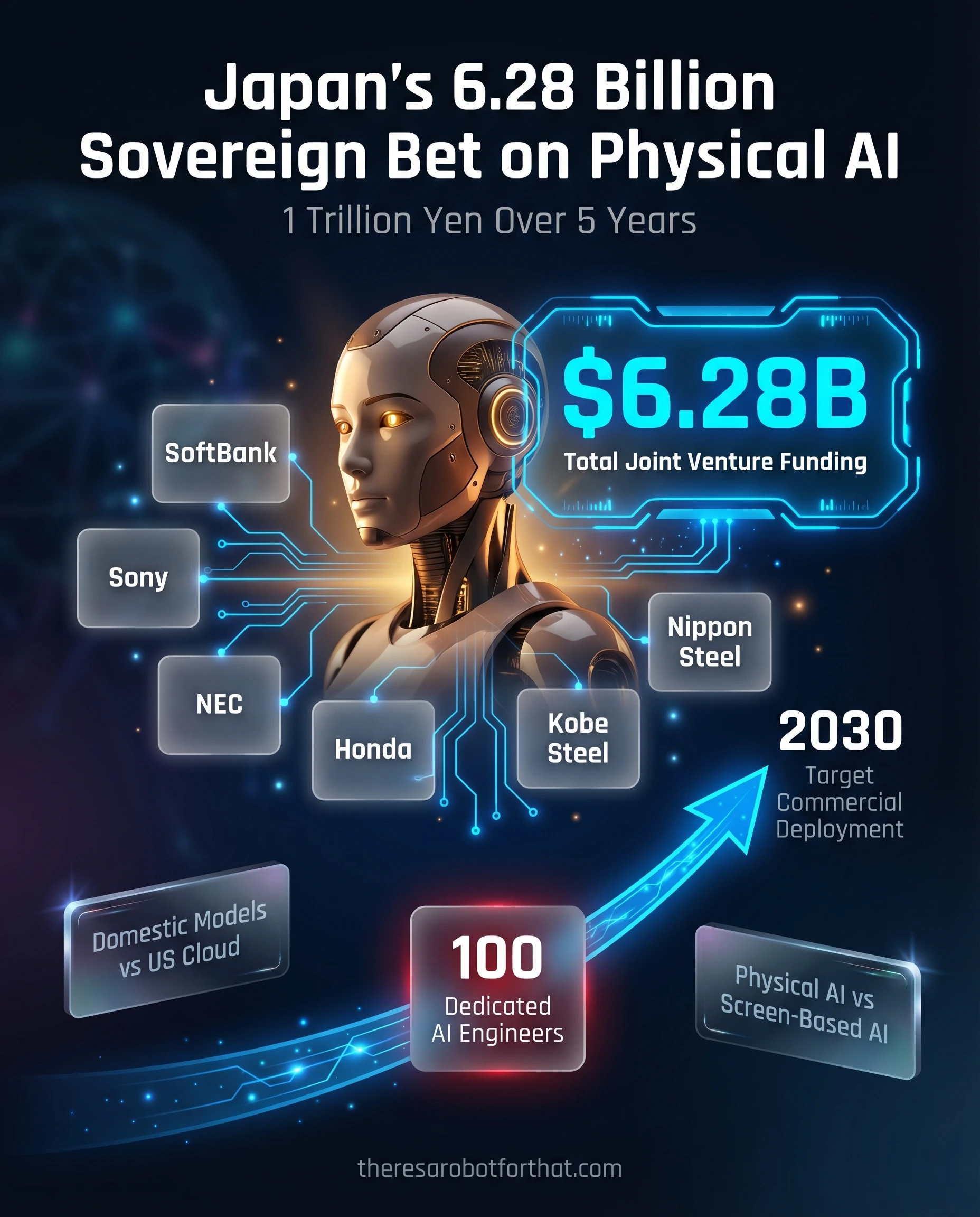
Image Source: There's A Robot For That
Snapshot: SoftBank, Sony, NEC, and Honda are forming a new AI company backed by $6.28 billion in Japanese government funding to build a trillion-parameter model for autonomous machines, marking a strategic shift away from U.S. AI dependence. The venture targets commercial deployment of physical AI applications by 2030.
Breakdown:
Takeaway: This signals sovereign AI concerns are now driving multi-billion dollar domestic robotics investments, not just defense or data privacy initiatives. Operations leaders at multinational manufacturers should watch whether this model spawns similar regional partnerships in Europe or elsewhere, potentially fragmenting the robotics ecosystem and creating new compliance considerations for global deployments.
Chery brings humanoid robot to general consumer market at $41,400
Snapshot: Chinese automaker Chery's AiMoga brand launched direct online sales of its Mornine M1 humanoid robot at $41,400, combining e-commerce with plans for 300+ physical dealer locations mixing auto showrooms, specialty stores, and mall experience centers. The company is offering direct purchase, long-term leasing, and installment payment options to lower barriers for ordinary consumers and business buyers.
Breakdown:
Takeaway: A major automaker treating humanoids like consumer vehicles—with dealer networks, financing options, and mall showrooms—suggests the business model is shifting from pilot programs to volume distribution. The sub-$50K price point with flexible payment terms puts capable humanoids within reach of mid-sized operations, making 2026-2027 the window when cost objections start losing credibility in budget discussions.
China deploys wall-climbing humanoid for high-risk industrial operations
Snapshot: China has deployed its first embodied AI humanoid designed specifically for hazardous industrial work, using a magnetic chassis to climb chemical storage tank walls while performing precision welding, rust remediation, and inspections with 15 degrees of freedom. The 90-kg system operates continuously via tethered power, eliminating battery constraints for true 24/7 operation.
Breakdown:
Takeaway: Purpose-built industrial humanoids solving specific high-risk problems are already deployed and operating, not in labs but at active chemical facilities. Companies with hazardous confined-space work, difficult vertical access, or 24/7 maintenance requirements should evaluate whether their safety incidents and insurance costs justify piloting task-specific humanoids now rather than waiting for general-purpose models.
Apptronik's Apollo humanoid hits factory floors with Google DeepMind AI integration
Snapshot: Apptronik's Apollo humanoid robots are being deployed on active manufacturing lines at Mercedes-Benz and Jabil, integrating Google DeepMind's Gemini multimodal reasoning to enable vision-language-action models that convert visual information and spoken instructions into motor commands for factory tasks. The 5-foot-8-inch, 160-pound units can lift up to 55 pounds and work alongside human employees.
Breakdown:
Takeaway: Major manufacturers are already running humanoids on active production lines alongside workers, not in isolated test cells. Operations leaders should ask their manufacturing and logistics teams to identify three repetitive tasks currently performed by humans where a 55-pound payload capacity and conversational instruction could deliver ROI, then request pilot proposals from vendors before competitors gain 12-18 months of deployment learning advantages.
Other Top Robot Stories
DeepX showcased its mass-produced DX-M1 AI chip at Japan's DX Week 2026, targeting embedded IoT and robotics markets as the Korean fabless firm pushes into physical AI applications ahead of its 2-nanometer DX-M2 chip launch in H2 2026.
Beijing hosted a full-scale test run for its second humanoid robot half-marathon scheduled April 19, with over 70 teams completing the 21-kilometer course — up nearly fivefold from last year's inaugural event where only six of 21 robots finished.
Humyn committed $20 million to expand data collection operations across India, Southeast Asia, Latin America, and West Asia for training physical AI systems, focusing on egocentric video and conversational voice data across 33 languages without institutional venture backing.
Washington State University developed a soft inflatable robotic arm weighing under 50 pounds and costing $5,500 that can identify and pick apples in 25 seconds, addressing Washington's agricultural labor shortage in its multibillion-dollar farming industry.
🤖 Your robotics thought for today:
Japan just committed $6.28 billion to avoid paying U.S. cloud bills. That's not an AI strategy — it's an independence strategy that happens to build robots. If Europe follows the same playbook, your 2028 factory might need three different robot operating systems depending on which country you're deploying in.
I'm watching whether sovereignty concerns fragment the market faster than standards can keep up.
Until Friday,
Uli


