
Tether bets $1B on German humanoid startup Neura
PLUS: LG's physical AI alliance + MIPS pivots to RISC-V
Welcome back to your Robot Briefing
Crypto giant Tether just dropped $1 billion into German humanoid startup Neura Robotics, handing the Metzingen-based company a $4 billion valuation in one of the largest funding rounds robotics has ever seen. When stablecoin operators start writing ten-figure checks for physical AI infrastructure, the capital dynamics of the entire sector shift.
The question for automation leaders: does this flood of unconventional money accelerate your deployment timeline, or does it just inflate valuations before the technology proves itself in production environments?
In today's Robot update:
Tether backs German humanoid startup with massive $1B bet
Snapshot: Crypto giant Tether is financing a $1 billion round for German robotics company Neura Robotics, valuing the humanoid maker at $4 billion and signaling that unconventional capital sources are flooding into the embodied AI sector.
Breakdown:
Takeaway: This funding signals that robotics companies can now access capital at scales previously reserved for software unicorns, potentially compressing the timeline from prototype to production deployment. For operations leaders evaluating automation vendors, expect increased competition and faster product iteration cycles as this new capital reshapes the supplier landscape.
LG's 'Physical AI' alliance targets vertical integration
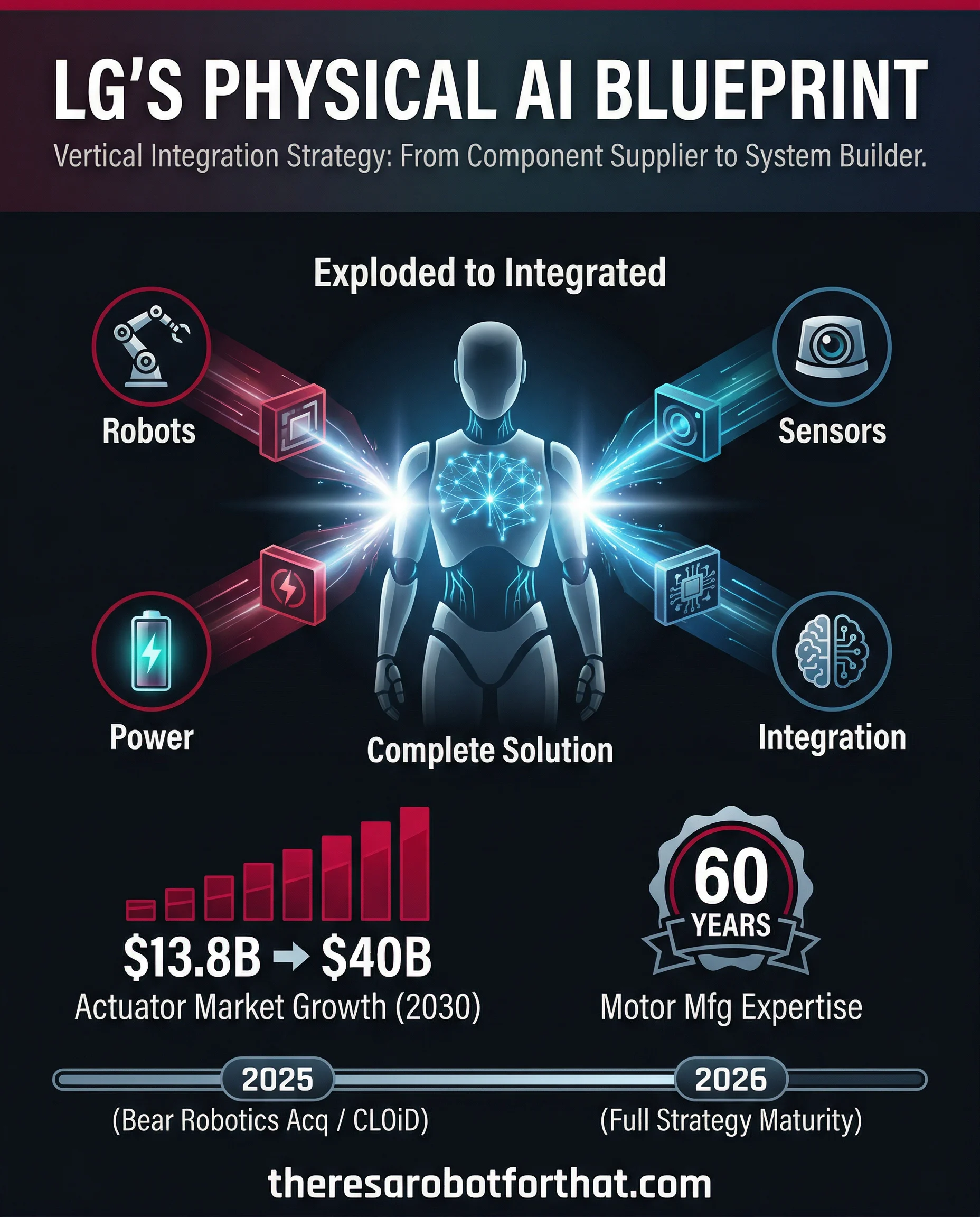
Image Source: There's A Robot For That
Snapshot: Four major LG subsidiaries are combining forces to build vertically integrated robotics solutions, signaling that component suppliers are becoming direct competitors in the complete systems market.
Breakdown:
Takeaway: When component suppliers move downstream to build complete systems, procurement strategies need revisiting—the companies you buy sensors or batteries from today may compete for your automation projects tomorrow. LG's timeline suggests this shift is happening now, not in some distant future.
MIPS pivots to RISC-V to conquer the 'Physical AI' chip market
Snapshot: Chip architecture veteran MIPS is transitioning to RISC-V and betting on safety-critical processors for autonomous vehicles and industrial robots, signaling that the physical AI chip market has matured enough to warrant major strategic pivots from established players.
Breakdown:
Takeaway: When a 40-year-old chip architecture abandons its namesake technology to chase the robotics market, that's a clear signal the physical AI opportunity has moved from speculative to strategic. The shift toward vertically integrated chip providers could also reshape procurement for companies building autonomous systems, potentially simplifying supplier relationships but increasing foundry lock-in.
Researchers map 200k 3D faces to fix the 'Uncanny Valley'
Snapshot: Chinese researchers built a 200,000-scan facial dataset and AI model that helps humanoid robots express emotions without the creepy factor that comes from relying on 2D texture mapping.
Breakdown:
Takeaway: This addresses a core barrier to humanoid adoption in customer-facing environments—the technology to make robot faces look natural exists now, not in three years. Companies evaluating humanoids for hospitality, elder care, or retail should note that the uncanny valley problem has a technical solution that's moving from research to deployment.
Other Top Robot Stories
CMR reached $1.5 billion in total venture capital funding to become the world's top-funded surgical robotics startup, with CEO Massimiliano Colella strategically delaying the US market launch by one year to ensure the second-generation Versius Plus meets exacting standards before entering the competitive American healthcare landscape.
Georgetown analyzed thousands of People's Liberation Army procurement documents revealing China's military is developing humanoid robots for space warfare, autonomous drone swarms for coordinated attacks, deepfake propaganda systems, and AI-powered decision-making tools to compensate for the PLA's limited combat experience and command-chain vulnerabilities.
Boston announced a webinar where Atlas engineering teams will discuss how application requirements and safety philosophy shaped the humanoid's modular hardware architecture, addressing the fundamental question of how human a commercial humanoid robot should actually be for industrial deployment.
🤖 Your robotics thought for today:
Tether just valued Neura at $4 billion with a $1 billion check from crypto reserves while traditional robotics companies spend years pitching institutional VCs—so if stablecoin giants can deploy venture capital faster than Sequoia, does that mean the robotics funding bottleneck just evaporated or are we watching hot money chase the embodied AI narrative before anyone proves unit economics?
Until tomorrow,
Uli


