
Siemens humanoid works full 8-hour factory shift
PLUS: Chef Robotics hits 100 million servings, China's Canton Fair robot showcase, and ISRO's satellite tech now does surgery

Welcome back to your Robot Briefing
Siemens just put a humanoid robot through a full factory shift in Germany — not in a test lab, but on a live production floor with real deadlines, moving 60 containers an hour at over 90% accuracy.
The question isn't whether humanoids can handle factory work anymore. It's how fast companies can scale them before labor economics flip entirely, and whether your competitors are already running the math.
In today's Robot update:
Siemens humanoid robot works full 8-hour factory shift in live production test
Snapshot: Siemens deployed a humanoid robot on its live electronics factory floor in Germany, where it autonomously handled logistics tasks for 8+ hours with 90%+ task completion and moved ~60 containers per hour. This isn't a demo — it's a production environment with real output targets.
Breakdown:
Takeaway: The signal here is deployment methodology — major industrials are now testing humanoids in active production with measurable throughput requirements, not just R&D facilities. Companies evaluating automation should watch completion rates and operational duration as leading indicators of when these systems move from "interesting" to "deployable at scale."
Chef Robotics hits 100 million servings as food robots reach production scale
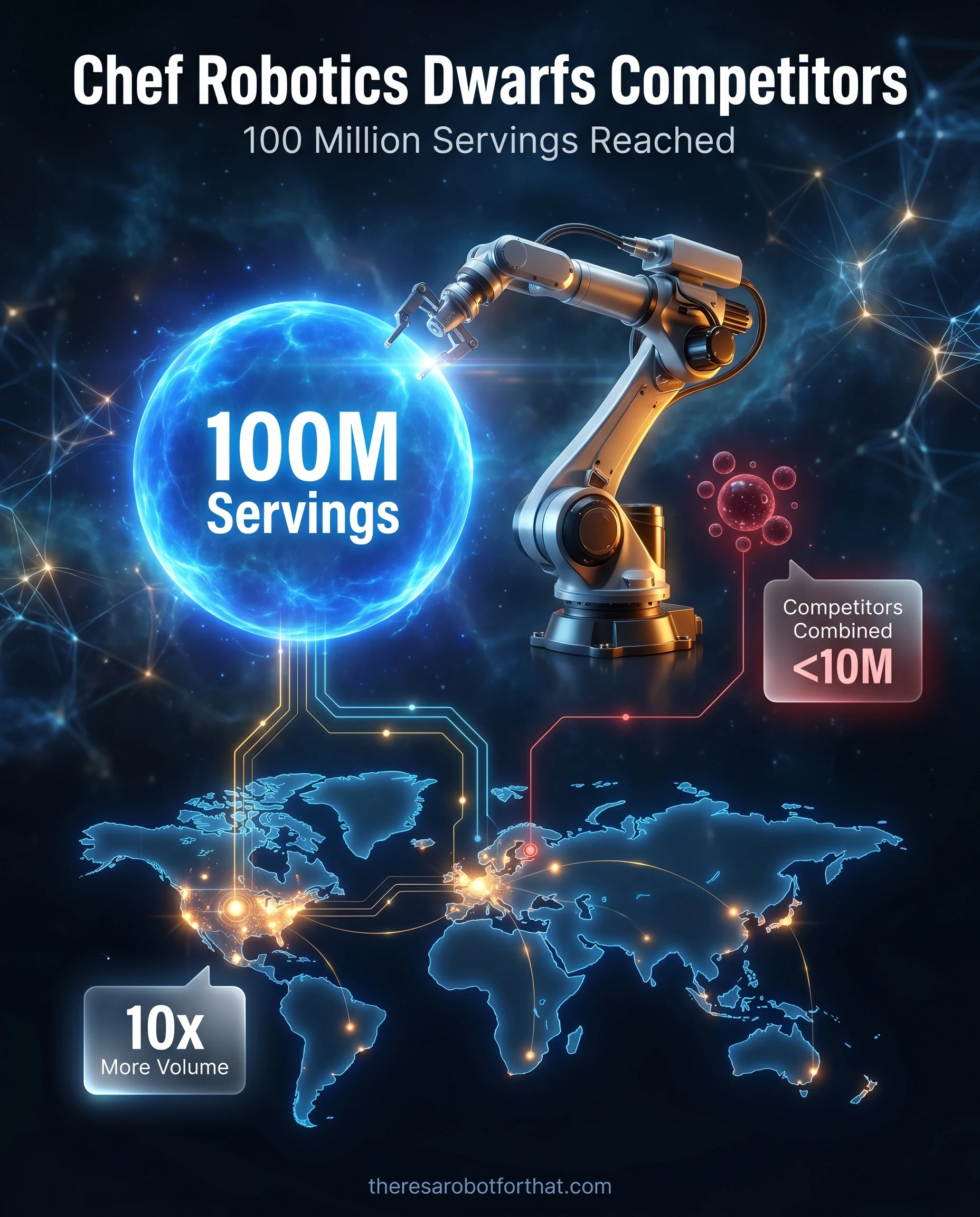
Image Source: There's A Robot For That
Snapshot: Chef Robotics announced its robots have completed 100 million servings across customer facilities in the US, Canada, and Europe — an order of magnitude more than all other food robotics companies combined. The company claims this gives it the world's largest real-world food manipulation dataset.
Breakdown:
Takeaway: This marks a business model inflection — the company turned production deployments into its competitive moat by using customer data to improve performance across all sites. Food and beverage executives should note this indicates robotics providers with live production experience now have a compounding advantage over purely lab-based competitors.
China's Canton Fair opens with wall-to-wall robotics showcase across industrial applications
Snapshot: The 2026 Canton Fair opened April 15 with dozens of Chinese humanoid robot makers displaying production-ready systems ranging from warehouse automation to athletic humanoids. The showcase featured companies like Ti5, ChangingTek, and PHYBOT with robots already deployed across industries.
Breakdown:
Takeaway: The Canton Fair signals Chinese manufacturers are moving from prototypes to application-specific product lines with defined use cases and load capacities. Operations leaders should interpret this as the supplier landscape expanding rapidly with lower-cost alternatives to Western robotics providers, likely accelerating pricing pressure and deployment timelines globally.
ISRO's satellite control technology moves from space to surgical operating rooms
Snapshot: India's space agency ISRO is applying the same digital twin technology used to operate satellites remotely to robotic surgery planning, with former Chandrayaan director Dr. Mylswamy Annadurai explaining the technology transfer at a major surgical robotics conference in New Delhi. The concept traces back to NASA's 1970s exploration of remote astronaut surgery.
Breakdown:
Takeaway: This represents cross-industry technology transfer at work — proven remote operation systems from aerospace entering healthcare robotics as connectivity and miniaturization finally catch up to 1970s concepts. The timeline signal matters: if space-grade control systems are migrating to surgery now, adjacent industries with similar precision requirements should evaluate whether their automation assumptions are already outdated.
Other Top Robot Stories
UBTECH secured a $37 million contract to deploy Walker S2 humanoid robots at China's Fangchenggang border crossing with Vietnam starting this month, marking one of the first large-scale humanoid deployments in border security operations where cargo trucks and travelers cycle through constantly.
Asylon deployed robotic security dogs equipped with thermal cameras and electro-optical sensors across Bayer's 8,000-acre Hawaiian corn farm to guard hundreds of thousands of dollars in cash crops from vandals, wildfires, and wildlife around the clock, supplementing human patrols at the industrial agriculture site.
Fraunhofer announced that 20 international teams will compete in the European Land Robot Trial (ELROB) 2026 at Switzerland's Thun military training area June 15-19, testing unmanned ground vehicles through extreme terrain in reconnaissance, transport, and search-and-rescue scenarios at one of Europe's most demanding military robotics field trials.
Sheffield unveiled a new dual-console da Vinci Xi surgical robot at Northern General Hospital funded by a £1.45 million donation from Sheffield Hospitals Charity, the largest single gift from the organization, to perform minimally invasive procedures across general, thoracic, colorectal, and upper gastrointestinal cancers with faster patient recovery times.
🤖 Your robotics thought for today:
Siemens ran a humanoid for eight hours in live production. Chef Robotics hit 100 million servings. These aren't pilots anymore — they're proof that the unit economics already work at scale. The companies still running feasibility studies are now a full deployment cycle behind competitors who started testing two years ago.
I'm tracking how fast the laggards move once they see the margin data.
Until Wednesday,
Uli


