
Gemini Robotics-ER 1.6 powers autonomous factory robots
PLUS: Chinese humanoids work 8-hour production shifts, UK invests £50M in farm robotics, and Uber commits $10B to robotaxi fleets
Welcome back to your Robot Briefing
Google DeepMind just shipped Gemini Robotics-ER 1.6, a foundation model that gives robots spatial reasoning and autonomous planning capabilities. The killer feature: reading factory instruments and gauges so machines can actually operate without someone watching over their shoulder.
The real question isn't whether robots can now think spatially — it's whether this unlocks the fully autonomous factory floor, or if we're still years away from trusting machines to make critical decisions when things go sideways.
In today's Robot update:
Google DeepMind launches Gemini Robotics-ER 1.6 to power autonomous robot decision-making
Snapshot: Google DeepMind released Gemini Robotics-ER 1.6, a foundation model that adds high-level spatial reasoning and autonomous task planning to physical robots. The standout capability: reading instruments and gauges in factories, enabling robots to operate independently in complex industrial environments without constant human oversight.
Breakdown:
Takeaway: This narrows the gap between robots that follow scripts and robots that adapt to changing conditions on factory floors. Operations leaders should watch for partnerships between DeepMind and robotics manufacturers — if this reasoning layer gets embedded in commercial hardware within 12-18 months, it accelerates the timeline for truly flexible automation.
Chinese humanoid robots complete first full production shift on precision electronics line
Snapshot: AgiBot's G2 wheeled humanoid robots worked a full 8-hour shift on a live tablet manufacturing line alongside human workers in Nanchang, China, achieving 99.9% success rates at 310 units per hour. The company calls this the world's first large-scale industrial deployment of humanoid AI in consumer electronics production.
Breakdown:
Takeaway: The business signal here is speed-to-deployment in high-mix environments, not just repeatability. If humanoids can maintain 99%+ accuracy on precision electronics assembly after just months of commercial availability, the 3-5 year adoption timeline that most manufacturers are planning for may be too conservative — especially for companies facing labor shortages in Asia-Pacific markets.
UK commits £50M to deploy AI and robotics across agriculture sector
Snapshot: The UK government announced £50 million in combined public and private investment to accelerate deployment of robotics, AI, and autonomous systems into practical farming tools. The funding targets technologies including biopesticides, soil biology monitoring, and precision agriculture through the government's Farming Innovation Programme.
Breakdown:
Takeaway: Agriculture represents one of the clearest near-term ROI cases for robotics — labor costs are rising faster than in manufacturing, and outdoor autonomous systems have matured significantly. Companies in food production or supply chain should note that government-backed deployment programs like this typically signal technology readiness, not just research funding — expect commercial offerings within 18 months.
Uber earmarks $10B+ for autonomous vehicle fleets as robotaxi competition intensifies
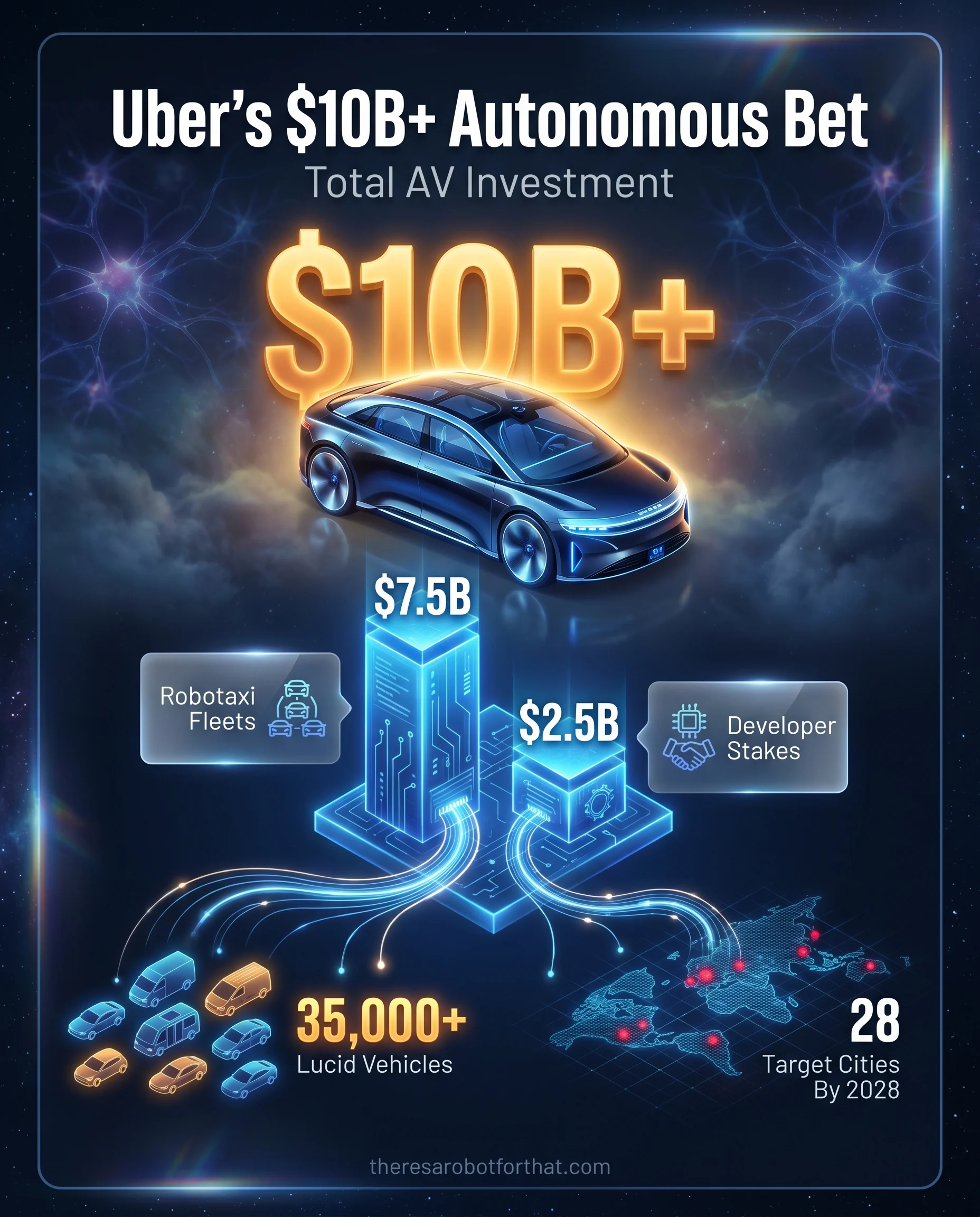
Image Source: There's A Robot For That
Snapshot: Uber is allocating over $10 billion to secure autonomous EV fleets and take equity stakes in AV developers, including a $500M investment in Lucid and commitments to purchase 35,000+ vehicles. The company plans to deploy robotaxis in 28 cities by 2028 as competition heats up against Waymo, Tesla, and Amazon-backed rivals.
Breakdown:
Takeaway: Uber's spending telegraphs that autonomous fleets are moving from pilot to procurement phase, with deployment timelines compressed to 2-3 years instead of 5+. The platform's willingness to invest $10B+ in hardware partnerships rather than waiting for technology to commoditize suggests first-mover advantage matters more than unit economics in the near term — a signal for any business evaluating autonomous logistics investments.
Other Top Robot Stories
Unitree began selling its $8,150 R1 humanoid robot on AliExpress with free shipping to the US, Canada, Japan, UAE, and Singapore, marking a major international expansion by Tesla's Chinese rival ahead of its planned IPO.
Tesla confirmed its Shanghai Gigafactory has the capability to manufacture humanoid robots, with the China executive signaling the facility could help solve mass-production challenges for the company's Optimus program.
Monarch collapsed despite raising $240 million and reaching a $518 million valuation, offering a cautionary tale about the brutal economics of automating agricultural equipment as the once-promising autonomous tractor maker shut down operations.
Ukraine captured a Russian fortification using only unmanned ground and aerial platforms with no infantry present, marking the first time in the war a position was taken exclusively by robotic systems according to President Zelensky.
🤖 Your robotics thought for today:
Google's model reads factory gauges. AgiBot's humanoids ran 8-hour shifts at 99.9% accuracy. Uber just committed $10 billion to robotaxis. Everyone's still debating *if* autonomous systems are ready — but deployment capital is already moving like the question's been answered.
I'm watching how fast manufacturers revise their automation timelines.
Enjoy your weekend,
Uli


