
Nvidia partners with ABB, FANUC, KUKA, Universal Robots
PLUS: 41% of companies expect physical AI transformation by 2029, AT&T and Cisco launch network-driven edge AI, and John Deere backs new agtech lab

Welcome back to your Robot Briefing
Nvidia just locked down partnerships with every major industrial robot maker — ABB, FANUC, KUKA, Universal Robots, and YASKAWA — to embed AI directly into the 2 million+ robots already working in factories worldwide. The goal: make virtual testing standard practice before any hardware hits the floor.
It's a clear bet that simulation beats trial-and-error on the factory floor. But can virtual environments really predict the chaos of real-world production lines — or will companies still need expensive physical pilots to trust their automation investments?
In today's Robot update:
Nvidia Unites Industrial Robotics Giants in Physical AI Push
Snapshot: Nvidia is embedding AI directly into industrial robots through partnerships with every major manufacturer — ABB, FANUC, KUKA, Universal Robots, and YASKAWA — using simulation tools to help companies validate automation systems before physical deployment. The platform targets 2 million+ robots already installed globally, promising to turn virtual testing into a standard step before factory floor rollout.
Breakdown:
Takeaway: Industrial robotics is moving from custom integration projects to platform-driven deployment, similar to how enterprise software evolved from bespoke systems to configurable solutions. Companies with existing robot fleets now have a clearer path to AI upgrades without ripping out hardware, compressing the timeline for smarter automation from multi-year capital cycles to software-driven improvements.
Physical AI Set to Transform 41% of Companies by 2029
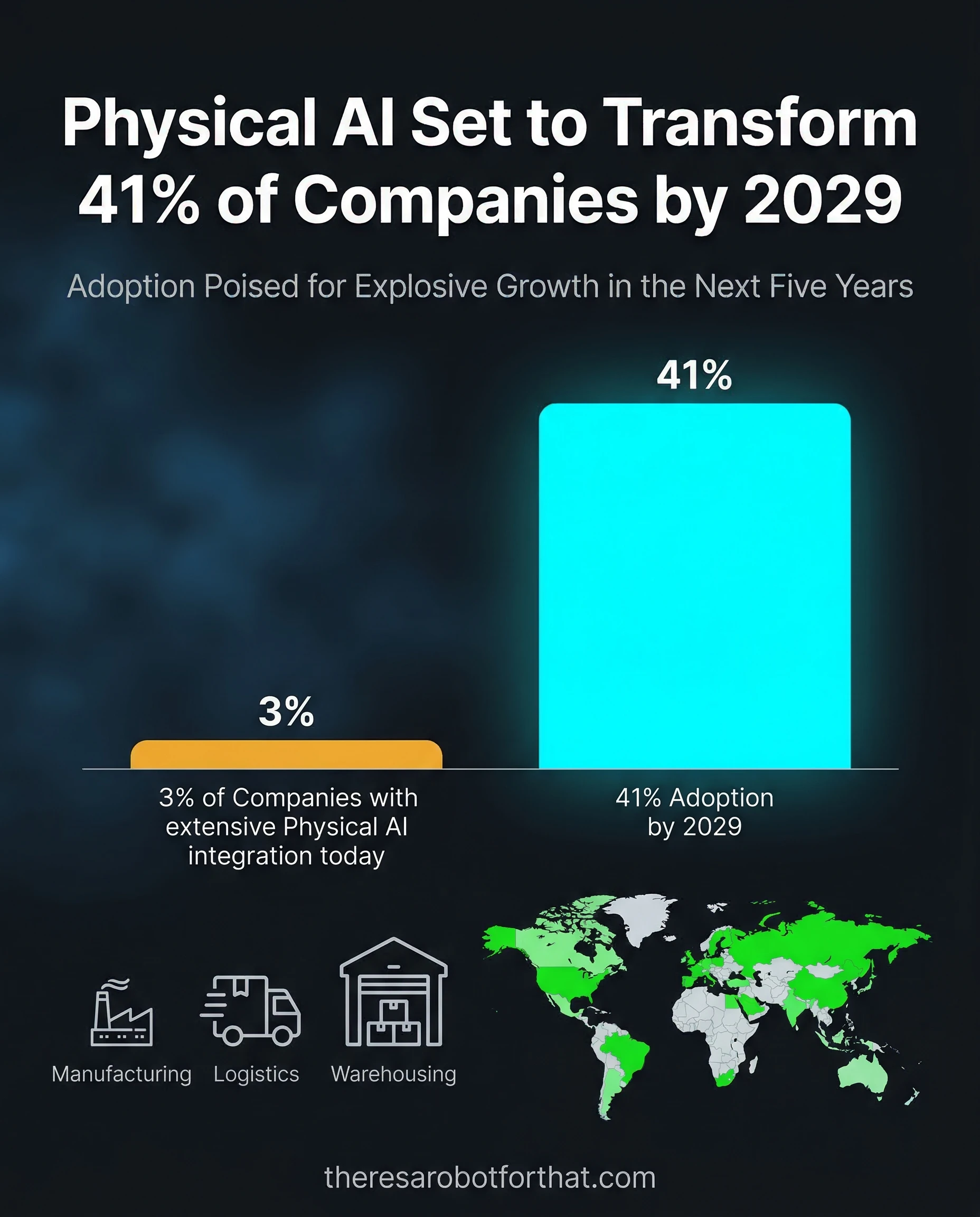
Image Source: There's A Robot For That
Image Source: There's A Robot For That
Snapshot: Deloitte research shows just 3% of companies have extensively integrated physical AI today, but 41% expect transformation within three years — with manufacturing, logistics, and warehousing leading adoption as the technology moves from pilots to production scale.
Breakdown:
Takeaway: The 2026-2029 window appears to be the "watch and prepare" period for most organizations — early enough that waiting carries limited competitive risk, but late enough that procurement and vendor evaluation should start now. Companies in manufacturing and logistics face a shorter decision timeline, as sector-specific case studies and benchmarks will likely emerge within 12-18 months.
AT&T, Cisco and Nvidia Team Up on Network-Driven Edge AI
Snapshot: AT&T and Cisco launched a collaboration combining dedicated IoT connectivity, Nvidia AI infrastructure, and zero-trust security to deliver real-time AI inference for industrial environments — targeting video security, manufacturing, and transportation use cases where cloud latency breaks operational requirements.
Breakdown:
Takeaway: This signals that telecom providers see enterprise edge AI as a services business, not just infrastructure — similar to how cloud providers evolved from selling compute to selling managed application platforms. Companies evaluating robotics or industrial AI deployments now have a network-delivered option that bypasses the complexity of building private edge infrastructure, potentially lowering the barrier to pilot projects.
John Deere Backs New Agricultural Robotics 'Living Lab' in California
Snapshot: Reservoir Farms opened a 24-acre agtech innovation hub in Salinas featuring dedicated test fields, manufacturing space, and partnerships with John Deere, Western Growers Association, and multiple universities — creating a concentrated testing ground for agricultural robotics startups to validate solutions with actual growers.
Breakdown:
Takeaway: Agriculture is adopting the "living lab" model that manufacturing and logistics tested earlier, compressing the time between prototype and field deployment by embedding startups directly in operational environments. For companies in food production or processing, this creates a clearer pipeline for identifying proven technologies — solutions graduating from Reservoir will have demonstrated grower traction, reducing the evaluation risk of early-stage vendors.
Other Top Robot Stories
STMicroelectronics announced integration of its sensor and actuator portfolio into NVIDIA's Holoscan Sensor Bridge and Isaac Sim platforms, enabling faster sim-to-real development cycles for humanoid, industrial, and healthcare robots with high-fidelity component models.
SuperSeed launched a £50 million Fund III backed by the British Business Bank to invest in seed-stage B2B companies deploying AI across manufacturing, energy, construction, and autonomous systems, with a portfolio of 38 companies focused on revenue-generating industrial deployments.
Synopsys unveiled its Electronics Digital Twin (eDT) Platform to enable automotive OEMs to complete up to 90% of software validation before hardware availability, with Volvo Cars pioneering virtualized ECU testing to reduce development costs and accelerate innovation cycles.
RealSense presented a first-of-its-kind autonomous navigation demonstration with LimX Dynamics at NVIDIA GTC, showcasing how its 3D vision and Visual SLAM technology enables humanoids trained in NVIDIA Isaac Lab to achieve safer real-world localization, mapping, and collision avoidance.
🤖 Your robotics thought for today:
Nvidia just locked partnerships with every major robot maker to virtualize factory testing. AT&T and Cisco are putting GPUs at the network edge for real-time inference. Meanwhile, 41% of companies say they'll deploy physical AI by 2029 — but only 3% have done it today.
I'm watching who moves now versus who's still "evaluating" in 2027.
Until tomorrow,
Uli


