
Lightning robot beats human half-marathon record by 7 minutes
PLUS: Bezos' physical AI lab nears $10B raise, Samsung's humanoid retail assistants, and a warning on US robotics investment
Welcome back to your Robot Briefing
A Chinese humanoid just ran a half-marathon faster than any human ever has — clocking 50:26 and shaving nearly 7 minutes off the world record. The robot, called Lightning, tore through Beijing's course in what might be the clearest signal yet that bipedal mobility has crossed a critical threshold.
If a robot can handle 13 miles of pavement without falling apart, what does that mean for the economics of warehouses, last-mile delivery, and any job that requires walking all day? The question isn't whether humanoids can move anymore — it's whether they can move profitably at scale.
In today's Robot update:
Chinese humanoid smashes half-marathon world record by 7 minutes
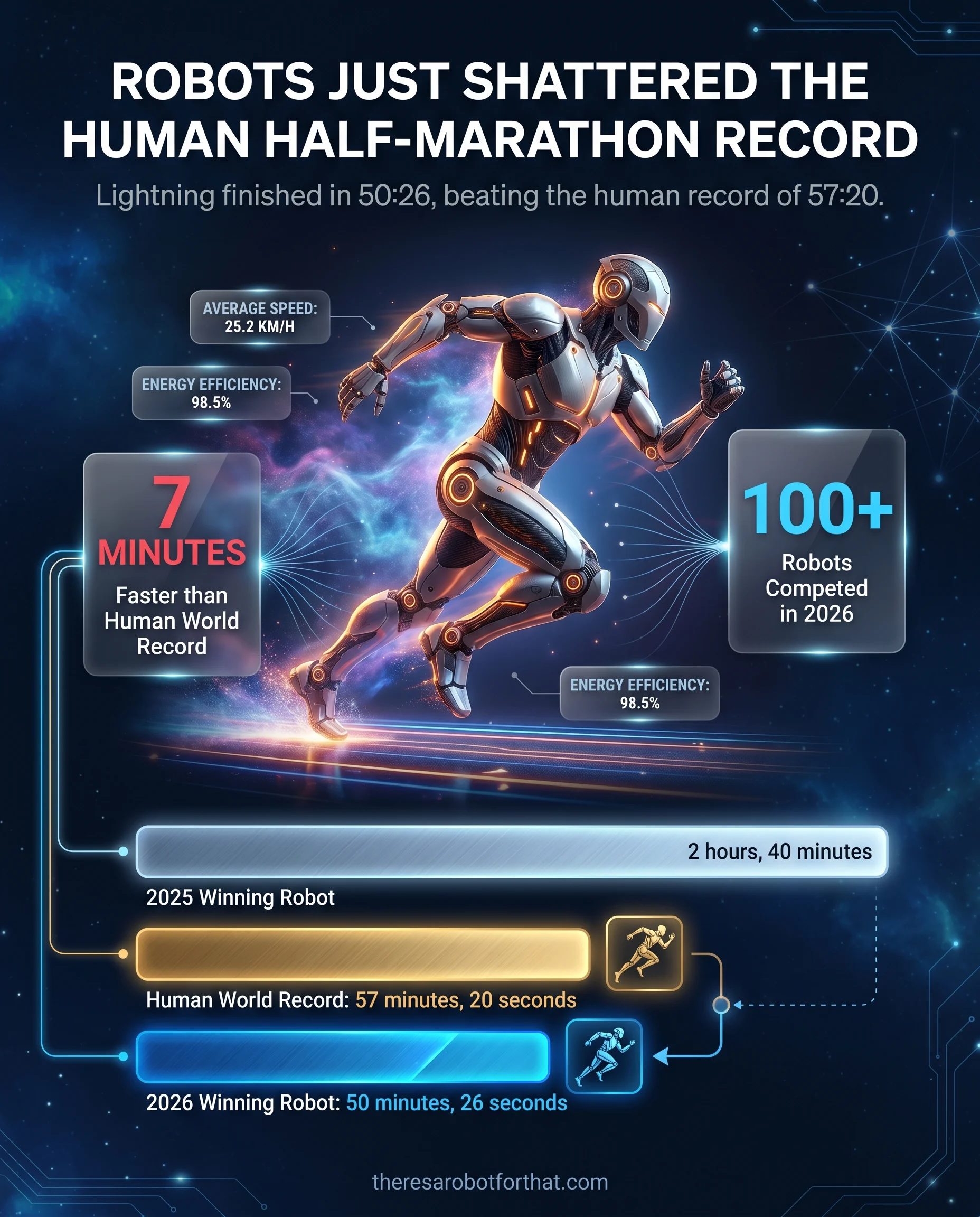
Image Source: There's A Robot For That
Snapshot: A Chinese humanoid robot named Lightning completed Beijing's half-marathon in 50:26, beating the human world record by nearly 7 minutes in a dramatic demonstration of mobility advances that should make warehouse and logistics executives pay attention.
Breakdown:
Takeaway: When bipedal robots can navigate 13.1 miles of varying terrain faster than elite human athletes, the technical barrier to warehouse navigation and last-mile delivery collapses dramatically. The year-over-year improvement — from 2:40:42 to 50:26 — suggests the deployment timeline for mobile manipulation in controlled industrial environments just shortened considerably.
Bezos' physical AI lab nears $10B raise at $38B valuation
Snapshot: Jeff Bezos is finalizing a $10 billion funding round for Project Prometheus, his physical AI laboratory, at a $38 billion valuation with JPMorgan and BlackRock as investors — a scale that signals physical AI has moved from research curiosity to strategic infrastructure.
Breakdown:
Takeaway: A $10 billion single round for a 6-month-old lab tells executives that physical AI — systems that understand manufacturing, logistics, and material science — is being priced as critical infrastructure, not a research bet. Companies with proprietary operational data suddenly hold assets that mega-cap investors value at software-scale multiples.
Samsung unveils AI-powered retail ecosystem with 3D signage and humanoid assistants
Snapshot: Samsung launched a retail showcase in India featuring glasses-free 3D Spatial signage, AI-powered avatar assistants, and humanoid robots as part of a broader push to redefine physical retail experiences beyond apps and touchscreens.
Breakdown:
Takeaway: The convergence of 3D displays, avatar assistants, and physical robots in a single retail pilot signals that brands are moving beyond adding digital touchpoints to fundamentally reimagining the store interface. Operations leaders should watch which approach — screen, avatar, or robot — actually changes conversion and satisfaction metrics over the next 12 months.
VC warns US 'under-investing' in robotics as China ships 90% of humanoids
Snapshot: Bessemer Venture Partners released a report warning that robotics receives 18x fewer funded companies than software despite a market 30x larger, as China dominates humanoid robot shipments with 90% market share — a structural imbalance with competitive implications.
Breakdown:
Takeaway: When VCs call out an 18-to-1 funding gap in a sector predicting 50x growth, that's a market structure problem that creates supply chain risk for any company planning automation roadmaps. The China dominance in humanoids specifically means procurement strategies that assume Western suppliers may need rethinking sooner than most boards realize.
Other Top Robot Stories
Blaize announced a $50 million contract with NeoTensr to deploy edge AI infrastructure across defense, robotics, and healthcare applications, with analysts projecting the company will reach positive adjusted EBITDA by fiscal year 2027 as physical AI adoption accelerates.
China deployed humanoid robots to perform maintenance on its national power grid, with developers positioning the machines to eventually handle repetitive and hazardous electrical infrastructure work at scale.
NHS faced scrutiny over unequal access to robot-assisted surgery across England, with London deploying 28 robotic surgical systems compared to just six across the South West, while some trusts resort to local fundraising to acquire equipment costing up to £1.5 million per unit.
Leonardo integrated its Maritime Mission Equipment Package onto autonomous unmanned surface vessels to detect, track, and defeat aerial drone threats in maritime environments, providing layered protection for ships, ports, and shoreline infrastructure as the U.S. military faces increasingly complex unmanned aerial vehicle threats.
🤖 Your robotics thought for today:
Lightning's time dropped from 2:40 to 50 minutes in one year. That's not incremental progress — that's a capability cliff. If locomotion can improve that fast, manipulation tasks in controlled environments are probably closer than the 5-year roadmaps suggest.
I'm watching which Fortune 500 starts talking about humanoid pilots in Q3 earnings calls.
Until Friday,
Uli


