
JAL's humanoid robots now handle airport luggage
PLUS: Toyota deploys 7 Digit robots in Canada, weeding bots raise $180M, and Apptronik hires Waymo and Boston Dynamics execs

Welcome back to your Robot Briefing
Japan Airlines is putting humanoid robots to work hauling luggage at Tokyo's Haneda Airport, testing them through 2028 as the country's labor crunch collides with a travel boom. It's one of the first real deployments of humanoids in large-scale airport operations.
The pilot raises a critical question for any labor-intensive industry: can humanoids handle the throughput and reliability demands of a major international hub, or will they remain expensive placeholders until the workforce shortage eases?
In today's Robot update:
JAL deploys humanoid robots to handle luggage at Tokyo's Haneda Airport
Snapshot: Japan Airlines is testing humanoid robots for ground operations at Haneda Airport through 2028, starting with moving passenger luggage between cargo containers — a direct response to Japan's labor shortage as travel demand surges.
Breakdown:
Takeaway: The multi-year timeline and narrow initial scope (luggage handling only) indicate this is still a capability-building phase, not immediate operational deployment at scale. Airport operators facing similar labor constraints should watch whether JAL can make the unit economics work with today's battery life limitations — that's the real gating factor for broader adoption.
Toyota deploys 7 humanoid robots in Canadian manufacturing plant
Snapshot: Toyota Motor Manufacturing Canada is deploying seven Digit robots at its Woodstock facility for production logistics after a year-long pilot, with three already operational on the assembly line — one of the first commercial humanoid deployments in high-volume auto manufacturing.
Breakdown:
Takeaway: Toyota doesn't pilot manufacturing technology for a year unless the business case closes. The key signal here is that humanoids are now competing on economics for tasks that previously didn't justify fixed automation — the "last glue step" work that's too variable or low-volume for traditional robotics but too repetitive for optimal human deployment.
Autonomous weeding robots captured most precision ag funding in 2025
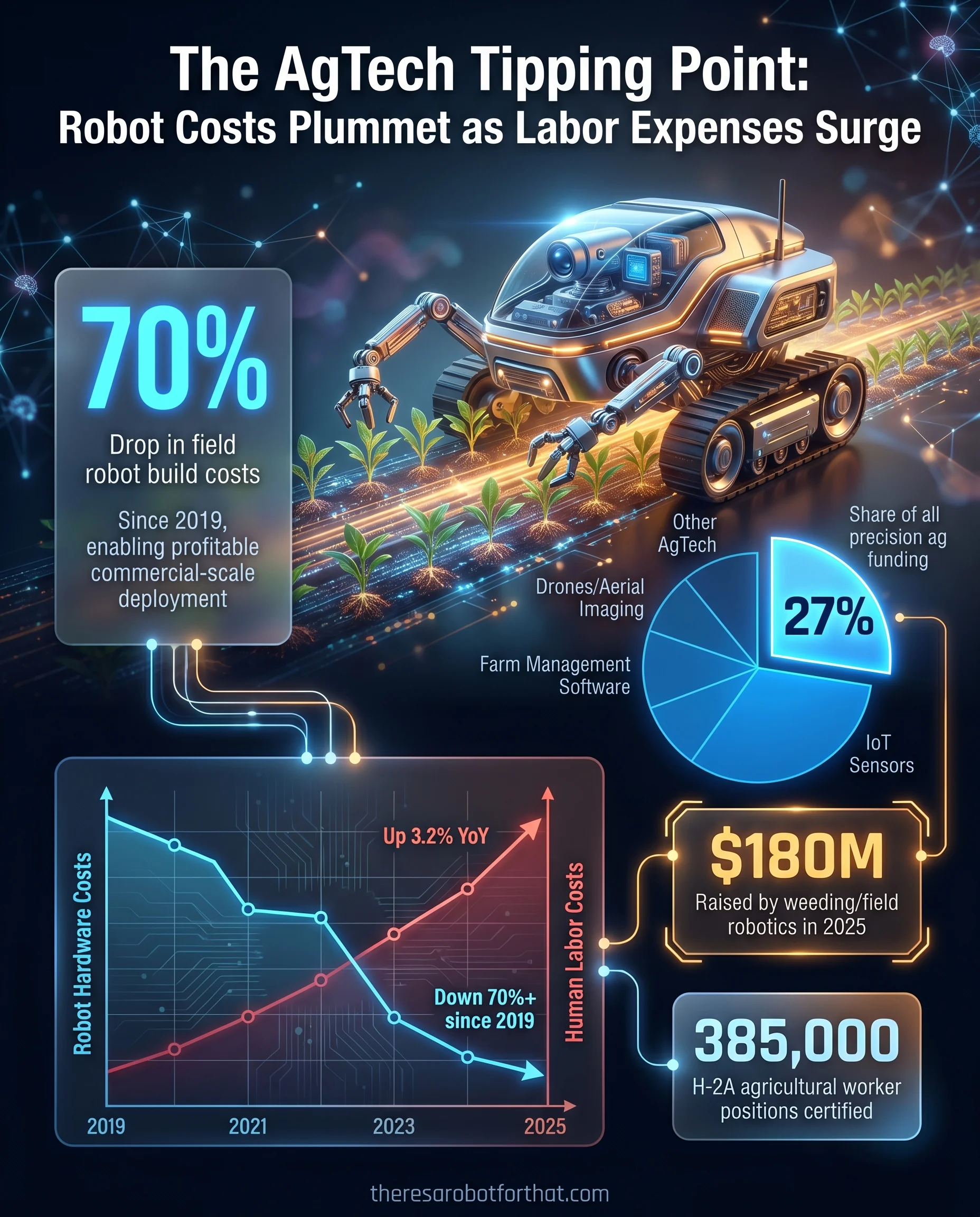
Image Source: There's A Robot For That
Snapshot: Autonomous weeding and field robotics companies raised over $180M in 2025 — 27% of all precision agriculture capital — with Ecorobotix closing a $105M Series D as growers seek alternatives to both chemical herbicides and increasingly expensive seasonal labor.
Breakdown:
Takeaway: When both investors and end customers (food companies, not just farmers) are moving capital toward the same category, it signals a market inflection point rather than speculative interest. The combination of falling hardware costs and rising labor costs has created a window where chemical-free robotic weeding can pencil out today, not in three years — relevant for any operation-intensive business watching labor market trends.
Apptronik stacks C-suite with Waymo, Boston Dynamics and Amazon veterans
Snapshot: The humanoid robotics company hired five senior executives from Waymo, Boston Dynamics, Amazon, iRobot and Paramount+ while teasing a new robot, following its $935M Series A at a $5.3B valuation — a signal that talent consolidation is accelerating among robotics leaders.
Breakdown:
Takeaway: Executive talent raids at this level indicate the competitive dynamics are shifting from "can anyone build a working humanoid?" to "who can operationalize at scale first?" — similar to the autonomous vehicle race in 2016-2017. Companies that can't attract product, operations and go-to-market leadership away from established tech players will likely struggle to move from pilots to commercial deployments, regardless of their robot's technical capabilities.
Other Top Robot Stories
Saskatchewan completed its first stereotactic robotic epilepsy surgery using a robot named Erin, reducing procedure time from all-day to 90 minutes while achieving sub-millimeter accuracy and sub-1% complication rates for the 4,000 drug-resistant epilepsy patients in the province.
Baptist deployed a fifth-generation da Vinci surgical robot at its North Mississippi hospital, completing 100 procedures since February with a platform featuring 150 design improvements, integrated AI and machine learning, and fingertip-level precision through high-definition 3D visualization at 10x magnification.
Foundation sent two Phantom humanoid robots to Ukraine for pilot demonstrations of supply transport and reconnaissance scenarios, with CEO Sankaet Pathak positioning military applications as a "moral imperative" to replace human soldiers in high-risk operations rather than domestic use cases.
NMBU developed the Thorvald platform, a modular autonomous field robot designed for seeding, weeding, disease treatment and harvesting operations, as Norway's robotics group addresses agriculture's simultaneous demands for higher yields, reduced chemical use, and labour efficiency.
🤖 Your robotics thought for today:
Toyota doesn't pilot factory robots for a year unless the math works. JAL is committing through 2028. That's not R&D — that's procurement treating humanoids like they'd treat any capital equipment decision. The shift from "let's try this" to "what's the payback period" happened faster than most people noticed.
I'm tracking how many more of these quiet deployments close before someone writes the "humanoids failed to deliver" thinkpiece.
Until Friday,
Uli


