
1X launches America's first humanoid robot factory
PLUS: Meta acquires humanoid AI startup, hardware bottlenecks slow robotics race, and humanoid joins SWAT patrols in Shenzhen
Welcome back to your Robot Briefing
1X Technologies just flipped the switch on America's first humanoid production line, cranking out NEO robots at a 58,000 square foot California facility with plans to hit 100,000 units annually by late 2027. The company moved 10,000 pre-orders in five days at $20K each.
The real test isn't whether they can build them fast — it's whether the supply chain, training infrastructure, and use cases can scale at the same speed. Can the humanoid market absorb six-figure production volumes when most deployments are still pilots?
In today's Robot update:
1X launches America's first high-volume humanoid robot factory
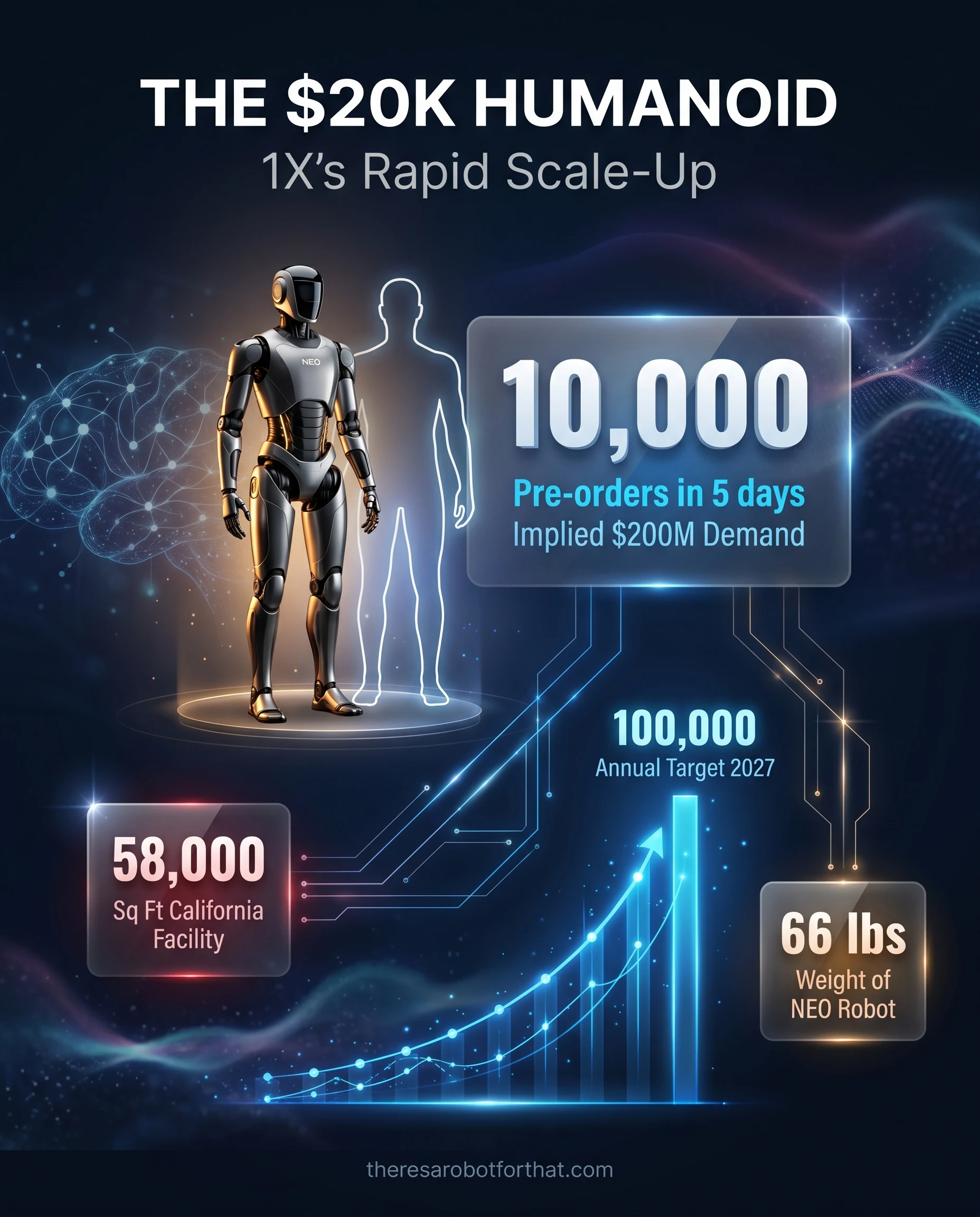
Image Source: There's A Robot For That
Snapshot: Silicon Valley's 1X Technologies began full-scale production of its NEO humanoid at a new 58,000 sq ft California facility, targeting 100,000 units annually by end of 2027 after selling 10,000 pre-orders in five days at $20,000 per unit.
Breakdown:
Takeaway: The five-day sellout at $20K per unit provides the clearest price signal yet for home robotics, while in-house manufacturing suggests 1X believes supply chain control matters more than outsourcing for margin. The company using its own robots on the production line isn't just marketing—it's practical beta testing at scale before customer deployments begin.
Meta acquires humanoid robotics AI startup Assured Robot Intelligence
Snapshot: Meta purchased Assured Robot Intelligence, a startup building AI models that enable robots to understand and adapt to human behavior, with the team joining Meta's Superintelligence Labs to advance humanoid hardware and software development.
Breakdown:
Takeaway: A Big Tech company acquiring a humanoid AI startup sends a signal that embodied AI has moved from research curiosity to strategic priority, especially coming during a quarter when Meta added $10 billion to infrastructure spending. Companies watching Meta's playbook should note the focus on behavior prediction and adaptation—the hardest problems for robots working alongside humans in unstructured environments.
Hardware bottlenecks emerge as key challenge in humanoid robotics race
Snapshot: The competitive battleground in humanoid robotics is shifting from AI capabilities to hardware constraints, with manufacturing capacity and component availability becoming the limiting factors as companies move from prototypes to scaled production.
Breakdown:
Takeaway: This marks an inflection point where the constraint changes from "can we make robots smart enough?" to "can we build enough robots?" Operations leaders should watch which companies control their manufacturing and component supply chains—those will likely deliver faster than competitors dependent on external suppliers. The timeline for deployment at scale now depends more on factory capacity than software breakthroughs.
Humanoid robot joins SWAT patrols on streets of Shenzhen
Snapshot: A humanoid robot police officer has been deployed for street patrols alongside SWAT officers in Shenzhen, China, representing one of the first public-facing law enforcement applications of humanoid robotics.
Breakdown:
Takeaway: Public-sector deployments in China often preview what becomes commercially viable 18-36 months later in industrial settings—the same pattern seen with facial recognition and autonomous delivery. For operations leaders, the signal isn't about policing robots but about confidence that humanoids can handle unstructured outdoor environments reliably enough for high-stakes applications where failure has consequences.
Other Top Robot Stories
Accenture piloted humanoid robots inside Vodafone Procure & Connect's Duisburg warehouse, integrating with SAP Extended Warehouse Management to autonomously detect misplaced inventory, safety hazards, and unused storage space with real-time reporting into enterprise systems.
Ecorobotix closed a $105M Series D in October 2025, the largest precision ag robotics round globally that year, as autonomous weeding and field robotics companies captured $180M—27% of all tracked precision agriculture capital—driven by rising farm labor costs and H-2A wage rates climbing 4.5% year-over-year.
BLT collaborated with Haptron Scientific to scale production of optical multi-axis force sensors for humanoid robotics using metal additive manufacturing in 18Ni350 maraging steel, achieving 2400 MPa tensile strength and enabling the second-generation Photon Finger Max to deliver 700 N measurement range within a 9.5 mm diameter form factor.
Ballad Health invested $15M to deploy da Vinci 5 surgical robots across Sycamore Shoals, Smyth County Community, and Norton Community hospitals, bringing robotic-assisted surgery access to 100% of its rural hospital network as the system approaches 30,000 total robotic surgical cases.
🤖 Your robotics thought for today:
1X sold 10,000 robots in five days. Meta just bought a humanoid AI startup during the same quarter they added $10 billion to infrastructure spending. Meanwhile the actual constraint isn't software anymore—it's whether you can source actuators and build factory capacity fast enough.
The companies controlling their supply chains will ship. Everyone else will have great demos.
Until Wednesday,
Uli


