
Figure now ships 1 humanoid per hour
PLUS: Schaeffler orders 1,000 humanoids by 2032, Neuralink's surgical robots automate brain implants, and Hyundai's physical AI expansion

Welcome back to your Robot Briefing
Figure just crossed a manufacturing threshold most humanoid makers only talk about: 1 robot per hour rolling off the line, up from 1 per day four months ago. They've already shipped over 350 units, making this one of the first real industrial-scale production runs in the humanoid space.
The question now isn't whether humanoids can be built at scale—it's whether the companies buying them can deploy them fast enough to justify the capital outlay. Figure's 24x ramp suggests the supply bottleneck is breaking; demand is the next test.
In today's Robot update:
Figure hits 24x production jump, now shipping 1 humanoid per hour
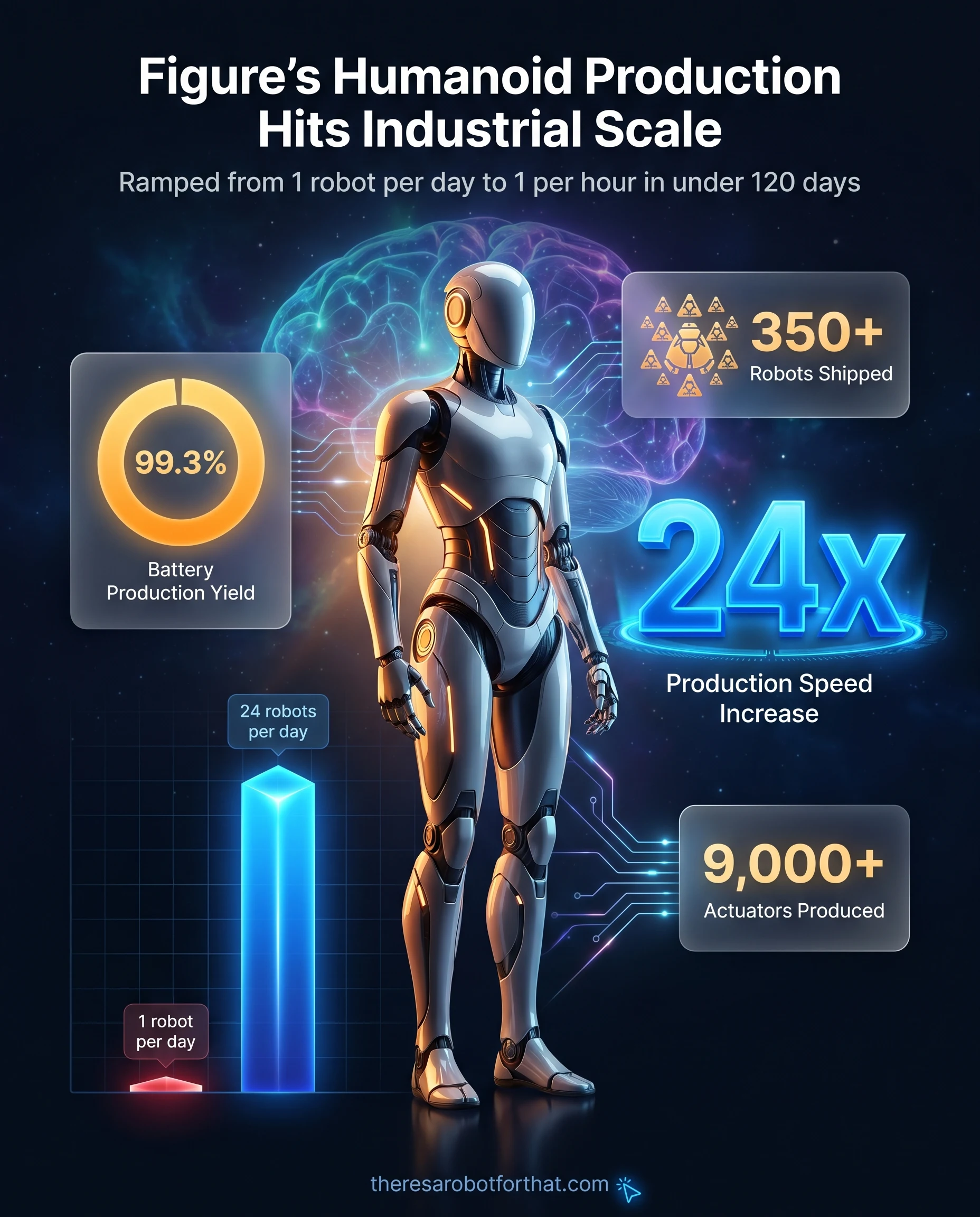
Image Source: There's A Robot For That
Snapshot: Figure ramped its manufacturing from 1 humanoid per day to 1 robot per hour in under 120 days, delivering over 350 third-generation robots as it transitions from prototype to scaled fleet production. This marks one of the first times a humanoid robotics company has hit industrial production rates rather than small-batch pilot runs.
Breakdown:
Takeaway: The 24x throughput increase in four months signals that humanoid production is moving past the "hand-built prototype" phase that has characterized the industry for years. Companies evaluating humanoid pilots in 2026 should expect vendor lead times and unit economics to improve substantially through 2027 as multiple manufacturers hit similar production milestones.
Schaeffler commits to 1,000 humanoid robots across global factories by 2032
Snapshot: German automotive supplier Schaeffler will deploy at least 1,000 AEON humanoid robots from Hexagon across its production system by 2032, following successful pilot programs and expanding its partnership to include Schaeffler's actuators in the robots themselves. This represents one of the largest multi-year humanoid deployment commitments from a traditional manufacturer to date.
Breakdown:
Takeaway: When a Tier 1 automotive supplier commits to 1,000 units over six years, it's a signal that humanoid ROI is becoming calculable for repetitive manufacturing tasks. No change needed.
Neuralink's surgical robots will automate brain implant procedures at scale
Snapshot: Neuralink unveiled specialized surgical robots designed to fully automate the implantation of its brain-computer interfaces, using eight cameras and OCT scanners to insert ultra-thin electrode threads with sub-millimeter precision as the company prepares for mass production starting in 2026. The robots handle tasks requiring consistency beyond human capability while surgeons oversee the overall procedure.
Breakdown:
Takeaway: Neuralink's move to automate surgery reflects a broader pattern where robotics unlock scale in procedures too precise or repetitive for human consistency. While brain implants sit far from most operational contexts, the automation playbook—identify high-precision bottlenecks, build specialized robots, validate through limited trials, then manufacture at scale—applies across industries from semiconductor assembly to pharmaceutical production.
Hyundai accelerates physical AI push to deploy robots across Korea's industry
Snapshot: Hyundai Motor Group is pivoting into a mobility solutions provider through physical AI and robotics, building a dedicated application center and foundry plant while Boston Dynamics expands partnerships with Google DeepMind to accelerate humanoid development for industrial deployment. The conglomerate is leveraging its manufacturing, logistics, and sales operations to generate training data for AI-powered robots across its entire value chain.
Breakdown:
Takeaway: Hyundai's commitment to physical AI infrastructure and a robot foundry plant indicates major industrials now view robotics as a make-versus-buy decision, not just a vendor relationship. Companies with complex operations should evaluate whether their process data could become a competitive moat if used to train proprietary automation, rather than waiting for off-the-shelf solutions that competitors can also purchase.
Other Top Robot Stories
Roland projects that humanoid robotics manufacturers could reach $750 billion in revenues by 2035 as AI advances enable running costs around $2 per hour, making humanoids cost-competitive in high-wage countries and potentially addressing skilled labor shortages in manufacturing.
Fanuc partnered with Nvidia to integrate physical AI into its industrial robots, joining Siemens in leveraging decades of shop-floor data to boost production speed and precision as Japanese and German manufacturers push into AI-driven automation despite lagging in digital technology.
Flex expanded its partnership with Teradyne Robotics to deploy Universal Robots cobots and MiR autonomous mobile robots across its global manufacturing facilities while simultaneously producing core components for Teradyne, creating a dual-track strategy that positions Flex as both manufacturer and primary testing ground for physical AI at industrial scale.
GMO supplied Chinese-made humanoid robots including Unitree's G1 model for Japan Airlines' two-year Haneda Airport pilot starting in May, with the 77-pound robots handling baggage loading, cargo movement, and cabin cleaning despite current battery limitations of 2-3 hours per charge.
🤖 Your robotics thought for today:
Figure went from 1 robot per day to 1 per hour in four months. Schaeffler just committed to 1,000 units by 2032. The supply constraint is breaking faster than most procurement teams are moving. If you're still treating humanoids as "5 years out," your competitors are already writing RFPs.
Enjoy your weekend,
Uli


