
Household humanoid maker Sunday hits $1.15B valuation
PLUS: Ai2's synthetic data breakthrough, NVIDIA's Edge-LLM update, and the world's first bone surgery robot

Welcome back to your Robot Briefing
Sunday Robotics just joined the unicorn club at a $1.15 billion valuation, pulling investment from Benchmark, Tiger Global, and other top-tier VCs who've largely avoided hardware bets since 2022. The company is racing against Tesla's Optimus, Figure AI, and 1X to prove household humanoid robots can finally deliver genuine utility at a price consumers will actually pay.
With elite investors now betting big on home automation, the question facing operations leaders is whether this signals the technical and economic pieces are finally aligning—or if Sunday has just 18 months to prove viability before the market's patience runs out.
In today's Robot update:
Sunday Robotics Hits $1.15B Valuation in Household Bot Push
Snapshot: Sunday Robotics achieved unicorn status with a $1.15 billion valuation, backed by Coatue, Tiger Global, Benchmark, and Bain Capital — signaling that top-tier VCs believe household humanoid robots are transitioning from long-term R&D projects to near-term commercial opportunities.
Breakdown:
Takeaway: This valuation marks a turning point where sophisticated investors believe the technical and economic pieces are finally aligning for household robots, but Sunday now has 18 months to prove it can manufacture and deploy at scale before the market loses patience. Business leaders watching automation should note the timeline for viable home robots is compressing rapidly, though the path to profitability remains the industry's biggest question mark.
Ai2's MolmoBot Closes the Sim-to-Real Gap with Synthetic Data
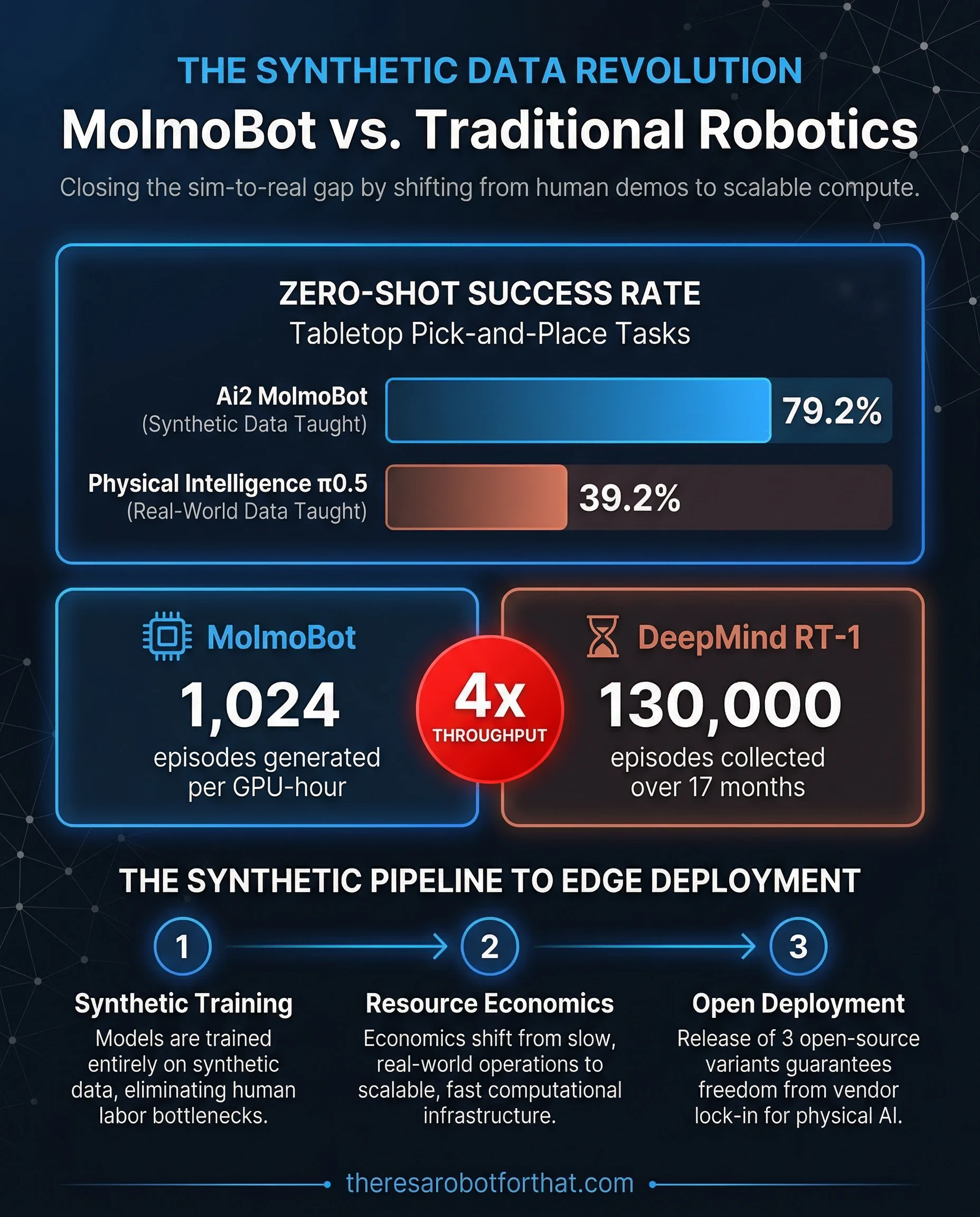
Image Source: There's A Robot For That
Snapshot: The Allen Institute for AI released MolmoBot, a robotic manipulation model trained entirely on synthetic data instead of expensive human demonstrations, achieving a 79.2% success rate in real-world tasks and opening robotics development to companies without massive training budgets.
Breakdown:
Takeaway: This shifts the economics of robot training from labor-intensive data collection to computational infrastructure that scales predictably. Companies evaluating robotics pilots can now access production-ready manipulation models without building proprietary datasets or waiting years for deployment readiness.
NVIDIA Unleashes TensorRT Edge-LLM for Physical AI
Snapshot: NVIDIA just made it significantly easier to deploy reasoning-capable AI directly onto robots and autonomous vehicles, eliminating cloud dependency while maintaining sophisticated decision-making abilities—a critical shift for operations leaders evaluating automation timelines.
Breakdown:
Takeaway: The shift from modular AI stacks to unified reasoning models running directly on edge hardware compresses the deployment timeline for intelligent automation from "3-5 years out" to "pilots happening now." Operations leaders who've been waiting for practical, explainable robotics should start having those vendor conversations—the infrastructure just became production-ready.
Robossis Alpha Pioneers Robotic Surgery for Long Bone Fractures
Snapshot: Rowan University researchers unveiled Robossis Alpha, the first surgical robot designed specifically for aligning fractured long bones like femurs—a procedure that currently causes significant blood loss, requires repeated X-rays, and often leads to chronic pain from misalignment.
Breakdown:
Takeaway: This represents surgical robotics expanding into force-intensive specialties that have resisted automation due to technical limitations. Operations leaders in healthcare systems should note that robotics is moving beyond minimally invasive procedures into trauma and orthopedics, where labor intensity and complication rates directly impact bed turnover and readmission costs.
Other Top Robot Stories
The Asset examined China's strategic pivot from cloud-based AI toward "embodied intelligence," where the country is building state-funded robot training farms with 70 instructors operating 46 humanoids to generate the massive datasets needed to power physical AI systems at industrial scale.
Rowan University unveiled Robossis Alpha, the first surgical robot engineered specifically for aligning fractured long bones like femurs, delivering 10 times the force of existing surgical systems while maintaining submillimeter precision—targeting FDA approval within 2-3 years for trauma and orthopedic procedures that have historically resisted automation.
Zoox announced a commercial partnership with Uber to deploy its purpose-built autonomous robotaxis on the Uber platform, marking a significant milestone in bringing Level 4 self-driving vehicles from controlled testing environments into a major rideshare network serving real consumer demand.
🤖 Your robotics thought for today:
Sunday just raised $1.15B from Benchmark and Tiger Global for household robots.
Jibo, Anki, and Mayfield all failed at the same mission—useful home robots under $20K.
Either the unit economics finally work, or we're watching tier-one VCs rebrand the same bet with better AI.
Which is it?
Have a great weekend,
Uli


