
Foundation's humanoid soldiers deployed to Ukraine frontlines
PLUS: BMW's wheeled humanoids hit Leipzig factory, XGSynBot's Z1 swaps tools in 6 seconds, and TI teams with Nvidia on radar sensing

Welcome back to your Robot Briefing
American startup Foundation just deployed two humanoid robots to Ukraine's frontlines for reconnaissance — the first time combat-ready humanoids have entered an active warzone. The company's vision goes further: building machines capable of wielding any weapon a human soldier can.
What happens when the economics of warfare shift from training soldiers to manufacturing combatants? We're about to find out whether humanoid robots will transform battlefields the way drones did, or if the human element remains irreplaceable.
In today's Robot update:
Foundation Ships Combat Humanoids to Ukraine Frontlines
Snapshot: American startup Foundation deployed two Phantom MK-1 humanoid robots to Ukraine's frontlines in February for reconnaissance, marking the first known use of humanoid soldiers in active combat. The company's combat veteran co-founder says the goal is building robots that can wield "any kind of weapon that a human can."
Breakdown:
Takeaway: The Ukraine deployment moves humanoids from controlled factory environments to the chaos of active warfare faster than most business leaders anticipated. Companies evaluating humanoids for high-risk industrial tasks now have a extreme-conditions proof point, though the ethical and regulatory implications of weaponized humanoids will likely create headwinds for commercial applications.
BMW Deploys Hexagon's AEON Humanoids at Leipzig Plant
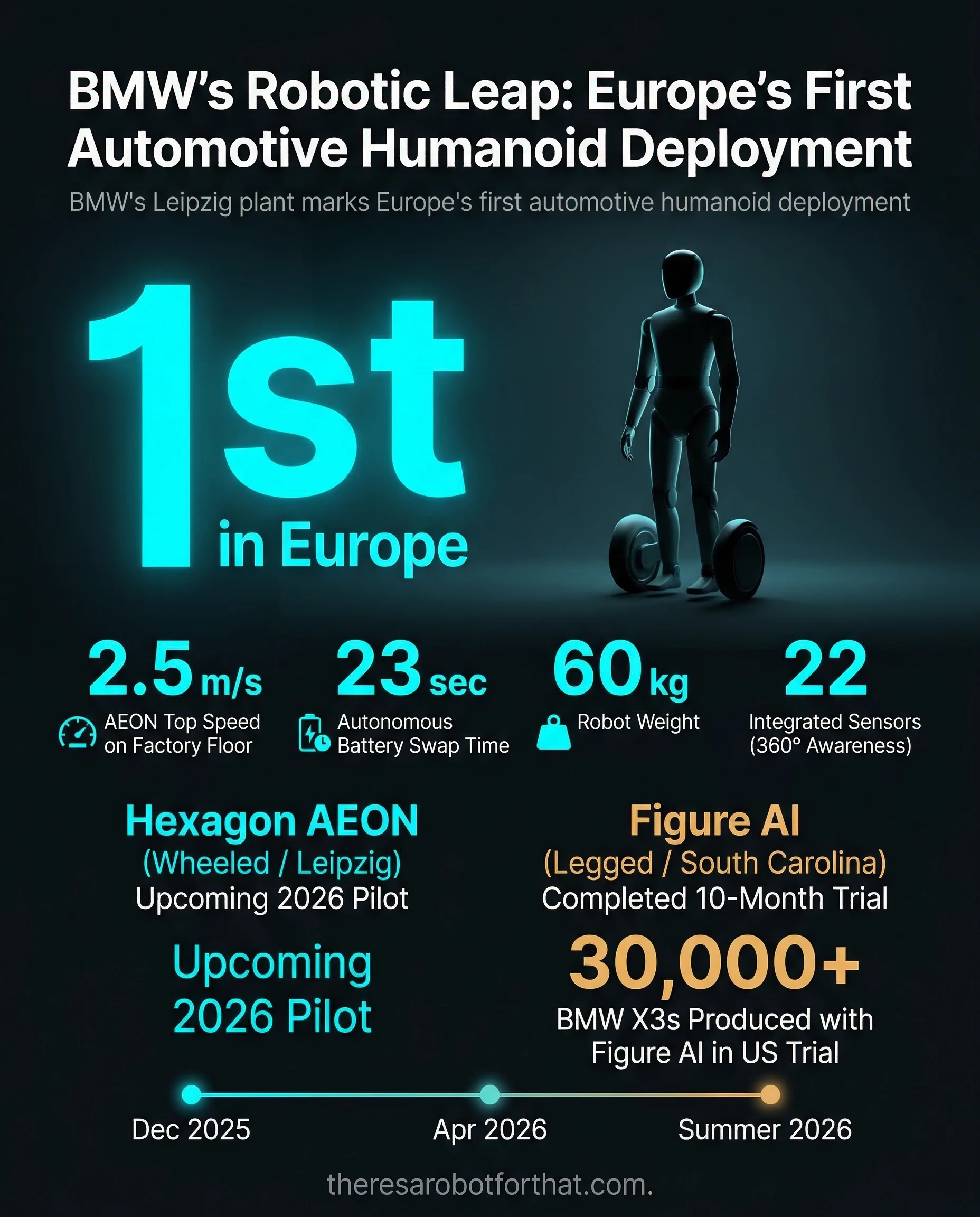
Image Source: There's A Robot For That
Snapshot: BMW launched Europe's first automotive humanoid deployment at its Leipzig factory with Hexagon Robotics' wheeled AEON platform, planning a full pilot with two units in high-voltage battery and exterior parts manufacturing by summer 2026. This follows a successful 10-month trial at BMW's South Carolina plant where Figure AI's humanoid supported production of 30,000+ BMW X3s.
Breakdown:
Takeaway: BMW is treating this as an engineering deployment, not a publicity stunt—the phased rollout with hard metrics from the Spartanburg trial signals they're validating business cases before scaling. European manufacturers watching Leipzig closely now have a regional proof point that eliminates the "this only works in Asia or North America" objection.
XGSynBot Unveils Z1 Humanoid With 6-Second Tool Swapping
Image Source: There's A Robot For That
Snapshot: Chinese robotics firm XGSynBot launched its Z1 wheeled humanoid featuring a modular end-effector system that swaps tools (grippers, welders, suction cups) in under six seconds, eliminating the need for multiple specialized robots. The company positioned it as a "blue-collar worker" designed for heavy-duty, oil-spattered factory environments.
Breakdown:
Takeaway: The six-second tool swap directly addresses the ROI question—one flexible robot replacing multiple specialized machines changes the capital efficiency math for mid-sized manufacturers. XGSynBot's ecosystem play suggests they're positioning for volume deployment rather than premium one-off installations, potentially accelerating price pressure across the industry.
Texas Instruments, Nvidia Partner to Accelerate Physical AI Deployment
Snapshot: Texas Instruments and Nvidia announced a partnership integrating TI's mmWave radar sensing with Nvidia's Jetson Thor computing platform to enable safer humanoid deployment through environmental perception beyond visual sensors. The radar system allows robots to navigate challenges like glass doors, low light, fog, and smoke that fool camera-only systems.
Breakdown:
Takeaway: This partnership addresses the reliability gap between controlled demos and messy real-world conditions—the same technical barrier that has delayed autonomous vehicle deployment. Operations leaders evaluating humanoids should note that sensor fusion is becoming table stakes, meaning first-generation vision-only systems may face shortened useful lives as multi-modal perception becomes standard.
Other Top Robot Stories
Sunday reached $1.15B valuation after raising $165M in a Series B led by Coatue Management, with the company targeting Thanksgiving 2026 to launch its Memo household humanoid robot designed for tasks like laundry and dishwashing.
BofA projected global humanoid robot population will reach 3 billion units by 2060—surpassing the world's 1.5 billion cars on a per-capita basis—with 62% deployed in homes as aging workforces and labor shortages make robotic labor economically attractive even before machines fully match human ability.
RyderVentures identified "physical AI" as warehouse automation's next breakthrough, betting on AI-powered systems that enable equipment to handle multiple use cases rather than single-function deployments, addressing the fear factor that has kept warehouse automation penetration low despite clear utility.
Solinftec expanded U.S. agricultural operations 243% year-over-year while deploying more than 100 autonomous Solix solar-powered robots across American farms, alongside launching a commercially available next-generation Refill Station designed for continuous 24/7 field operation.
🤖 Your robotics thought for today:
Foundation just put humanoids on a battlefield. BMW's running a multi-month engineering validation in Leipzig. XGSynBot built a robot that swaps tools in six seconds. One of these will tell us more about the 2027 factory floor than the other two combined.
I'm betting it's not the war zone.
Until tomorrow,
Uli


