
Fanuc shares hit record on Google Gemini partnership
PLUS: Sony's table tennis robot beats elite humans, Bosch's touch-predicting AI, and South Korea's five-finger manipulation breakthrough

Welcome back to your Robot Briefing
Fanuc, the world's largest robot arm manufacturer, just hit an all-time stock high after announcing it's shipping Google's Gemini AI inside industrial robots — with over 1,000 units already in the field. The 16% share surge signals that AI-native robotics is no longer a lab experiment.
The question now: how fast can legacy manufacturers retrofit millions of existing robots with generative AI, and what happens to companies that don't? As Fanuc races ahead, the gap between AI-equipped and traditional automation is becoming a competitive moat.
In today's Robot update:
Fanuc shares hit record as Google partnership brings Gemini to industrial robots
Snapshot: The world's largest robot arm manufacturer saw shares surge 16% to an all-time high after partnering with Google to integrate Gemini AI into industrial robots — with over 1,000 AI-equipped units already shipped since December and demand accelerating.
Breakdown:
Takeaway: This isn't vaporware — four-figure shipment volumes in five months signals that AI-enabled industrial robotics crossed from pilot to production. Companies currently planning 2027-2028 automation projects should reassess timelines, as the barrier between "program a robot" and "tell a robot what to do" just collapsed at the world's largest industrial robotics vendor.
Sony's table tennis robot beats elite humans in Nature-published breakthrough
Snapshot: Sony AI's robot became the first autonomous system to achieve expert-level competitive performance against elite and professional table tennis players, marking a peer-reviewed milestone in the transition from virtual AI dominance to real-world physical capability.
Breakdown:
Takeaway: The business signal isn't about table tennis — it's about mastering real-time physical interaction at human performance levels. Operations requiring fast, precise human-robot collaboration in dynamic environments just moved from "decades away" to demonstrated reality at one of the world's most credible research organizations.
Bosch and Carnegie Mellon's 'touch dreaming' AI boosts humanoid success 90.9%
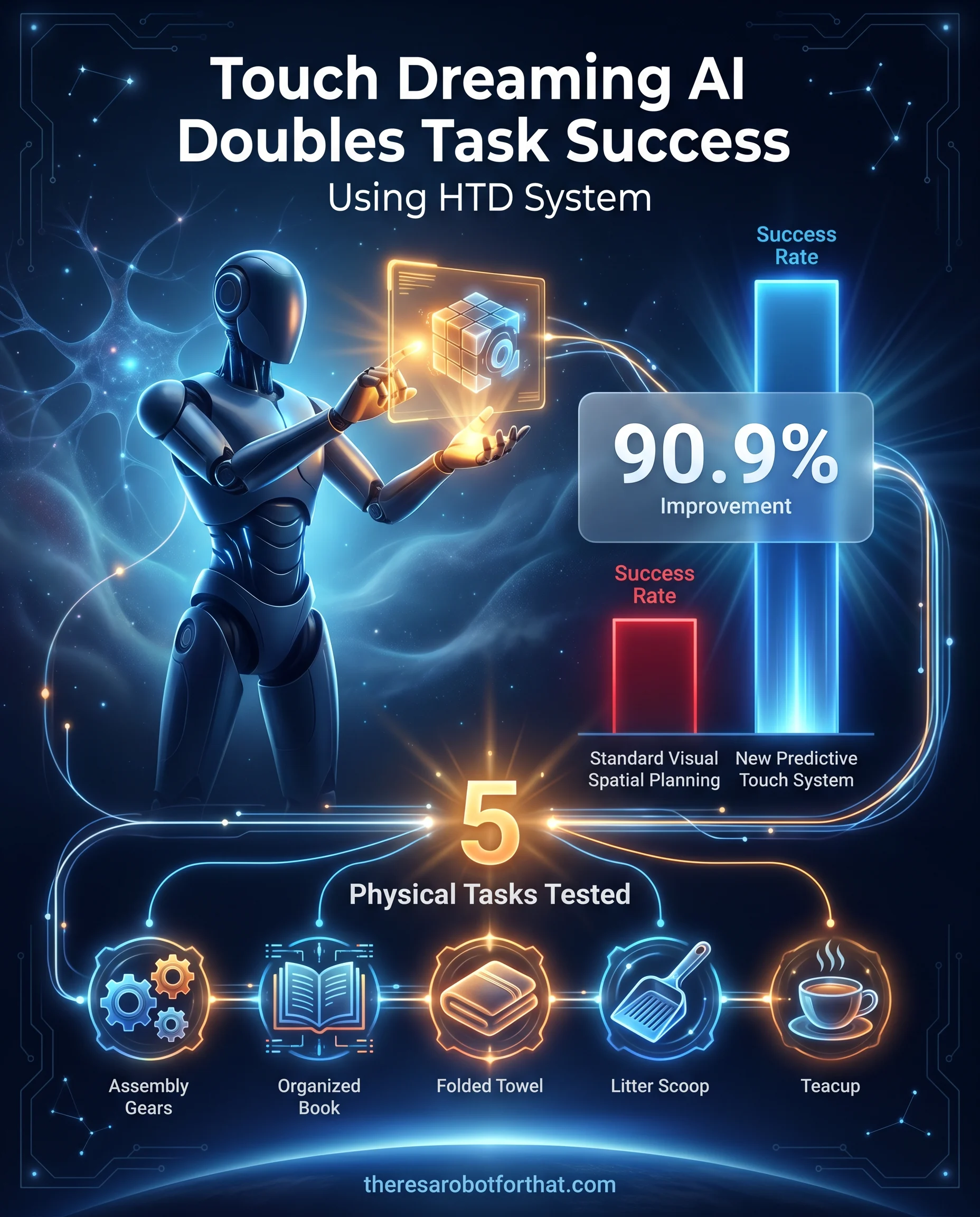
Image Source: There's A Robot For That
Snapshot: Researchers at Bosch Center for AI and Carnegie Mellon developed a system that enables robots to predict touch and force outcomes during manipulation, achieving a 90.9% improvement in task success rates across five real-world tests including assembly, folding, and serving.
Breakdown:
Takeaway: Bosch doesn't publish moonshots — this is a major industrial player solving the coordination problem between whole-body movement and fine manipulation. The 90% success rate improvement and roadmap toward retail and manufacturing deployment suggests the timeline for practical humanoid applications in controlled environments just compressed significantly.
South Korea's RealWorld RLDX-1 outperforms NVIDIA and Physical Intelligence in robot dexterity
Snapshot: Korean AI company RealWorld launched RLDX-1, a general-purpose robotics AI specialized in five-finger manipulation that beat models from NVIDIA and Physical Intelligence across eight global benchmarks, with robots from Japan's Enactic, Korea's WIRobotics, and US's Origami Robotics already deploying the technology.
Breakdown:
Takeaway: The competitive landscape just shifted — a relatively unknown Korean company beat established US players in the critical dexterity layer while simultaneously deploying across Japanese, Korean, and American hardware platforms. Executives betting on a slow, US-dominated rollout of capable humanoid systems should recalibrate expectations about both timeline and geographic source of breakthrough solutions.
Other Top Robot Stories
JABAS.AI launched from Ceres Agri-Tech's portfolio to deliver autonomy-as-a-service for agricultural robot fleets using lidar and computer vision instead of GPS, targeting farms where 15-20% of time is spent moving picked fruit across fields that lack reliable satellite coverage.
Automated unveiled SmartBay, a robotic system that changes and balances tires without removing wheels from vehicles, using physical AI to dismount tires directly from rims while cars stay lifted—eliminating TPMS disruption and manual wheel handling across service bays.
Avaya integrated its Infinity platform with avatarin's social robots to orchestrate AI-powered physical agents across airline reservation desks, government service counters, and retail floors, using Model Context Protocol to preserve conversation context as customers switch between phone, chat, and in-person robot interactions.
🤖 Your robotics thought for today:
Fanuc shipped over 1,000 Gemini-equipped robots in five months. That's not a pilot — that's production scale at the world's largest industrial robotics company. If you're budgeting for traditional automation in 2027, you're already spec'ing yesterday's technology.
I'm watching how fast the rest of the industrial base responds.
Enjoy your weekend,
Uli


