
China builds one humanoid robot every 30 minutes
PLUS: Unitree's transforming mecha switches between 2 and 4 legs, South Korea's $220M AI greenhouse, and Egypt's first autonomous harvester

Welcome back to your Robot Briefing
A factory in Guangdong is now rolling out a complete humanoid robot every 30 minutes—hitting 10,000 units annually, which represents roughly 70% of the 2025 entire global humanoid market. Tesla, Figure, and Boston Dynamics combined can't match that production pace.
The question isn't whether China dominates manufacturing volume anymore—it's whether Western robotics companies can ever close the gap, or if they're competing in fundamentally different markets. When one facility outproduces entire industries, does innovation still matter without the capacity to scale?
In today's Robot update:
China produces one humanoid every 30 minutes while US rivals struggle for scale
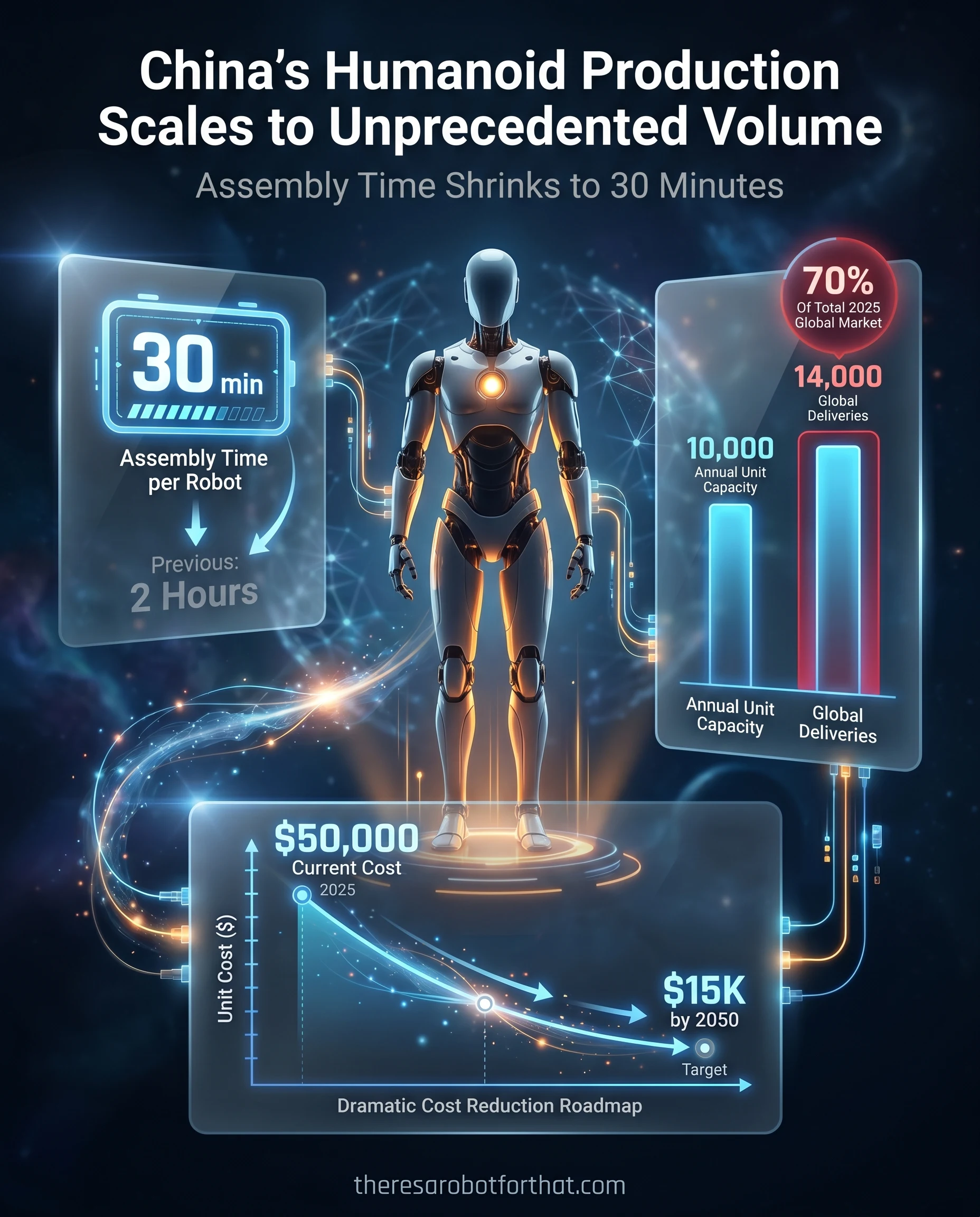
Image Source: There's A Robot For That
Snapshot: A Guangdong factory operated by Leju Robotics and Dongfang Precision now churns out a complete humanoid robot every 30 minutes, achieving 10,000 units per year capacity—roughly 70% of last year's entire global humanoid market—while Tesla, Figure, and Boston Dynamics combined can't match that volume.
Breakdown:
Takeaway: The cost and scale advantage isn't incremental—it's structural, and it's happening now, not in three years. If your operations compete with Chinese manufacturers or deploy automation in parallel industries, the pressure to match this speed-to-market and price point just became the new normal.
Unitree unveils transforming mecha that shifts between 2 legs and 4
Snapshot: Chinese robotics firm Unitree launched the GD01 manned mecha, a 2.7-meter-tall production-ready machine priced at $574,000-650,000 that transforms between bipedal walking and four-legged mode while its pilot operates mechanical arms strong enough to smash through walls.
Breakdown:
Takeaway: This isn't a research project—it's a production-ready machine from a company already shipping thousands of commercial robots annually. The symbolic value matters less than the infrastructure and supply chains that enable a firm to go from humanoids to human-piloted mechas within the same commercial roadmap.
South Korea commits $220M to build fourth-generation AI greenhouse with Daedong
Snapshot: A Daedong-led consortium including LG CNS won South Korea's National Agriculture AX Platform contract to build a 254.6 billion won ($220M) AI-autonomous farming system spanning 21.6 hectares, demonstrating 'fourth-generation' agriculture where robots and AI manage cultivation through distribution without human intervention.
Breakdown:
Takeaway: A $220M government commitment with a timeline starting next year signals that autonomous agriculture has moved from pilot to infrastructure investment in advanced economies. Companies with labor-intensive agricultural operations or food supply chain exposure should track whether this model proves replicable at scale.
Egypt launches first autonomous harvesting robot in Arab region
Snapshot: Egyptian robotics firm Egrobots unveiled the Arab world's first fully autonomous agricultural harvesting robot, built with computer vision and AI by Egyptian engineers, capable of 160kg/hour productivity while operating 24/7 to address seasonal labor shortages.
Breakdown:
Takeaway: Regional players in emerging markets are now developing autonomous agricultural solutions locally rather than waiting for Western or Chinese imports, potentially creating faster deployment paths in markets with acute labor challenges. The 24/7 operation advantage matters more than the 160kg/hour rate—it's the reliability and consistency that changes operational economics.
Other Top Robot Stories
RoboStrategy began trading on NASDAQ under ticker "BOT" as the first public closed-end fund offering single-stock exposure to robotics and physical AI companies including Figure AI, Apptronik, Dyna Robotics, Standard Bots, and Dexmate across private, pre-IPO, and public stages.
Fieldwork raised £3 million led by Elbow Beach to deploy its selective harvesting robots commercially across Norfolk farms in a two-year harvesting-as-a-service program, targeting labor shortages and rising costs squeezing berry grower margins globally.
Groningen developed mathematical control systems enabling drones and ground robots to coordinate autonomously in agriculture without massive datasets, using "Systems and Control" mathematics instead of AI training to ensure stable cooperation between mixed sensor fleets.
Classover launched an embodied AI robotics education platform integrating Unitree humanoid and robotic dog systems with proprietary K-12 curriculum, combining hardware, intelligent software, and classroom applications designed for hands-on programming and AI experimentation.
🤖 Your robotics thought for today:
One Chinese factory now produces 10,000 humanoids annually. That's 71% more than the entire global market shipped last year. Meanwhile, South Korea just committed $220M to autonomous greenhouses, and Egypt deployed its first harvesting robot.
The manufacturing gap isn't closing—it's widening while new markets adopt faster than Western companies can scale.
Until Friday,
Uli


