
Amazon acquires humanoid maker Fauna Robotics
PLUS: Toyota deploys 7 humanoids in Canadian factory, Hyundai partners on welding robots, and Carbon Robotics hits $100M revenue

Welcome back to your Robot Briefing
Amazon just bought Fauna Robotics, a humanoid startup selling $50,000 robots, and confirmed it's entering the consumer market. After a decade of warehouse-only automation, the e-commerce giant is finally bringing humanoids home.
The big question: Is Amazon betting consumer robots are ready for prime time, or is it hedging against a future where everyone else gets there first? With 50 new employees and a New York hub, this isn't a lab experiment—it's a market play.
In today's Robot update:
Amazon Acquires Humanoid Maker Fauna Robotics
Snapshot: Amazon confirmed yesterday it acquired Fauna Robotics, a startup building $50,000 humanoid robots for consumers and businesses, bringing roughly 50 employees into its New York operations. This marks Amazon's first move into consumer-facing humanoids after more than a decade focused on warehouse automation.
Breakdown:
Takeaway: The $50,000 price point signals Amazon believes a consumer/small business humanoid market exists now, not in three years—this isn't R&D theater. If your CEO asks about humanoids, the business anchor just shifted from "Tesla's building one" to "Amazon's shipping one."
Toyota Moves Humanoid Robots Into Daily Production
Snapshot: Toyota Motor Manufacturing Canada signed a commercial agreement to deploy 7 Digit humanoid robots at its Ontario RAV4 plant for daily operations, moving heavy parts between assembly lines after a year-long pilot. This represents a shift from testing to actual production work at a facility building one of Toyota's highest-volume vehicles.
Breakdown:
Takeaway: This isn't a press release demo—Toyota put humanoids on a production floor making RAV4s after 12 months of validation. Operations leaders should read this as a timing signal: the technology passed Toyota's standards for repeatability and cost justification in 2026, not 2028.
Hyundai Builds Welding Humanoids for Shipyard Work
Snapshot: HD Hyundai signed a joint development agreement with US robotics firm Persona AI to create bipedal humanoid platforms for high-risk shipyard welding tasks, targeting a prototype by late 2026 and commercial deployment in 2027. The partnership builds on a May 2025 agreement after successful prototype evaluations confirmed technical feasibility.
Breakdown:
Takeaway: Hyundai chose humanoids for welding because the work environment was built for human workers—not because humanoids are inherently better than specialized machines. Companies with labor shortages in human-designed facilities should note this timing: 18-month development cycle from prototype to commercial deployment at scale.
Agricultural Robotics Firm Hits $100M Revenue
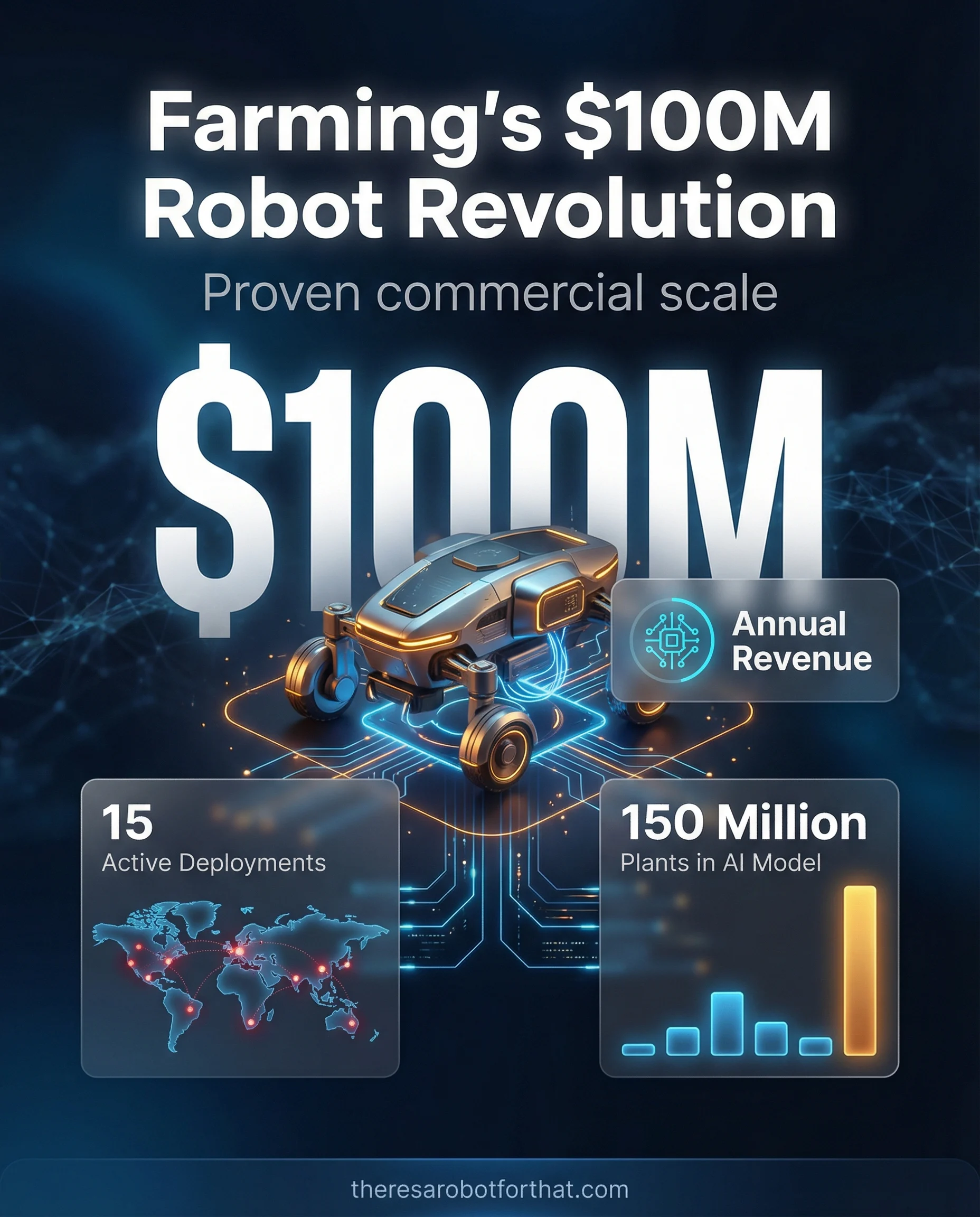
Image Source: There's A Robot For That
Snapshot: Carbon Robotics exceeded $100 million in annual revenue for the fiscal year ending January 2026, operating across 15 countries with its AI-driven LaserWeeder system and deploying a Large Plant Model trained on 150 million plants. The company recently appointed an experienced CFO from VMware and Everpure as it scales operations globally.
Breakdown:
Takeaway: A robotics company reaching $100M revenue in agriculture—a notoriously conservative sector—demonstrates that ROI justification has been solved for specific use cases. Operations leaders should note that successful robotics deployments aren't coming from humanoids or factories first—they're coming from industries with clear labor cost problems and measurable output metrics.
Other Top Robot Stories
Keenon deployed humanoid robots at a Shanghai McDonald's during the Shanghai Science and Technology Museum opening, greeting customers for five days before being removed—though the company promoted it as a showcase of "service automation becoming a seamless part of global dining."
Hesai joined NVIDIA's Halos AI Systems Inspection Lab as the first member focusing on LiDAR validation, becoming part of the first ANSI-accredited inspection lab for AI-driven physical systems as NVIDIA pushes its physical AI infrastructure beyond GPUs.
Agrikola.AI demonstrated successful fungal control in Spanish field vegetables using its Wagus UVC robot, autonomously treating powdery mildew and downy mildew in lettuce, onion, and courgette—with plans to expand into grapes, strawberries, and arable crops as chemical pesticide restrictions tighten across Europe.
GITAI showcased a lunar communications infrastructure demonstration where its rover coordinated with three inchworm robots to assemble a 5-meter communication tower piece by piece, highlighting robotics designed for space construction applications.
🤖 Your robotics thought for today:
Amazon paid real money for a company selling $50,000 humanoids. Toyota moved past the pilot phase. Hyundai's targeting 18 months from prototype to production deployment. The "when will humanoids be ready" question just became "which supplier are we evaluating?"
I'm watching how fast the Toyota deployment scales beyond seven units.
Until tomorrow,
Uli


