
Xpeng breaks ground on humanoid factory for 2026 delivery
PLUS: Kawasaki challenges da Vinci, 10-year autonomous farm bet

Welcome back to your Robot Briefing
Xpeng just broke ground on what the company calls the industry's first full-chain humanoid production facility — a 110,000-square-meter factory in Guangzhou designed to deliver mass-market robots by late 2026. The move signals something bigger than another prototype unveiling: a major automaker is betting manufacturing infrastructure and hard timelines on humanoid commercialization.
For executives weighing automation investments, the real question is whether Xpeng's 2026 deadline becomes the marker for when humanoids shift from expensive experiments to scalable business tools.
In today's Robot update:
Xpeng breaks ground on humanoid factory for 2026 delivery
Snapshot: Chinese EV maker Xpeng has started construction on a 110,000-square-meter humanoid robot factory in Guangzhou, targeting mass deliveries by the end of 2026.
Breakdown:
Takeaway: When a major automaker builds dedicated humanoid manufacturing infrastructure with specific delivery dates, it signals the market is moving from prototypes to products. Companies evaluating automation should watch whether Xpeng hits its 2026 timeline as a bellwether for when humanoid robots become commercially viable at scale.
Inside a 16,000-hectare farm's 10-year autonomous robot bet
Snapshot: Australian farm Beefwood Farms shares results from a decade deploying autonomous field robots, showing how machines like SwarmBot have successfully cut crop protection costs despite early setbacks.
Breakdown:
Takeaway: A 10-year track record matters because it moves autonomous robots from "interesting pilot" to "proven operations tool" - exactly the validation signal executives need when boards ask about automation ROI. The cost savings in crop protection show where the business case works today, while the acknowledged challenges help calibrate realistic deployment timelines.
Kawasaki challenges da Vinci with European expansion
Snapshot: Kawasaki Heavy Industries launches its hinotori surgical robot in Europe this year and opens its first overseas R&D center in France, directly challenging Intuitive Surgical's da Vinci system that has dominated surgical robotics for two decades.
Breakdown:
Takeaway: Competition emerging in surgical robotics suggests the technology has matured enough that established players can be challenged on performance and price, not just in manufacturing but in specialized medical applications. For business leaders evaluating robotics adoption, this signals that even in highly regulated, safety-critical domains, multiple viable solutions are becoming available.
AI drones and robots team up to track radioactive waste
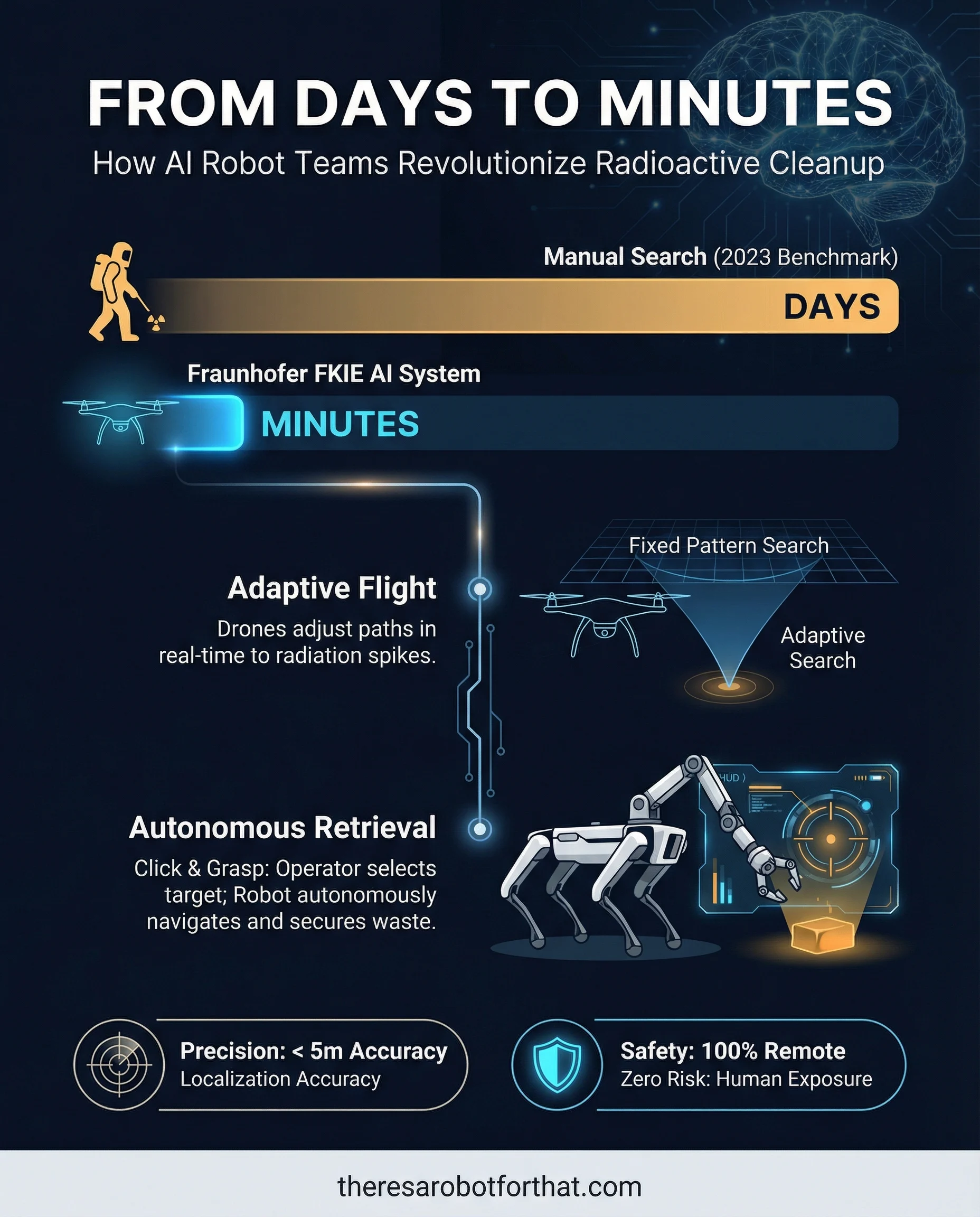
Image Source: There's A Robot For That
Snapshot: Researchers at Fraunhofer FKIE have developed a system that pairs autonomous drones with ground robots to detect and map radioactive hazards in real-time, keeping humans out of dangerous environments.
Breakdown:
Takeaway: This demonstrates that coordinated multi-robot systems are now field-ready for high-stakes hazardous material work, not just lab experiments. The shift from days of manual searching to minutes of autonomous detection represents the kind of step-change in operational efficiency that makes these systems viable for industries beyond nuclear facilities—think chemical plants, industrial cleanup, or anywhere humans face invisible threats.
Other Top Robot Stories
AI2 Robotics raised $144.7 million in Series B funding at a $1.4 billion valuation, with backing from Baidu and state-owned manufacturer CRRC as the Chinese company scales from 1,000 units in 2025 to 10,000 AlphaBot wheeled humanoids in 2026 for retail, biotech, and manufacturing applications.
Grodi secured €2.5 million led by Swanlaab to industrialize its VEGA 11 autonomous robot that uses computer vision to navigate Mediterranean greenhouses independently, providing growers with real-time plant health monitoring and yield forecasting to reduce costs and improve resource efficiency.
Unitree launched the As2 quadruped robot with 90 N·m maximum torque, 4+ hour runtime, IP54 weatherproofing, and 13 km range with 15 kg payload, targeting industrial applications with open secondary development and shifting quadruped robots from research tools to production-ready platforms.
🤖 Your robotics thought for today:
Xpeng's breaking ground on a 110,000-square-meter humanoid factory targeting 2026 deliveries while most companies run pilots—so is committing factory capital before proving demand bold leadership or premature manufacturing?
What does their timeline signal about humanoid market maturity?
Until tomorrow,
Uli


