
World's first surgical humanoid debuts with Nvidia AI
PLUS: Caterpillar’s voice-controlled excavators, robots that ‘feel’ crops, and Bonsai’s new autonomous fleet

Welcome back to your Robot Briefing
A Swiss medtech company is now performing spinal surgeries in Las Vegas using a three-armed robotic system that coordinates like a human surgical team—and it's already FDA-cleared and generating patient outcomes, not just demos.
This raises a critical question for healthcare systems planning automation investments: if coordinated multi-arm precision is the current baseline, what happens when AI-driven autonomy becomes standard in the next wave of surgical platforms?
In today's Robot update:
World's First 'Surgical Humanoid' Debuts at CES
Snapshot: Swiss medtech firm LEM Surgical showcased its Dynamis robotic system at CES 2026, positioning it as the first "surgical humanoid" for operating rooms—and unlike most CES healthcare demos, this one is already FDA-cleared and performing routine spinal procedures in Las Vegas.
Breakdown:
Takeaway: The business signal here is clear: surgical robotics have moved beyond single-arm assistance to coordinated multi-arm systems that are commercially viable today, not in three years. Healthcare systems evaluating automation should note this represents the baseline capability level for modern surgical robotics, with AI-enhanced autonomy coming next as the competitive differentiator.
Caterpillar & NVIDIA Bring Voice AI to Heavy Machinery
Snapshot: Caterpillar unveiled an AI-powered voice assistant for the Cat 306 CR Mini Excavator , letting operators control heavy machinery through natural conversation instead of levers and buttons.
Breakdown:
Takeaway: This isn't just a novelty feature—it signals that AI is ready for harsh, mission-critical environments where mistakes cost thousands per hour. Companies in industries with complex machinery and operator training challenges should watch how Caterpillar measures adoption and productivity gains over the next 12 months.
CMU's 'SonicBoom' Sensor Lets Robots 'Feel' Crops
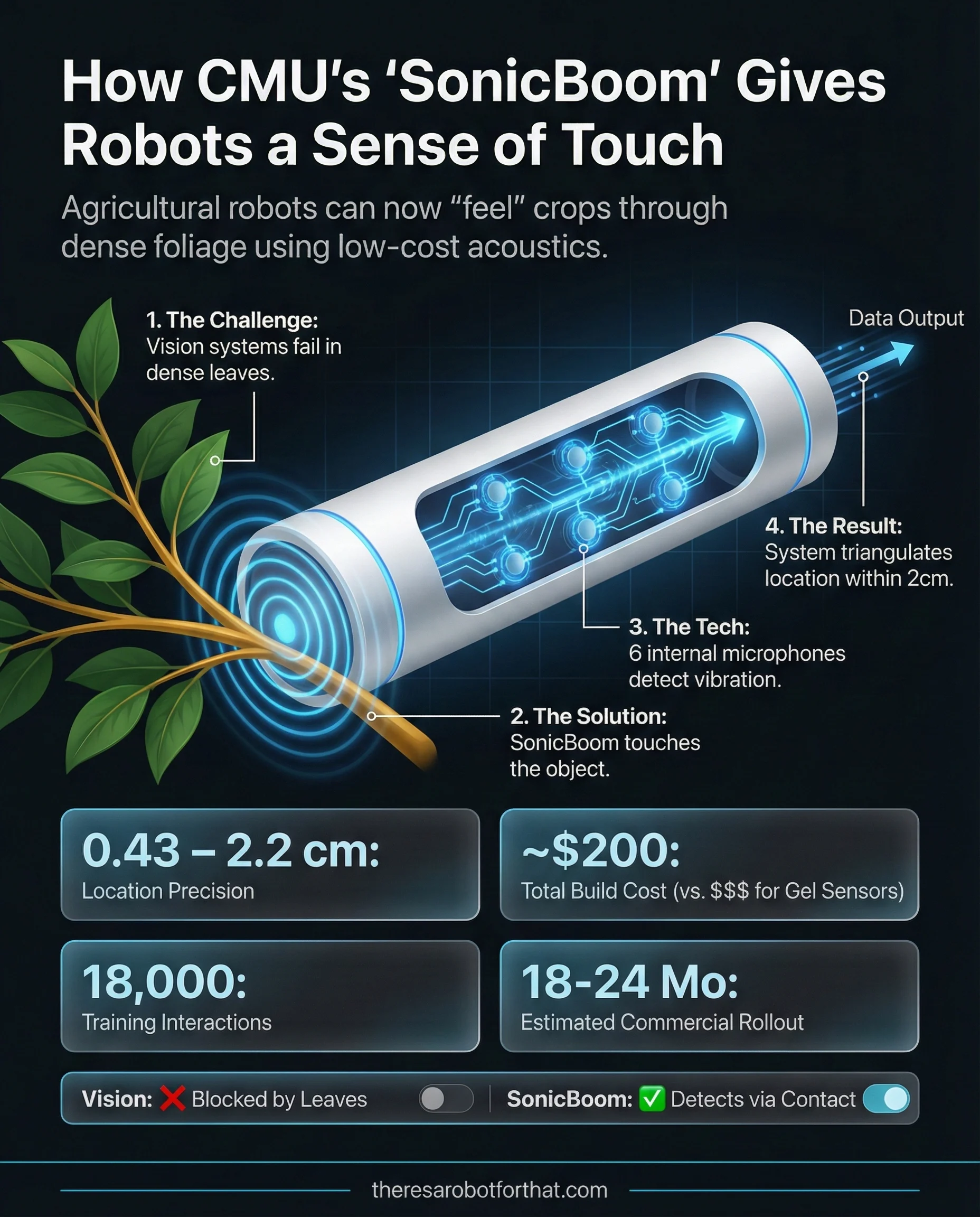
Image Source: Gemini / There's A Robot For That
Snapshot: Researchers at Carnegie Mellon University developed SonicBoom, a sensor system that uses contact microphones to detect crops hidden by foliage—solving a critical limitation for farm robots that rely on cameras but can't see through dense leaves.
Breakdown:
Takeaway: This represents a practical breakthrough for agricultural automation because it addresses a real deployment blocker (vision failure in cluttered environments) with hardware that's both durable and affordable at scale. The sub-$250 bill of materials and demonstrated accuracy in orchard-like conditions suggest this technology could reach commercial farm robots within 18-24 months rather than remaining a lab curiosity.
Bonsai Robotics Unveils New 'Amiga' Robot Lineup
Snapshot: Following its July acquisition of Farm-ng, Bonsai Robotics debuts three new autonomous agricultural vehicles—marking unusually fast post-M&A product execution in a sector where integration typically stalls momentum.
Breakdown:
Takeaway: Bonsai's rapid product launch post-acquisition signals that agricultural robotics M&A is starting to produce real operational results rather than just consolidating cap tables. The focus on farms doing €10M-50M in revenue—not just agribusiness giants—suggests the technology is finally reaching price points that matter for mainstream operations.
Other Top Robot Stories
CMR Surgical received CE and UKCA Mark approval for its Versius Surgical System in pediatric surgery, marking the first regulatory clearance for treating children under 18 across abdominal procedures, with the compact modular design proving particularly suited for pediatric anatomy in early clinical deployments at three UK centers performing nearly 150 procedures on patients as young as a few months old.
Richtech Robotics announced a partnership with SoundHound to integrate AI-powered voice ordering technology into its ADAM robotic platform, creating a full automation system that handles conversational ordering, payment processing, and service delivery in a single workflow—targeting enterprise clients seeking scalable food and beverage automation with minimal human intervention.
🤖 Your robotics thought for today:
LEM's three-armed surgical humanoid is already FDA-cleared and operating on spines in Vegas while most hospital systems are still evaluating single-arm assist robots—so are procurement committees buying capability or just buying what they recognize?
Until tomorrow,
Uli


