
Why K-Scale died: 6 brutal lessons from inside
PLUS: Hyundai overtakes Toyota, microrobots scrub Alzheimer's, and NYU releases $10k open-source arm

Welcome back to your Robot Briefing
K-Scale Labs, a YC-backed humanoid robotics startup, shut down after failing to close its Series A, and now its former COO has published a brutally honest breakdown of exactly what went wrong. The six failure modes he identifies — from over-trusting AI models to cover hardware flaws to treating supply chain as a procurement task instead of a core capability — read less like one company's mistakes and more like a field guide to the structural problems plaguing dozens of robotics ventures.
For any executive weighing automation investments or evaluating vendor pitches, this autopsy offers a rare glimpse behind the demo videos: which organizational patterns separate teams that ship from teams that burn cash?
In today's Robot update:
Why a robotics startup died: 6 hard lessons from the inside
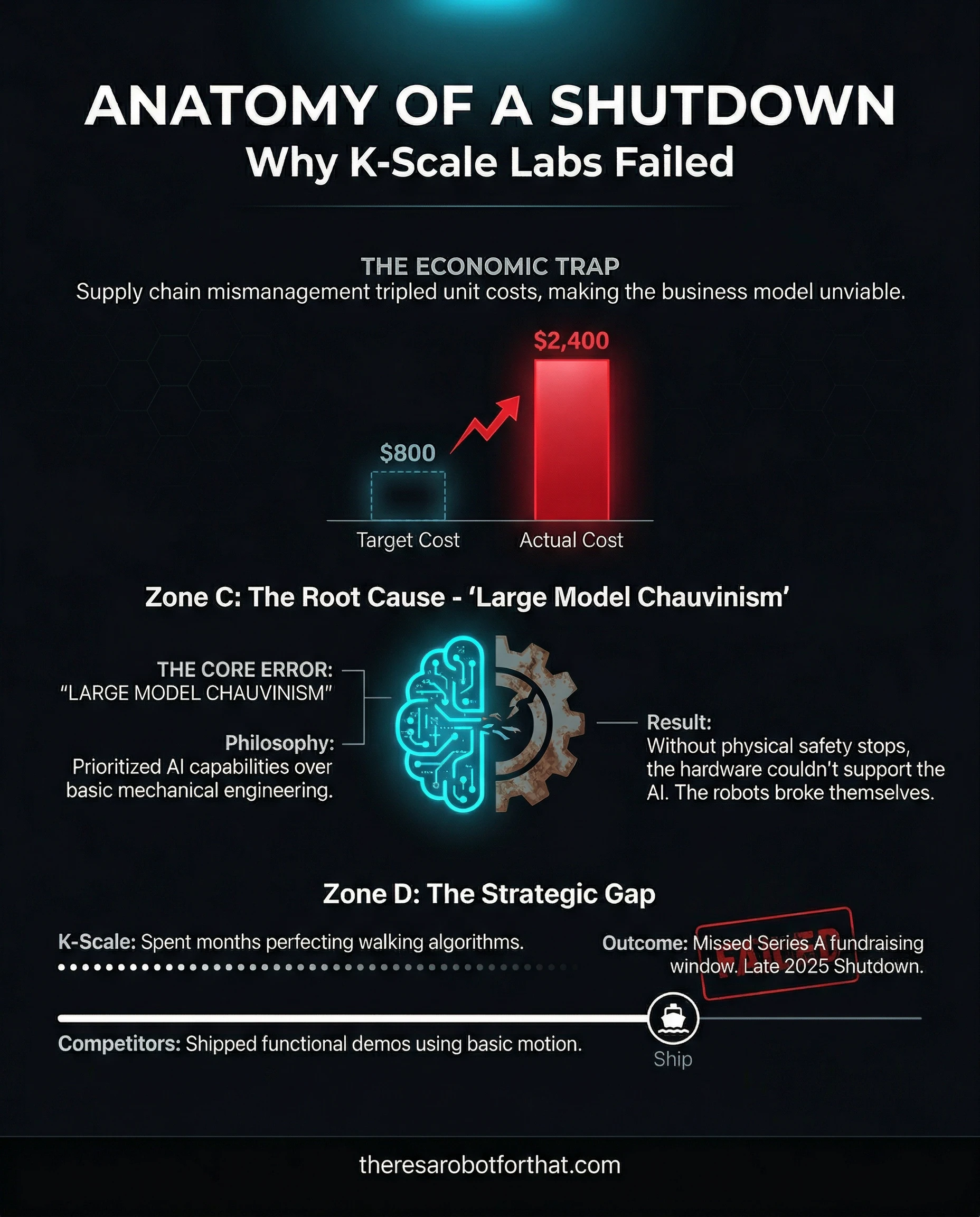
Image Source: There's A Robot For That
Snapshot: The former COO of K-Scale Labs published a detailed post-mortem explaining why their YC-backed humanoid robotics startup failed to close Series A and shut down in late 2025, revealing organizational mistakes that extend far beyond one company.
Breakdown:
Takeaway: This autopsy reveals failure modes that are epidemic across robotics startups, not unique to K-Scale: over-reliance on AI to compensate for hardware shortcuts, treating manufacturing as procurement rather than core capability, and confusing activity with progress. For executives evaluating robotics vendors or internal automation projects, these six lessons provide a checklist of red flags that indicate whether a team actually understands the physics and economics of shipping hardware at scale.
Microrobots enter FDA trials to scrub Alzheimer's from the brain
Snapshot: Medical Microinstruments won FDA approval to begin human trials using $1.5M microrobotic systems to clear waste pathways in Alzheimer's patients' brains—a procedure that could address a market of 7 million Americans if it proves the 5,000+ experimental Asian surgeries weren't just hype.
Breakdown:
Takeaway: This trial represents a critical test of whether medical robotics can move from experimental overseas procedures to FDA-validated therapies in mainstream Western healthcare systems. The 18-24 month approval timeline signals that medical robotics for neurodegenerative diseases could shift from "interesting research" to "budget conversation" faster than most enterprises expect.
Hyundai overtakes Toyota in valuation as robot strategies diverge
Snapshot: Hyundai's market valuation has surpassed Toyota's for the first time, driven by aggressive robotics investments including Boston Dynamics and US manufacturing expansion, while Toyota's cautious partnership approach sees it trading at a discount.
Breakdown:
Takeaway: Robotics strategy is now directly affecting core business valuations in traditional manufacturing sectors, not just R&D budgets. Companies across industries should recognize that aggressive automation investments are becoming table stakes for maintaining competitive market multiples, not optional future bets.
Build your own robot: NYU releases $10k open-source manipulator
Snapshot: NYU researchers released YOR (Your Own Robot), a fully open-source bimanual mobile manipulator with a bill of materials under $10,000, dramatically lowering the cost barrier for companies exploring custom robotics development.
Breakdown:
Takeaway: When robotics research platforms drop from $100k+ to $10k, development timelines compress and more companies can afford to experiment with custom automation solutions. This shift suggests that mid-sized manufacturers should start building internal robotics knowledge now, as the cost of entry for specialized applications is falling faster than most procurement cycles.
Other Top Robot Stories
KDDI deployed humanoid robots in partnership with AVITA for customer service roles across Japanese retail locations, building on earlier digital avatar trials at Lawson and au Style shops with plans for physical unit trials beginning Autumn 2026 at facilities including the Osaka Sakai Data Center.
Medical Microinstruments received FDA approval to begin human trials using $1.5 million microrobotic systems to operate on lymph vessels just 0.2mm in diameter for Alzheimer's treatment, with first surgeries scheduled for March 2026 and potential approval by end of 2027 if the procedure replicates results from 5,000 experimental Asian surgeries.
NYU released YOR (Your Own Robot), a fully open-source bimanual mobile manipulator with a bill of materials under $10,000 using commodity components like Piper robotic arms and Raspberry Pi 5, dramatically lowering the barrier for companies exploring custom robotics development compared to proprietary systems costing $100,000+.
🤖 Your robotics thought for today:
K-Scale just died because they believed AI models could compensate for unreliable hardware while Figure and Tesla obsess over mechanical fundamentals first—so if "Large Model Chauvinism" already killed a YC-backed startup, how many other humanoid companies are burning cash on the same delusion right now?
Until tomorrow,
Uli


