
UBTech offers $18M salary for AI scientist
PLUS: Autonomous farm robots in Ghana, FDA-approved dental surgery robot in Miami, and robot dogs harvesting tea in China

Welcome back to your Robot Briefing
Chinese robotics giant UBTech just posted a job listing with a salary range that tops out at $18 million — for a single AI scientist role. It's the kind of compensation package that turns heads and signals just how fierce the global race for humanoid talent has become.
The question isn't whether humanoid robots are gaining traction — UBTech's revenue mix proves they already are. The real question is whether throwing Silicon Valley-level salaries at top researchers will be enough to close the gap between factory deployments and true autonomous intelligence.
In today's Robot update:
Chinese robotics giant offers up to $18M salary for chief AI scientist
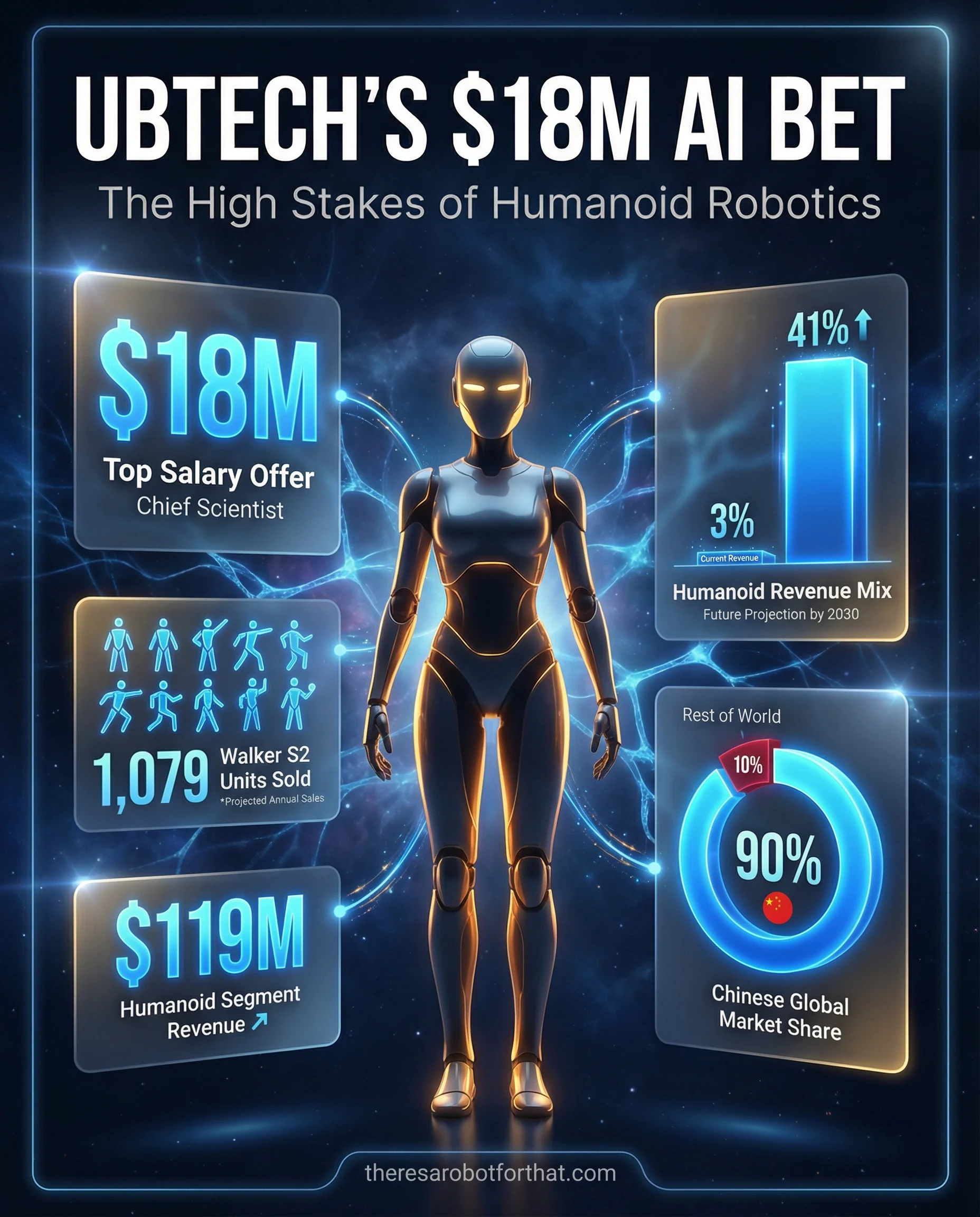
Image Source: There's A Robot For That
Snapshot: UBTech, the world's first publicly listed humanoid robot maker, posted a global job listing offering $2.2M-$18M annually for a Chief Scientist of Embodied Intelligence — a compensation package that signals how seriously Chinese manufacturers are taking the race to scale humanoid deployment. The Shenzhen-based company reported humanoid revenue jumped from 3% to 41% of total revenue in one year, a twenty-fold increase driven by factory automation contracts.
Breakdown:
Takeaway: When a robotics manufacturer structures compensation packages rivaling Silicon Valley AI labs, it reflects confidence that humanoid deployment has moved from pilot stage to production scaling. Operations leaders should note the shift from revenue footnote to majority business driver happened in a single fiscal year — the timeline for viability in structured environments like factories is now, not speculative.
African agritech startup deploys AI-powered autonomous farming robots
Snapshot: Ghana's 3Farmate is deploying Fama autonomous robots across African farms using AI vision systems to plant, weed, and fertilize without GPS dependency, covering 11-14 hectares daily with sub-85mm precision. The company uses a pay-per-hectare model that eliminates upfront capital costs, addressing the primary barrier to mechanization in regions where farms are fragmented and equipment investment is prohibitive.
Breakdown:
Takeaway: The business model innovation matters more than the technical capability here — removing capital barriers through pay-per-use pricing makes automation accessible to markets previously excluded from mechanization. Companies evaluating robotics ROI should note that deployment models eliminating upfront investment can unlock customer segments where traditional equipment sales never gained traction.
FDA-approved dental robot brings autonomous surgery to Miami clinics
Snapshot: Neocis's Yomi robot is performing dental implant surgeries in Miami using AI-driven planning and depth-controlled drilling, with 25 Florida doctors now deploying the only FDA-approved autonomous dental surgery system. The robot eliminates traditional gum-cutting procedures by using X-ray mapping to guide precise implant placement, reducing healing time and patient discomfort while cutting procedure duration. The system has potential expansion to crowns and fillings according to deploying dentists in 2027.
Breakdown:
Takeaway: Regulatory approval and multi-site deployment in a high-stakes medical application demonstrates that autonomous surgical robotics have crossed from experimental to clinically viable. The concentration of 16 practices in one metro area suggests peer validation and referral networks are driving adoption faster than marketing — a signal that ROI and patient outcomes are meeting real-world practice economics.
Robot dogs deployed to harvest premium Chinese tea on steep mountain terrain
Snapshot: DEEP Robotics partnered with JD Logistics to deploy LYNX M20 wheeled-legged and X30 quadruped robots at Hangzhou's Longwu Tea Plantation, navigating 50cm-wide paths and 45° slopes to transport West Lake Longjing tea leaves within the critical one-hour freshness window. The deployment addresses chronic rural labor shortages and injury risks from workers manually carrying heavy baskets down steep mountain terrain.
Breakdown:
Takeaway: Deploying robots for time-sensitive agricultural logistics in extreme terrain conditions indicates the technology has matured beyond controlled warehouse environments into genuinely difficult operating contexts. Operations leaders should recognize that when robots handle specialty crop applications with strict quality windows and challenging geography, the capability ceiling for industrial environments is considerably higher than pilot projects might suggest.
Other Top Robot Stories
Fieldwork secured £3M to deploy autonomous raspberry harvesting robots on UK farms in Norfolk and Stafford, with multi-robot fleets expected to operate commercially from 2027 following two-year trials aimed at reducing reliance on seasonal labor.
IHMC unveiled Alex, an all-electric humanoid robot designed for first responder roles including bomb threat response, marking a shift from lab-tethered research platforms to battery-powered systems capable of operating in urban environments and dangerous scenarios.
Huntington announced a partnership with GrayMatter Robotics to integrate physical AI and autonomous robotic systems into shipbuilding operations at America's largest Navy shipbuilder, targeting labor-intensive material preparation and construction processes to accelerate production timelines.
Intel joined Musk's Terafab AI chip project to support Tesla's humanoid robot and data center ambitions, marking a strategic shift as the chipmaker seeks new revenue streams beyond traditional computing markets.
🤖 Your robotics thought for today:
UBTech's humanoid revenue went from 3% to 41% of total in one year. That's not a pilot program — that's a business model flip. When a manufacturer offers $18M for a single scientist, they're not betting on the future. They're scaling what already works.
I'm watching how fast other manufacturers follow that compensation structure.
Until Friday,
Uli


