
Tesla kills Model S to build 1M humanoids
PLUS: Figure drops C++ for neural nets, Steam Decks control war bots, and robot farmers

Welcome back to your Robot Briefing
Tesla is shutting down its Model S and X production lines this quarter, repurposing the entire Fremont factory floor to manufacture Optimus humanoid robots at a target rate of one million units annually. The discontinued vehicles represent less than 3% of Tesla's sales, making this more strategic signal than sacrifice.
The move marks one of the biggest corporate bets on humanoid robotics to date, but Tesla admits no Optimus units are doing useful work yet—they're still in R&D phase. For companies watching this market, the question is whether Tesla's aggressive timeline signals imminent commercial viability, or if the gap between prototype and production means 2027-2028 remains the realistic deployment window.
In today's Robot update:
Tesla kills Model S and X to go all-in on Optimus
Snapshot: Tesla announced it will end production of its flagship Model S sedan and Model X SUV in Q2 2026, converting that Fremont factory space into a production line for Optimus humanoid robots with capacity to build 1 million units per year.
Breakdown:
Takeaway: Tesla shutting down production lines for a legacy vehicle business to build robot factories sends a clear message about where it sees the future—but the multi-year gap between current reality (zero useful deployments) and ambitious targets (1M units/year) suggests 2027-2028 is the earliest horizon for commercially viable humanoid robots at scale. Companies watching this space have time to let Tesla work through the hard problems before committing their own capital.
Figure's 'Helix 02' replaces C++ with Neural Nets
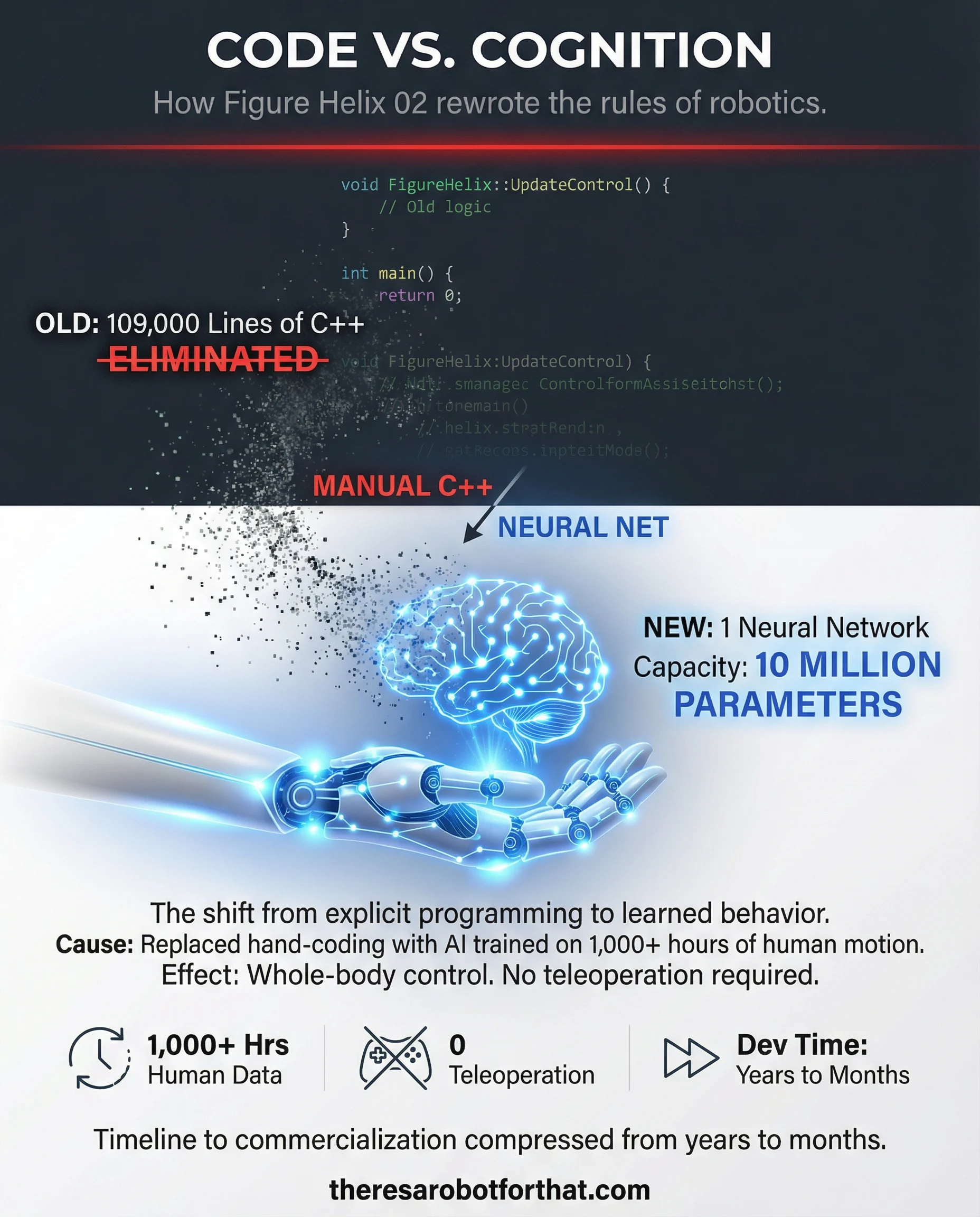
Image Source: There's A Robot For That
Snapshot: Figure unveiled Helix 02, a neural network that replaces 109,000 lines of hand-coded robotics software with AI-driven whole-body control—no teleoperation required.
Breakdown:
Takeaway: This shift from hand-coding to AI-trained control represents a fundamental change in how quickly humanoid robots can learn new tasks, potentially compressing the 3-5 year commercialization timeline that many analysts have projected. Companies evaluating humanoid robotics should watch whether this approach delivers faster task adaptation in real production environments over the next 12-18 months.
Soldiers are using Steam Decks to control robots
Snapshot: Ukrainian forces are repurposing Valve's Steam Deck gaming consoles to pilot armed ground robots in combat, demonstrating how commercial gaming hardware can solve complex military control challenges without custom engineering.
Breakdown:
Takeaway: When gaming consoles become battlefield robotics controllers, it signals that the hardware barrier for deploying ground robots has collapsed to consumer electronics pricing. Companies exploring robotics deployment should note that control interfaces don't require military-grade custom development—existing consumer hardware may already solve your toughest integration challenges.
Why one CEO is betting against the humanoid hype
Snapshot: While Tesla and others race to build humanoid robots, FJDynamics founder James Wu is taking the opposite bet—building specialized robots for agriculture and construction that solve real labor shortages today, not tomorrow.
Breakdown:
Takeaway: This represents a fundamentally different robotics investment thesis—prioritizing profitable deployment in under-served sectors over moonshot AGI bets. For companies evaluating robotics strategies, it's a reminder that the highest ROI may come from specialized applications with desperate customers today, not general-purpose robots that might work in five years.
Other Top Robot Stories
Researchers published findings on an inflatable humanoid robot developed in China that can walk, crawl, float on water, and compress to fit through tight spaces—demonstrating a fundamentally different mechanical approach to humanoid design that prioritizes adaptability over rigid structure, though the system's cautious gait and reliance on external air supply reveal tradeoffs between flexibility and performance.
NC State developed autonomous robotic systems called "Thor" and "Hawkeye" to automate labor-intensive vegetable production tasks including stake driving and crop monitoring, addressing staffing challenges by using machine learning trained on 50,000 field images to distinguish crops from weeds—with USDA funding supporting expansion into pest detection and nutrient deficiency identification.
Fauna Robotics introduced Sprout, a lightweight developer-focused humanoid platform powered by NVIDIA Jetson AGX Orin that emphasizes comfortable human interaction over industrial deployment, signaling a shift toward accessible robotics development tools as companies test human-centric design principles before scaling to commercial applications.
🤖 Your robotics thought for today:
Tesla's killing Model S and X to build a million Optimus units annually while admitting zero are doing useful work today—so are they betting on a 2027 breakthrough or just discovering that promising robots is more valuable than shipping cars?
Enjoy your weekend,
Uli


