
Tesla ends Model S production for humanoids
PLUS: Faraday’s $2,499 robot, Unitree targets 20,000 units, and Weave’s $8k laundry bot

Welcome back to your Robot Briefing
An automaker is shutting down production of luxury vehicles to build humanoid robots instead - Tesla's reported decision to end Model S and Model X manufacturing represents the most dramatic reallocation of factory capacity we've seen in the robotics sector. When companies sacrifice established revenue streams for robot production, the economics have clearly shifted from experimental to viable.
The question for operations leaders: if automakers see enough margin potential to justify cannibalizing billion-dollar product lines, what does that timeline mean for your automation roadmap?
In today's Robot update:
Tesla Ends Model S/X Production for Humanoid Robots
Snapshot: Tesla reportedly plans to end production of its Model S and Model X vehicles to manufacture humanoid robots instead, marking the most dramatic bet yet by an automaker on the emerging robotics market. This production shift, combined with Hyundai's plan to deploy Boston Dynamics' Atlas robot in its Georgia factory by 2028, signals that major manufacturers now view humanoids as a core business—not an R&D experiment.
Breakdown:
Takeaway: When established manufacturers start shutting down billion-dollar product lines to build robots, that's a validation signal business leaders can't ignore—it means the economics are becoming real enough to justify cannibalizing existing revenue. The 2028 Hyundai deployment date also gives operations executives a clear benchmark for when to expect commercially proven humanoid solutions in industrial settings.
Faraday Future launches robot lineup starting at $2,499
Snapshot: Struggling EV maker Faraday Future pivoted into robotics with three new models, including a quadruped priced at $2,499—undercutting most competitors and signaling that robot hardware pricing may compress faster than expected.
Breakdown:
Takeaway: When a cash-strapped automaker sees enough opportunity to launch a robotics division with production-ready timelines, it validates that the business case for commercial robots has crossed a threshold. The sub-$2,500 quadruped price point could accelerate adoption timelines for companies evaluating whether robotic systems fit their operational budgets.
Unitree targets 20,000 humanoids in 2026 following viral gala
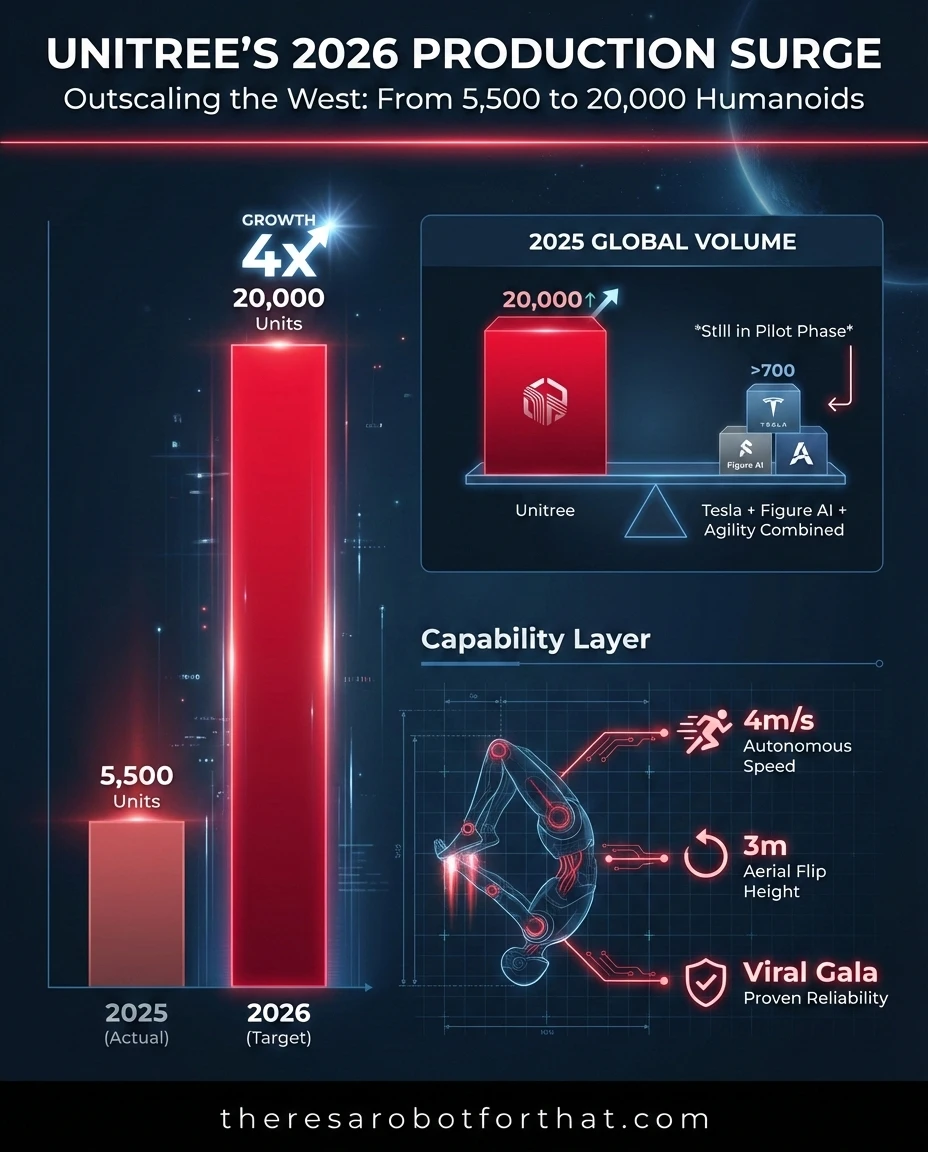
Image Source: There's A Robot For That
Snapshot: After robots performed choreographed kung fu at China's Spring Festival Gala, Unitree Robotics announced it targets 20,000 humanoid robots for 2026—a production leap that signals Chinese manufacturers are hitting scale ahead of Western competitors.
Breakdown:
Takeaway: The jump from 5,500 to 20,000 units demonstrates manufacturing capacity that most Western robotics companies won't match until 2027 or later. For operations leaders evaluating humanoid timelines, Chinese suppliers are now delivering production scale while US competitors remain largely in pilot phases.
Weave Robotics opens orders for laundry bot
Snapshot: San Francisco startup Weave Robotics started taking orders for Isaac 0, a household robot that folds laundry, testing whether consumers will pay premium prices for home automation with an $8,000 upfront cost or $450 monthly subscription.
Breakdown:
Takeaway: This launch provides the clearest pricing signal yet for premium home robotics, though the geographic constraint indicates companies are still testing whether consumers will actually pay thousands of dollars for single-task automation. The subscription option at $450/month suggests Weave expects ongoing service and software updates will be part of the value proposition, not just the hardware itself.
Other Top Robot Stories
HD Hyundai Samho plans to introduce humanoid robots in its Korean shipyard by 2027, studying ROI across different use cases while addressing labor shortages through partnerships with Neura Robotics and LG CNS—signaling that major industrial manufacturers are moving beyond pilots to concrete deployment timelines.
Deloitte reports more than half of global companies already use physical AI in some form, with adoption projected to reach 80% in coming years, though progress in controlled environments like factories and warehouses is advancing far faster than open real-world deployments where risks remain greater.
Rek demonstrated modified Unitree G1 humanoid robots in a commercial boxing match in San Francisco, with VR-controlled 4.5-foot robots drawing paying spectators and prompting plans for a professional robotic combat league featuring six-foot, 200-pound machines—validating both the commercial appeal and real-world durability of humanoid platforms that could translate to industrial applications.
🤖 Your robotics thought for today:
Tesla reportedly ends Model S and X production to build Optimus at scale while Hyundai waits until 2028 to deploy Atlas—so does going all-in before proving real-world deployments actually beat cautious timelines, or does first-mover advantage in factory reallocation matter more than deployment proof?
Until tomorrow,
Uli


