
Smartphone giant Honor unveils first consumer humanoid robot
PLUS: PUBG creator launches Ludo Robotics, EngineAI’s front-flipping humanoid, and Hitachi bets big on physical AI

Welcome back to your Robot Briefing
Honor Device Co., the smartphone maker that split from Huawei in 2020, is rolling out its first humanoid robot at MWC Barcelona this weekend. It's designed for consumer services like shopping assistance, marking the first time a major phone manufacturer has jumped into the humanoid arena.
The timing reveals how quickly consumer tech companies are treating robotics as the next platform battle. If smartphone giants are already deploying humanoids in 2026, the question for enterprises isn't whether to evaluate this technology—it's whether waiting for clarity means ceding ground to competitors already testing consumer-facing robots.
In today's Robot update:
Smartphone giant Honor enters the humanoid robot race
Snapshot: Honor Device Co. is set to unveil its first humanoid robot at MWC Barcelona this weekend, becoming the first smartphone manufacturer to enter the humanoid space with a consumer-focused service robot. The device, marketed as the HONOR ROBOT PHONE, promises to combine AI intelligence with robot mobility for applications like shopping assistance.
Breakdown:
Takeaway: Honor's move signals that robotics is no longer just about factory automation—smartphone manufacturers see consumer humanoids as the next platform war, similar to how they competed in smartphones and wearables. Companies waiting to see "who wins" in humanoid robotics should recognize that major consumer brands are already placing their bets for 2026 deployment.
PUBG creator KRAFTON launches 'Ludo Robotics'
Snapshot: Gaming giant KRAFTON is pivoting its simulation tech into the real world by appointing a Chief AI Officer and establishing Ludo Robotics to develop 'Physical AI' that powers robot intelligence.
Breakdown:
Takeaway: This marks a notable validation of the simulation-to-reality pipeline - companies with deep experience in virtual world physics and AI-driven characters are now viewing robotics as a natural extension of their expertise. KRAFTON's $200M+ investment track record in India's tech ecosystem suggests they're committed to backing this bet with meaningful capital, not just headlines.
EngineAI's new humanoid sticks the landing
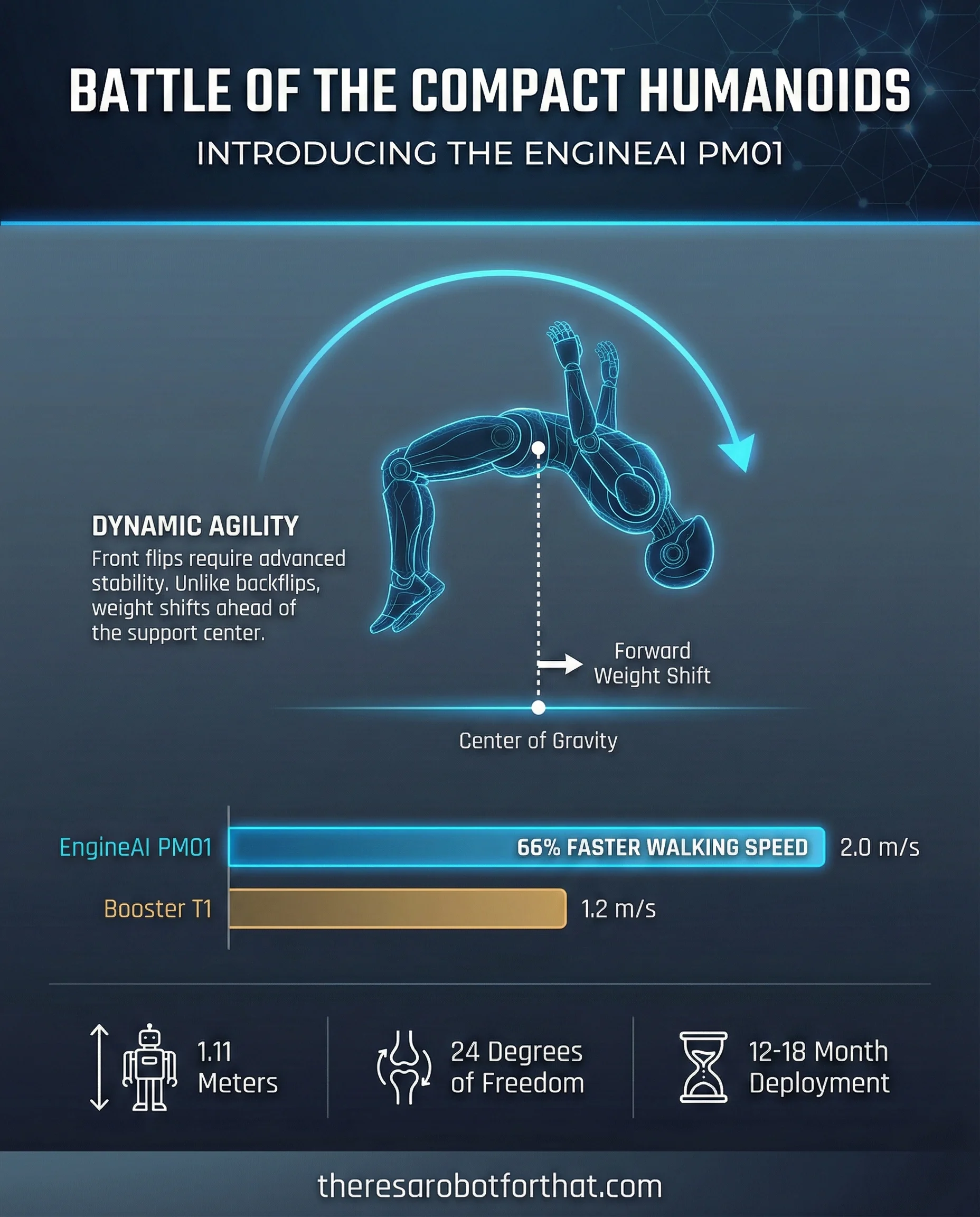
Image Source: There's A Robot For That
Snapshot: Chinese robotics firm EngineAI released front-flipping demonstrations of its compact PM01 humanoid, which maintains balance when pushed and executes controlled acrobatic maneuvers that signal major progress in dynamic motor control.
Breakdown:
Takeaway: The ability to absorb pushes and stick dynamic landings indicates these compact platforms are solving the motor control challenges that have kept humanoids confined to controlled lab settings. Companies evaluating humanoid deployments should watch whether this stability translates from demos to sustained operation in variable environments over the next 12-18 months.
Hitachi bets on industrial data to win 'Physical AI'
Snapshot: Hitachi is challenging Silicon Valley's foundation model approach to physical AI by leveraging decades of industrial control expertise, with live deployments at Daikin and JR East already showing measurable results.
Breakdown:
Takeaway: The deployments at Daikin and JR East signal that industrial physical AI is moving from pilot phase to production faster than many executives realize — particularly for companies with deep operational datasets. Hitachi's bet is that domain expertise, not just compute scale, determines which physical AI systems actually work in high-stakes environments.
Other Top Robot Stories
National Taiwan University Hospital performed over 9,000 surgeries using robotic assistance since 2011, with 908 procedures in 2025 alone representing a 70% increase over five years, as the institution added a third Da Vinci surgical system and established a Center for Robot-assisted and Innovative Surgery to meet growing demand for minimally invasive procedures across specialties from urology to oncology.
MIT Technology Review revealed how workers in Shanghai spend full days wearing VR headsets and exoskeletons to teach robots tasks like opening microwaves—exposing that humanoid robot training requires massive human labor that companies keep invisible, while Figure's partnership with Brookfield to collect household data across 100,000 residential units signals movement tracking at scale is becoming the new training data gold rush.
NVIDIA open-sourced DreamDojo, an interactive world model trained on 44,000 hours of egocentric human video that converts scalable human movement data into physical AI by extracting latent actions between frames, enabling real-time teleoperation inside simulated environments, model-based planning for action preview, and policy evaluation in out-of-distribution scenarios—releasing weights, code, and datasets for reproduction.
🤖 Your robotics thought for today:
Honor's unveiling a consumer humanoid this weekend—the first smartphone maker to enter the space.
Question: Is this the next platform war like smartphones → wearables, or will consumer humanoids stay niche while factories scale first?
Platform bets are made early, not safely.
Until tomorrow,
Uli


