
Skild secures $1.4B for universal robot brain
PLUS: Barclays predicts $200B market, LimX's cognitive OS
Welcome back to your Robot Briefing
Skild AI just closed a $1.4 billion Series C at a $14 billion valuation, backed by SoftBank, NVIDIA, and Jeff Bezos, to build what it calls a universal robot brain—one AI system that can control any hardware for any task. The company went from zero to $30 million in revenue in 2025 alone.
The speed of that traction raises a critical question for operations leaders: if general-purpose robot intelligence is arriving this fast, does it still make sense to invest in custom automation solutions, or is the window already closing on building proprietary systems that will be obsolete before deployment?
In today's Robot update:
Skild AI secures $1.4B to build the 'brain' of robotics
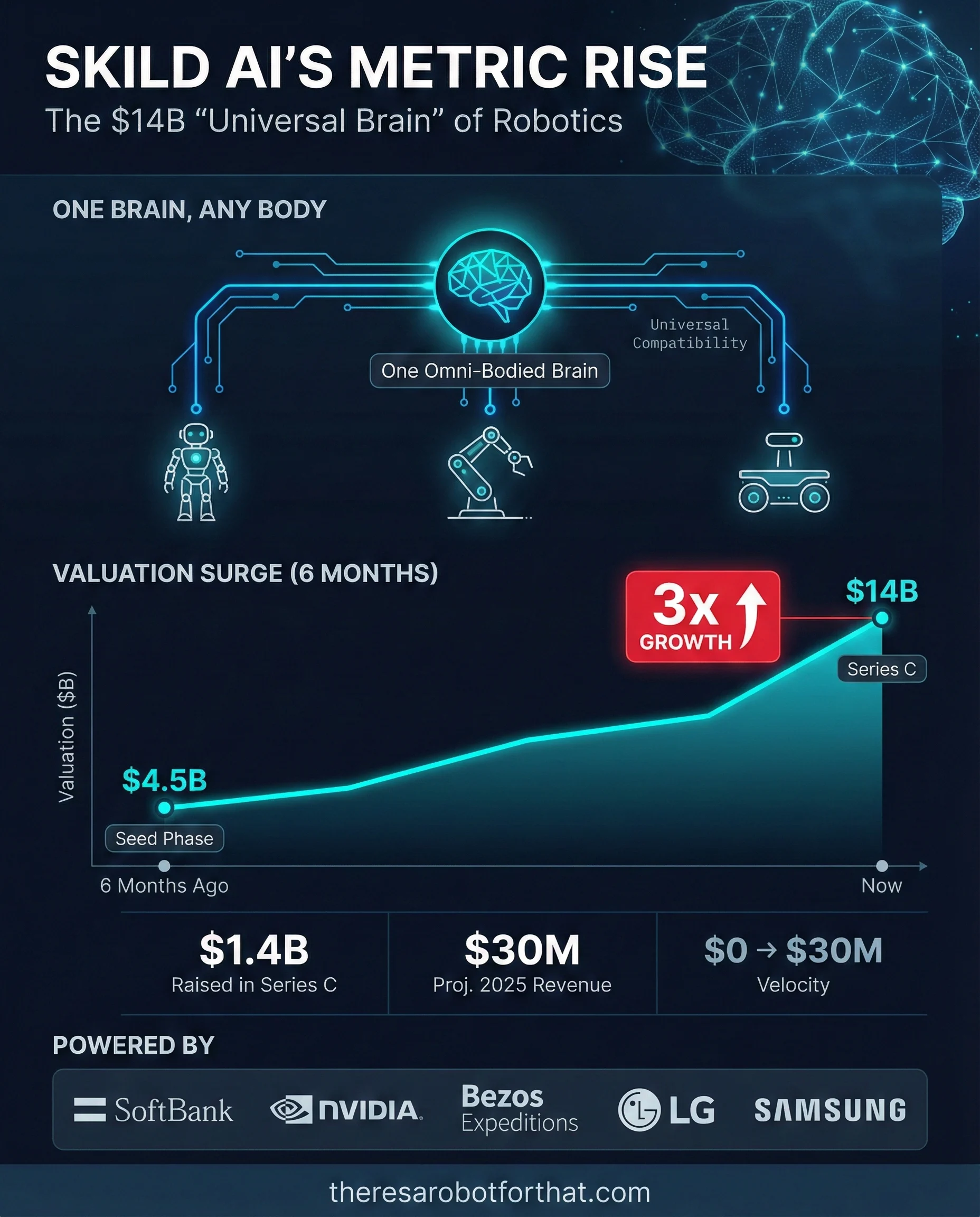
Image Source: Gemini / There's A Robot For That
Snapshot: Skild AI raised $1.4B in Series C funding at a $14B valuation to build a general-purpose AI system that can control any robot hardware for any task. SoftBank led the round with backing from NVIDIA, Jeff Bezos, LG, Samsung, and Salesforce Ventures.
Breakdown:
Takeaway: The caliber of investors (SoftBank, NVIDIA, Bezos) and the speed of revenue growth suggest the market believes general-purpose robot AI will arrive faster than most companies expect. This shifts the calculation for mid-sized manufacturers: waiting to build custom automation solutions may cost more than licensing a universal platform that's already being deployed.
LimX Dynamics unveils 'COSA' cognitive OS for humanoids
Snapshot: Chinese robotics firm LimX Dynamics unveiled COSA (Cognitive OS of Agents), an operating system that unifies high-level reasoning with low-level motion control—letting robots think and move simultaneously rather than processing tasks in disconnected steps.
Breakdown:
Takeaway: COSA signals that humanoid control systems are shifting from research prototypes to production-ready architectures that can handle unpredictable warehouse or facility environments. The real test will be whether LimX can prove COSA's reliability across diverse deployment scenarios beyond controlled demonstrations.
Barclays: Humanoid market poised to hit $200B by 2035
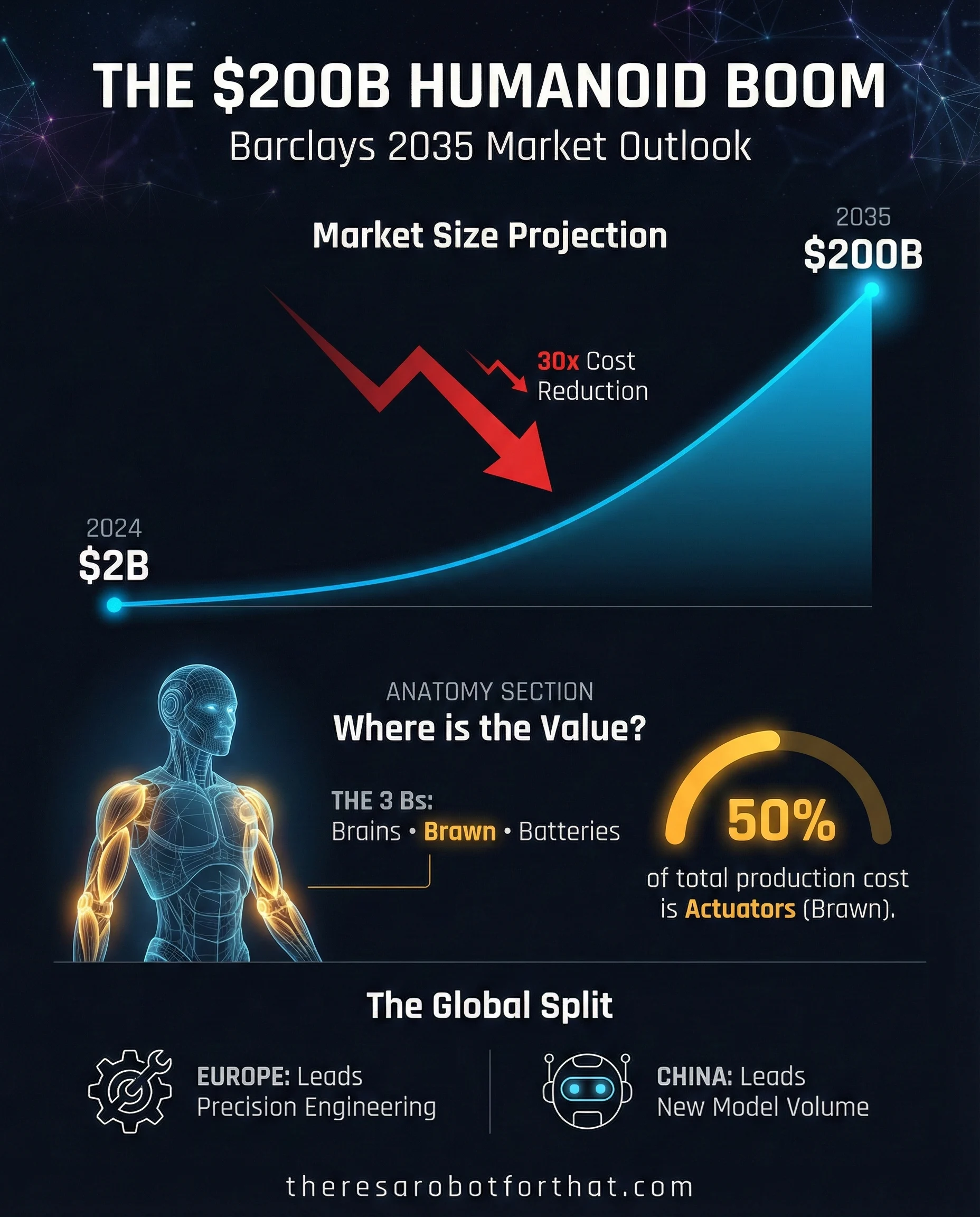
Image Source: Gemini / There's A Robot For That
Snapshot: A Barclays Research report projects the humanoid robotics market will surge from $2-3 billion today to $200 billion by 2035, driven by a 30-fold reduction in production costs over the past decade.
Breakdown:
Takeaway: When a major investment bank publishes specific market projections with defined timelines, it signals institutional capital is moving from skepticism to allocation mode. The focus on actuators and component costs tells operations leaders where the near-term business opportunities lie - not in the robots themselves, but in the precision manufacturing supply chain that makes them economically viable.
New 'differentiable simulation' enables robots to adapt in seconds
Snapshot: Researchers at the University of Zurich developed a method that lets robots adapt to unexpected physical disturbances in under 5 seconds, cutting control errors by 81% compared to traditional approaches. This tackles one of robotics' biggest deployment headaches: robots that work perfectly in simulation but fail when real-world conditions differ.
Breakdown:
Takeaway: This represents a fundamental shift from trying to predict every possible condition during training to enabling robots that adapt on the fly when deployed. For companies evaluating robotics, it signals that the sim-to-real gap—a major reason pilots fail to scale—may become less of a deployment blocker within the next 12-24 months as these techniques mature.
Other Top Robot Stories
Valuates projects the humanoid robot actuator market will explode from $150 million in 2024 to nearly $10 billion by 2031, with actuators representing roughly 50 percent of total humanoid production costs and Asia-Pacific leading demand growth as manufacturing automation scales.
Zoomlion deployed over 2,000 adaptive robots across 12 smart factories in China producing construction and agricultural machinery, with humanoid pilots now running in machining, logistics, assembly, and quality inspection tasks supported by an AI-native cloud platform and 100+ training workstations.
Researchers identified that humanoid robotics remains constrained by physical realities rather than AI capabilities, with a preprint study finding that data scarcity, sim-to-real failures, energy limits, and whole-body coordination present harder obstacles to commercial deployment than cognitive model performance.
🤖 Your robotics thought for today:
Skild AI hit $30M in revenue starting from zero this year, selling one "brain" that works across any robot hardware—so if the software problem is already solved and commercializing, why are mid-sized manufacturers still waiting to pilot automation until they find the "perfect" custom solution?
Enjoy your weekend,
Uli


