
Samsung targets full-scale humanoid factories by 2030
PLUS: Medtronic challenges Da Vinci, autonomous drone defense, and farming robot dogs
Welcome back to your Robot Briefing
Samsung just drew a line in the sand for humanoid manufacturing: full-scale deployment across its global factories by 2030, combining autonomous bipedal robots with AI systems that independently run everything from warehouse operations to quality control. The timeline puts Samsung alongside Foxconn and Hyundai in a growing cluster of manufacturers betting on humanoids within the next 4-6 years.
For companies still evaluating automation roadmaps, the question is whether this convergence represents proven technology ready to scale — or coordinated optimism that could leave early adopters exposed if the tech doesn't deliver on factory floors.
In today's Robot update:
Samsung targets 2030 for full-scale humanoid factory deployment
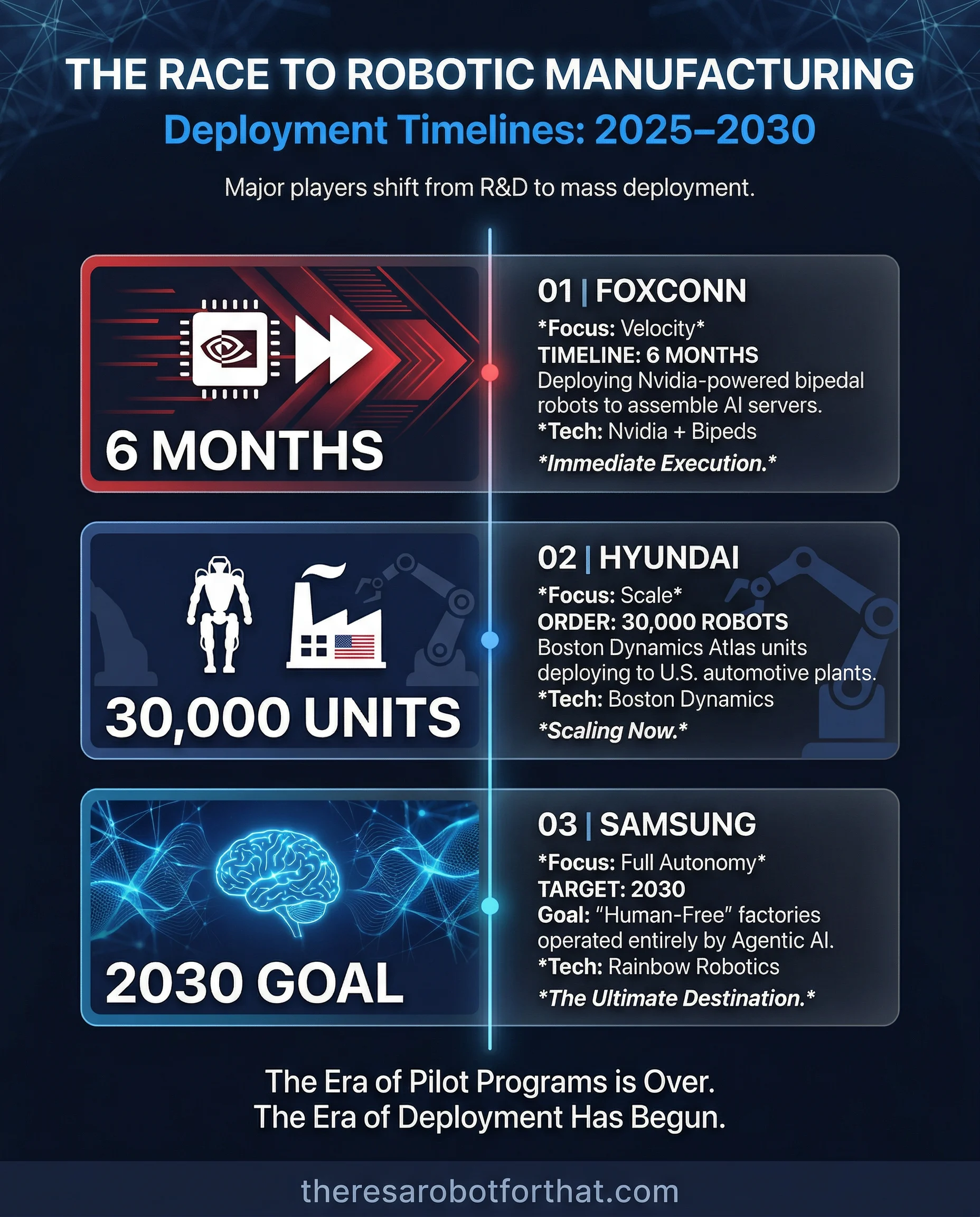
Image Source: There's A Robot For That
Snapshot: Samsung Electronics announced plans to transform its global manufacturing facilities into AI-driven factories by 2030, deploying humanoid robots and agentic AI systems across production lines. The electronics giant becomes the latest major manufacturer to set a concrete timeline for humanoid deployment at scale.
Breakdown:
Takeaway: The convergence of multiple major manufacturers around 2025-2030 deployment timelines suggests humanoid robotics is moving from R&D to operational planning phase. Mid-sized manufacturers should start scenario planning now for labor market shifts and competitor advantages that emerge as these systems prove out at scale over the next four years.
Medtronic challenges Da Vinci with first US robotic surgeries
Snapshot: Medtronic performed its first US surgeries with the FDA-approved Hugo robotic system in February, directly challenging Intuitive Surgical's two-decade monopoly in a market where installed robots generate roughly 84% recurring revenue from services and parts.
Breakdown:
Takeaway: Competition in surgical robotics signals the market is maturing beyond single-vendor dominance, which typically drives faster adoption as hospitals gain negotiating leverage and vendors compete on price and features. Hospital systems evaluating robotic surgery programs now have a credible alternative to consider, potentially accelerating deployment timelines across the industry.
Allen Control Systems debuts 'Bullfrog' robot to defeat lethal drones
Snapshot: Allen Control Systems unveiled its Bullfrog autonomous defense system, designed to intercept and neutralize loitering munitions like Iranian Shahed drones that have struck civilian infrastructure.
Breakdown:
Takeaway: The emergence of commercial autonomous defense systems signals that AI-powered threat response is moving from experimental to deployment-ready. Companies in critical infrastructure sectors should monitor how autonomous security systems mature, as similar technologies will likely flow into industrial facility protection within 2-3 years.
Deep Robotics' new wheeled-legged dog tackles steep slopes
Snapshot: Chinese robotics company Deep Robotics launched the LYNX M20, a quadruped robot that solves a specific logistics problem: moving crops and materials across steep, unstable terrain where traditional vehicles can't operate.
Breakdown:
Takeaway: This represents the robotics industry targeting specific infrastructure gaps rather than replacing existing systems. Companies operating in remote or challenging terrain should watch this space as mobile robots increasingly handle logistics tasks that wheeled vehicles simply can't perform economically.
Other Top Robot Stories
Carbon Robotics showcased its AI-powered laser weeding system as a herbicide replacement for large-scale agriculture, using computer vision to identify and eliminate weeds with precision lasers while crops pass through untouched, offering farmers a path to reduce chemical costs and meet organic certification requirements.
Tsubame Industries announced its current office facilities and confirmed plans to open a mass production factory in the near future, signaling the Japanese robotics manufacturer's move from prototype development to scaled manufacturing of its piloted robot systems.
🤖 Your robotics thought for today:
Samsung just set a 2030 timeline for full humanoid factories while Foxconn committed to deploy Nvidia-powered bipedals within six months and Hyundai committed to producing 30,000 Atlas robots per year by 2028
So if three manufacturing giants converged on deployment windows this tight, why are mid-sized manufacturers still treating humanoid evaluation like a 2027 strategic planning exercise instead of a survival decision you make this quarter?
Until tomorrow,
Uli


