
RoboParty open-sources the world’s first full-stack humanoid
PLUS: Navy taps AI welding, modular 'centaur' robots, and physical AI perception

Welcome back to your Robot Briefing
Beijing startup RoboParty just released the full design blueprints for its bipedal humanoid—hardware schematics, supplier contacts, control algorithms, and all—claiming companies can now slash humanoid development costs by 80%. The 21-year-old founder behind it built the robot in 120 days with $10M from Xiaomi and has already attracted 1,000+ developers to the GitHub repo.
If the barrier to humanoid R&D just dropped from half a million dollars to accessible open-source infrastructure, does this compress the timeline for when these machines become viable across mainstream business operations? Or will the hard part—reliable real-world deployment—still take years regardless of whose designs you start with?
In today's Robot update:
RoboParty open-sources full-stack humanoid 'Origin'
Snapshot: Beijing startup RoboParty open-sourced complete hardware and software designs for its bipedal humanoid 'Roboto Origin,' aiming to cut development costs by up to 80% and democratize access to humanoid robotics infrastructure.
Breakdown:
Takeaway: Open-sourcing the full stack—not just code, but supply chains and manufacturing specs—could significantly compress the timeline for when humanoid robots become economically viable for mainstream business applications. Companies that previously couldn't afford $500K+ in R&D to explore humanoid automation now have a validated starting point to build from.
LimX Dynamics debuts modular 'TRON 2' robot
Snapshot: Chinese robotics firm LimX Dynamics unveiled TRON 2, a modular robot platform that reconfigures between bipedal, wheeled, and dual-arm forms—potentially letting companies buy one adaptable system instead of multiple specialized robots.
Breakdown:
Takeaway: The modular approach directly addresses a pain point for companies hesitant about robotics ROI—the fear of investing in hardware that becomes obsolete when operational needs shift. If the reconfiguration process proves practical in real deployments, this design philosophy could accelerate adoption among mid-market companies that need versatility more than specialization.
Navy shipbuilder HII taps Path Robotics for AI welding
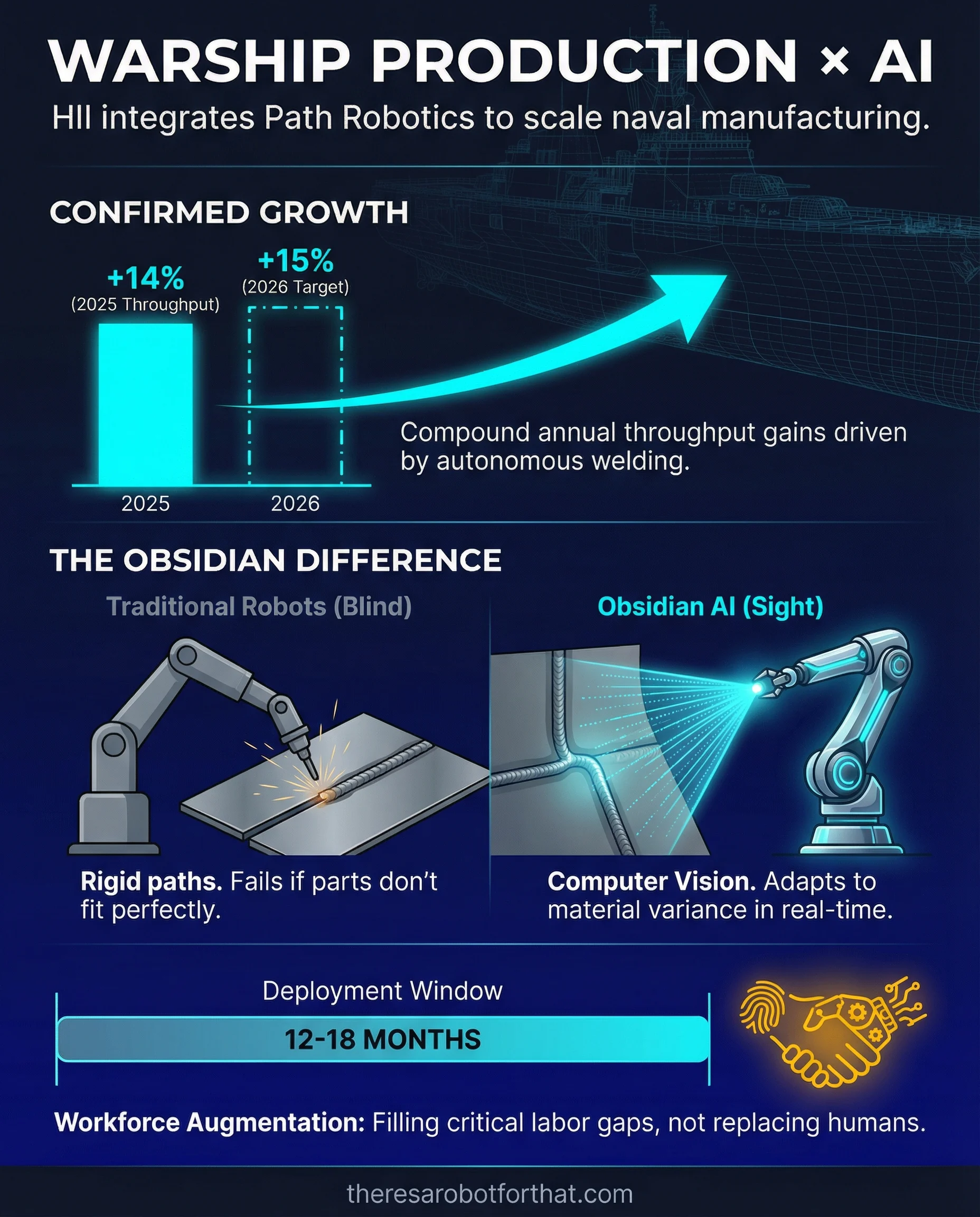
Image Source: There's A Robot For That
Snapshot: America's largest military shipbuilder signed a partnership with Path Robotics to deploy autonomous AI welding systems that address workforce shortages while accelerating warship production.
Breakdown:
Takeaway: This signals physical AI for manufacturing is transitioning from experimental to strategic partnerships with major industrial players facing acute labor shortages. The MOU structure means deployment is still 12-18 months out, but the involvement of a defense contractor already posting strong production gains suggests the technology has cleared key reliability thresholds.
Algorized raises $13M for 'Physical AI' perception
Snapshot: A startup building perception systems that let robots safely detect human presence and intent just raised $13M Series A from investors including Amazon's Industrial Innovation Fund—tackling the safety barrier that keeps humans and robots separated on factory floors.
Breakdown:
Takeaway: When Amazon's industrial investment arm backs safety perception technology, it signals that the bottleneck for robot deployment is shifting from hardware costs to safe collaboration capabilities. Companies planning automation rollouts should track whether perception systems like this become standard infrastructure that changes facility design requirements.
Other Top Robot Stories
Barclays projects the Physical AI market will expand from $2-3 billion today to $200 billion within the decade, with humanoid robotics delivering productivity gains up to 150% at full human parity as aging populations and labor shortages drive structural demand for automation solutions.
Foxconn achieved a 40% reduction in production line setup time by partnering with NVIDIA to build factory digital twins that train cable assembly and fastening processes virtually before physical deployment, while BMW introduced Figure AI humanoids at its Spartanburg plant to autonomously detect and correct positioning errors.
GITAI launched its first CubeSat satellite SC1 into orbit, capturing time-lapse imagery of Earth as the space robotics company advances toward autonomous orbital operations and lunar construction capabilities following earlier successful field demonstrations of drilling and material handling systems.
🤖 Your robotics thought for today:
A GitHub repo just replaced what used to cost $500K in R&D.
For students who couldn't afford to touch humanoid hardware, RoboParty's open-source stack isn't just interesting—it's a curriculum.
The question is whether universities will notice before their students do.
Until tomorrow,
Uli


