
OpenAI’s secret robot lab scales to 100 trainers
PLUS: China's shapeshifting robot, Louisiana steel humanoids, Waymo launches in Miami

Welcome back to your Robot Briefing
OpenAI is running a three-shift operation in San Francisco with 100 data collectors teaching robotic arms to fold laundry and make toast, using cheap 3D-printed controllers instead of expensive motion capture suits. The company just announced a second facility and is soliciting U. S.
manufacturing partners for robotics hardware. Does this bet on massive data collection with bargain-bin equipment beat the flashy humanoid demos competitors are chasing — or is OpenAI repeating the same "scale solves everything" assumption that works for LLMs but might not transfer to physical robots?
In today's Robot update:
Inside OpenAI's secret robotics lab
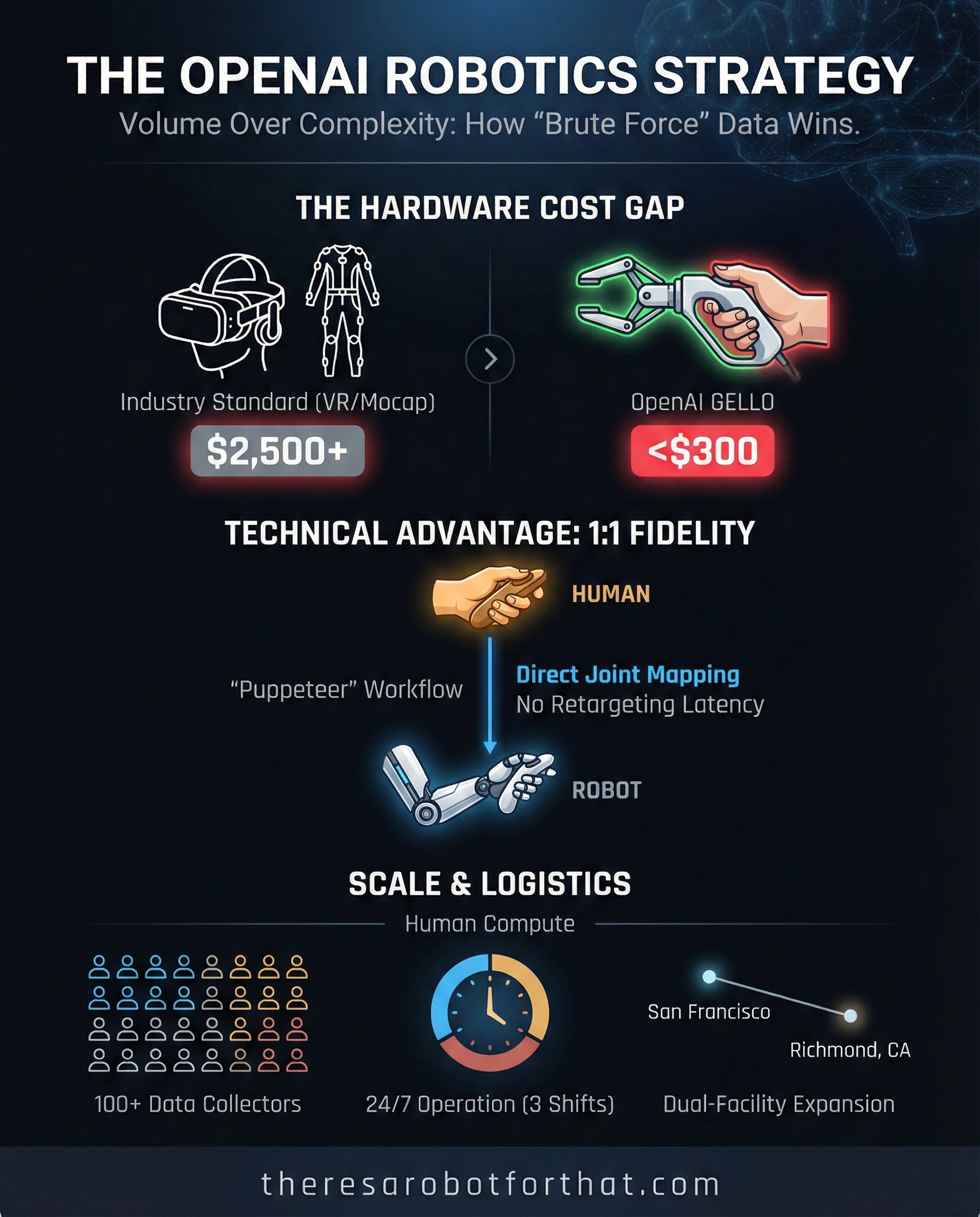
Image Source: Gemini / There's A Robot For That
Snapshot: OpenAI has quietly scaled a robotics team in San Francisco to 100 data collectors working around the clock, training robotic arms to perform household tasks like folding laundry and making toast—and just announced plans for a second facility in Richmond, California. The company's recent request for proposals for U. S. manufacturing partners explicitly includes robotics components, confirming hardware ambitions beyond data centers.
Breakdown:
Takeaway: OpenAI's decision to scale contract labor and low-cost teleoperation rather than invest in flashy humanoid demos suggests the path to functional household robots runs through massive data collection first, hardware second. The Richmond expansion and manufacturing RFP indicate this is a multi-year bet, not an experiment—but experts note the "ChatGPT moment" for robotics through data scaling remains unproven.
China's new shapeshifting robot walks on water
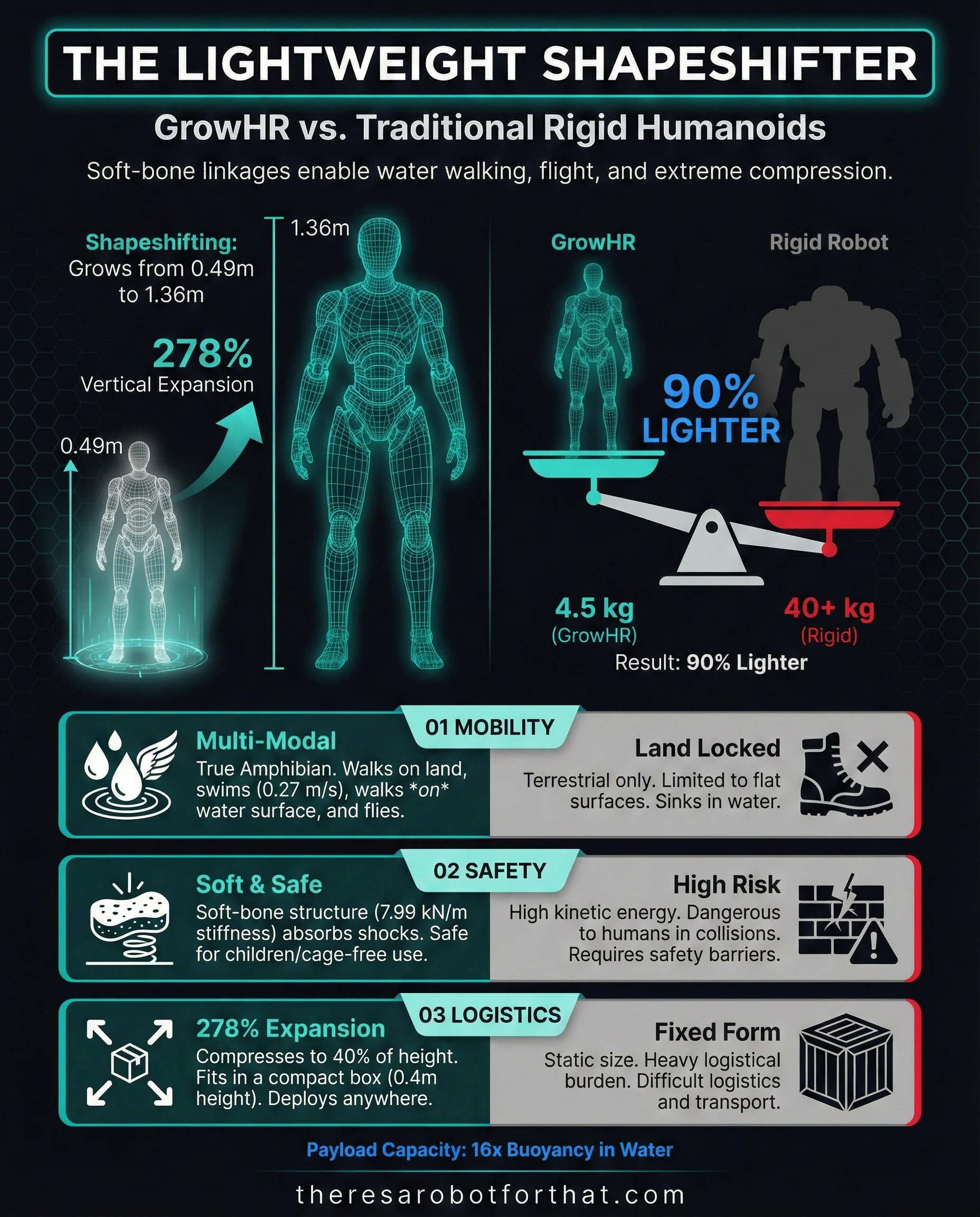
Image Source: Gemini / There's A Robot For That
Snapshot: Researchers at Southern University of Science and Technology unveiled GrowHR, a soft humanoid robot that extends to triple its height, weighs just 9.9 pounds, and demonstrates capabilities from walking on water to aerial transport.
Breakdown:
Takeaway: This research signals that soft robotics is moving beyond lab demonstrations into designs that solve real deployment constraints—portability, safety, and multi-environment operation. Businesses evaluating humanoid platforms should watch how quickly these bio-inspired approaches scale from 4.5kg prototypes to production-ready systems that can actually work alongside humans without expensive safety caging.
Louisiana taps humanoids for steel fabrication
Snapshot: Louisiana signed a partnership with Persona AI to deploy humanoid robots at SSE Steel Fabrication, marking the first time a U. S. state has formally backed humanoid testing in an active heavy-industry facility.
Breakdown:
Takeaway: When a state government backs humanoid deployment in live production environments, it signals reduced risk for companies considering similar adoption. This pilot offers a blueprint for how mid-sized manufacturers can test automation without overhauling existing facilities or workforce structures.
Waymo launches public rides in Miami
Snapshot: Waymo opened its autonomous ride-hailing service to the public in Miami this week, marking another major metro expansion that signals autonomous vehicles are moving from pilot programs to operational reality.
Breakdown:
Takeaway: Miami's launch shows autonomous ride-hailing has moved past the experimental phase into commercial deployment across diverse US metros. Companies evaluating logistics automation or fleet management should treat autonomous technology as operational now, not as a future possibility.
Other Top Robot Stories
Allen Control Systems successfully tested a robotic gun system that autonomously engaged and neutralized two small FPV drones using an M240 machine gun, marking a significant development in automated defense systems for counter-drone operations built entirely in Austin, Texas.
Zipline announced expansion of its autonomous delivery drone service to Houston and Phoenix, continuing the company's rollout of on-demand aerial logistics that eliminates last-mile delivery constraints for retailers and healthcare providers.
AGIBOT announced its first European brand launch in Milan on January 30th, marking the international expansion of China's leading humanoid manufacturer into Western markets with partner SIR Modena just weeks after capturing the top global market position.
🤖 Your robotics thought for today:
OpenAI's scaling to 100 data collectors working three shifts with $300 GELLO controllers while competitors burn cash on motion capture suits and VR rigs—does that mean the robotics race is won by whoever labels the most laundry folds, not whoever builds the fanciest hardware?
What's your take?
Until tomorrow,
Uli


