
Zerith mass produces $13k humanoid at 100/month
PLUS: UBTech’s $237M acquisition, Waymo vs 7,000 dark signals, Robot sabotage

Welcome back to your Robot Briefing
Zerith hit a production milestone that matters: 100 humanoid units per month at $13,600 each, with over $14 million in orders already on the books for wheeled service robots now cleaning hotels across China.
The question facing automation buyers isn't whether humanoids are coming—it's whether affordable wheeled platforms with proven deployment track records will capture the commercial market before bipedal robots ever ship at scale.
In today's Robot update:
Zerith begins mass production of $13k humanoid
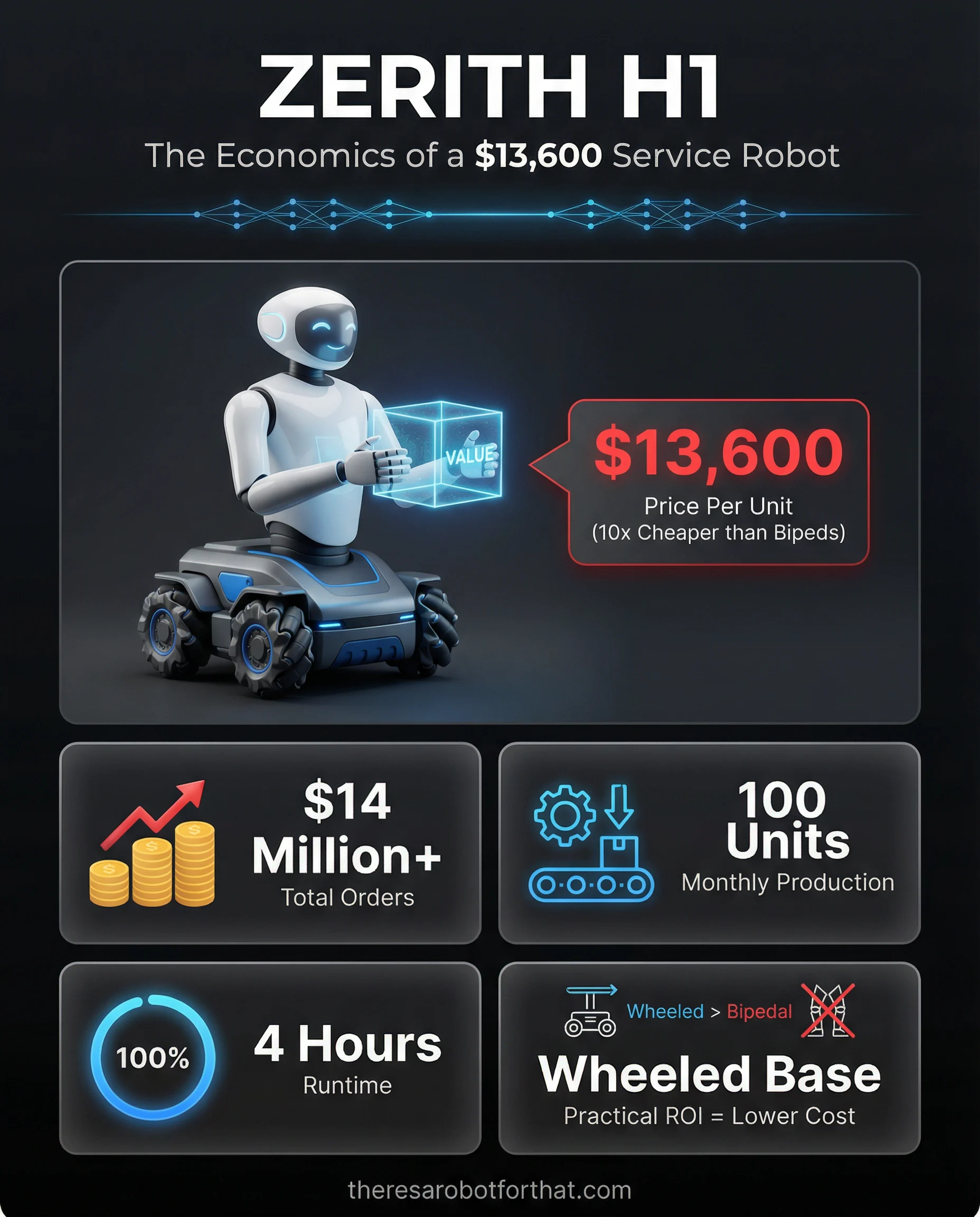
Image Source: There's A Robot For That
Snapshot: Chinese robotics startup Zerith scaled production of its H1 service humanoid to 100 units per month in under a year, with a surprising price tag of just $13,600 that's already generated over $14 million in orders.
Breakdown:
Takeaway: The H1's rapid production scale and commercial traction signal that the first wave of "humanoid" adoption may come from practical wheeled platforms rather than walking robots. For operations leaders evaluating automation timelines, sub-$15k service robots with proven deployment track records are no longer theoretical—they're processing purchase orders right now.
UBTech's $237M Supply Chain Play
Snapshot: UBTech Robotics is spending $237 million to take control of component manufacturer Zhejiang Fenglong, a clear signal that the race to scale humanoid production is moving from the lab to the factory floor.
Breakdown:
Takeaway: Supply chain control is emerging as the next competitive battleground in humanoid robotics, not just AI capabilities or hardware design. Companies serious about deployment at scale are now making the same manufacturing infrastructure bets that defined previous hardware revolutions, which means the timeline for widespread commercial availability may be compressing faster than many expected.
Worker sabotage and mice: The reality of deploying humanoids
Snapshot: Reports from the Humanoids Summit reveal the unglamorous side of robot deployment that promotional videos don't show—from workers placing "On Strike" signs on bots to environmental hazards like mice destroying units in premium facilities.
Breakdown:
Takeaway: The gap between controlled demonstrations and operational deployment remains significant, with social acceptance and environmental resilience posing bigger near-term barriers than pure technical capabilities. Companies evaluating humanoid investments should budget for change management programs and expect substantially longer deployment timelines than vendor roadmaps suggest.
Waymo fleet navigates 7,000 dark signals in SF blackout
Snapshot: When a PG&E outage knocked out power to one-third of San Francisco last Saturday, Waymo's autonomous vehicles navigated over 7,000 intersections with non-functioning traffic signals—a real-world stress test that revealed both the technology's capabilities and its current limitations.
Breakdown:
Takeaway: This incident validates that autonomous vehicles can function during infrastructure failures, but it also exposes the growing pains of scaling from pilot to citywide deployment. The speed of Waymo's software update response—addressing the bottleneck within days—signals that AVs are entering a phase where operational learnings drive rapid iteration, not just gradual improvement.
Other Top Robot Stories
Sunday demonstrated its Memo household robot learning kitchen tasks through imitation rather than programming, using proprietary Skill Capture Gloves that distill human movements into onboard AI—a shift toward intuitive learning that could finally make general-purpose home robots commercially practical beyond single-task demonstrations.
Richtech debuts its mobile humanoid robot DEX at CES 2026, expanding beyond its established food service robotics portfolio into general-purpose humanoid platforms as the company positions for broader commercial automation markets.
Figure deployed its Figure 03 humanoid fully autonomously at a demonstration, interacting with people and handing out items using the company's Helix AI model without teleoperation—signaling progress toward the autonomous human-robot interaction required for service environments rather than just manipulation tasks.
🤖 Your robotics thought for today:
Zerith's wheeled $13k "humanoid" hit $14M in orders while walking robots burn billions perfecting bipedal motion—does that mean the industry's been optimizing for the demo reel instead of the purchase order?
What am I missing?
Enjoy your weekend,
Uli


