
Robots master 1,000 tasks from a single demo
PLUS: Hyundai’s electric Atlas debuts and SwitchBot’s robot butler

Welcome back to your Robot Briefing
A robotic arm just learned 1,000 different physical tasks in a single day, with each task requiring only one human demonstration—slashing the data requirements that have kept flexible automation out of reach for most companies.
This tackles the economics problem head-on: if deployment costs drop by an order of magnitude while task flexibility explodes, does that finally tip the ROI calculation for mid-market warehouses and assembly operations that couldn't justify today's rigid systems?
In today's Robot update:
Robots Master 1,000 Tasks in One Day from a Single Demo
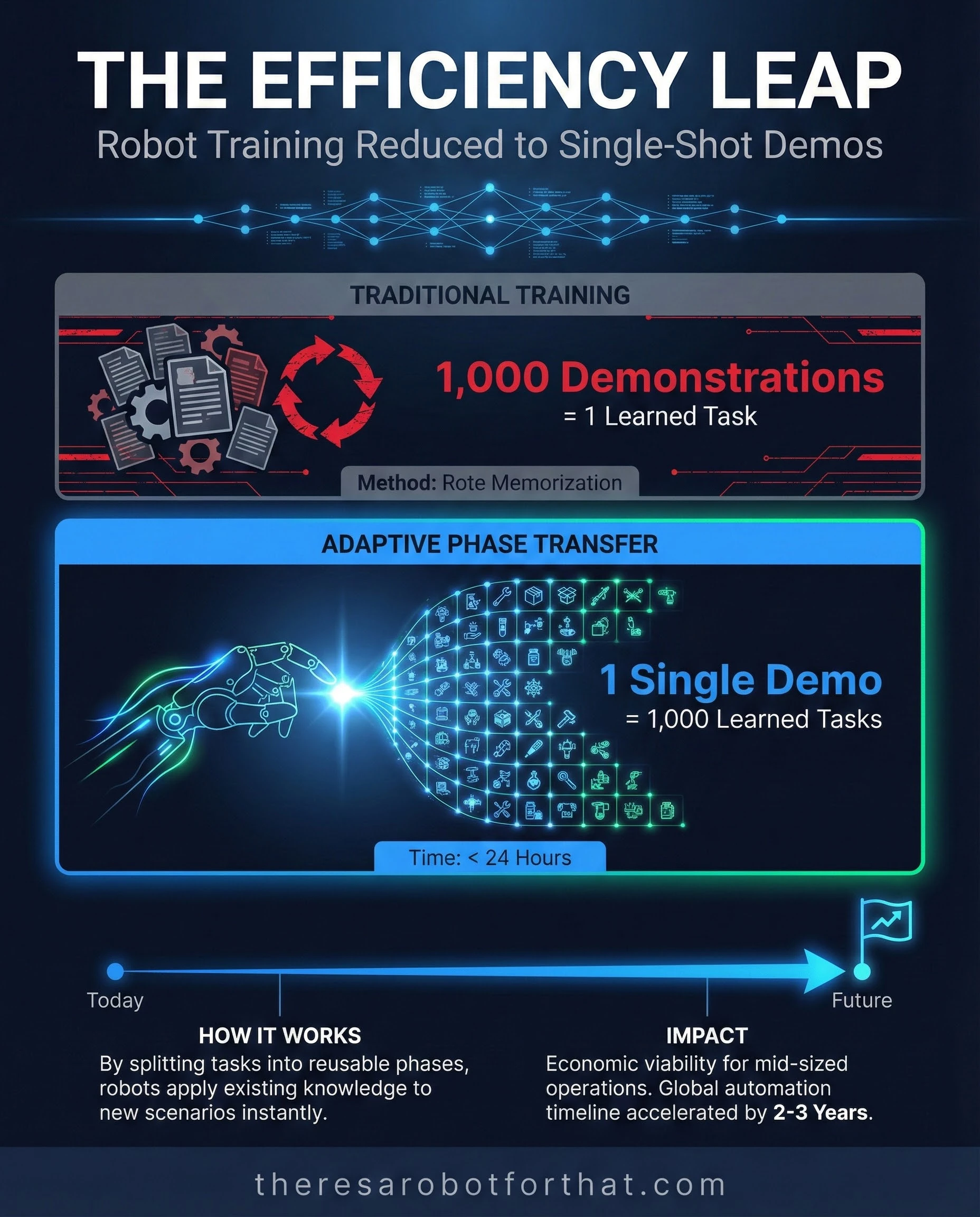
Image Source: Gemini / There's A Robot For That
Snapshot: Researchers achieved a breakthrough in robot training efficiency, teaching a robotic arm to perform 1,000 distinct physical tasks in under 24 hours using just one demonstration per task—a development that could finally make flexible automation economically viable for mid-sized operations. Full details here.
Breakdown:
Takeaway: The data bottleneck that kept flexible robotics confined to research labs appears to be cracking, potentially accelerating the timeline for adaptive robots in warehouses, healthcare facilities, and even light manufacturing by 2-3 years. Companies evaluating automation should watch for commercial systems incorporating these learning techniques, as they could slash implementation costs while dramatically expanding what tasks are automatable.
CES 2026 Preview: Electric Atlas and 'Physical AI' Take Center Stage
Snapshot: Hyundai Motor Group plans to unveil its next-generation electric Atlas humanoid robot at CES 2026 next week, positioning 'Physical AI' as the industry's next major growth area beyond chatbots and software-only solutions.
Breakdown:
Takeaway: Major manufacturers are now publicly demonstrating commercial humanoid robots for industrial deployment, not just research prototypes. Operations leaders should note this signals a shift from "watching and waiting" to active evaluation timelines for factory automation projects.
SwitchBot Enters the Chat: Meet the 'Onero H1' Robot Butler
Snapshot: Smart home accessories maker SwitchBot unveiled the Onero H1 humanoid robot at CES, marking a notable shift as consumer tech brands—not just robotics specialists—begin launching household robots designed to fold laundry and handle domestic chores.
Breakdown:
Takeaway: SwitchBot's entry signals that household humanoid robots are transitioning from research labs to actual product launches, but the vague functionality details and "pre-order soon" status suggest we're still 2-3 years from reliable, mainstream deployment. This is a market-timing indicator to watch rather than an immediate procurement decision for operations leaders.
Swancor Launches 'Backpack-Sized' Qiyuan Q1 Humanoid
Snapshot: Chinese materials firm Swancor Advanced Materials officially launched the Qiyuan Q1, a compact humanoid with full-body force control, marking its complete strategic pivot to robotics just two months after a November acquisition by Zhiyuan Robotics.
Breakdown:
Takeaway: The speed from acquisition to launch signals that personal robotics technology has matured enough for non-endemic companies to enter quickly, while the miniaturized force-control approach addresses a key barrier to home deployment. This "small humanoid" category may accelerate commercial adoption by lowering both cost and physical footprint compared to full-size alternatives.
Other Top Robot Stories
DEEP Robotics showcased its new platform at CES 2026 enabling seamless switching between autonomous operation and precise human control, with the LYNX M20 Pro earning a CES Innovation Awards Honoree designation in the Robotics category as the company targets industrial, security, and mission-critical applications requiring both fleet orchestration and operator override capabilities.
AGIBOT deployed its X2 humanoid robots at Hunan TV's New Year's Concert, where they performed coordinated dance routines, martial arts, and parkour alongside human celebrities before a mass-market television audience—signaling that humanoid robots are transitioning from industrial showcases to mainstream cultural acceptance, a shift that typically precedes broader commercial adoption cycles.
UniX confirmed its Wanda 2.0 humanoid will debut at CES 2026 with 23 high-degree-of-freedom joints and an 8-DoF bionic arm, targeting hotels, property management, and retail with claimed monthly production capacity of 100 units as the company pushes commercial validation in real-world service environments.
🤖 Your robotics thought for today:
If robots can learn 1,000 tasks from single demos in 24 hours, why are mid-sized manufacturers still choosing between "automate nothing" or "commit $500K to automate one thing"?
Until tomorrow,
Uli


