
Realbotix humanoids hold unscripted conversation for two hours
PLUS: SAP pilots humanoids, robots feel pain, new VLA model
Welcome back to your Robot Briefing
Two Realbotix humanoids just spent over two hours in unscripted conversation at CES 2026, switching between four languages while running all AI processing locally on embedded hardware—no cloud required. That's a direct challenge to the assumption that only well-funded giants like Tesla and Figure can deliver conversational humanoids.
If a TSX Venture-listed startup can achieve cloud-free operation, does that mean the playing field for enterprise humanoid deployment is leveling faster than expected?
In today's Robot update:
Robots talking to robots: Realbotix's unscripted breakthrough
Snapshot: Realbotix demonstrated two humanoid robots holding an unscripted conversation for over two hours at CES 2026, with all AI processing running locally on the robots rather than in the cloud. This addresses two major enterprise concerns: latency in real-time interactions and data privacy for customer-facing applications.
Breakdown:
Takeaway: The shift from cloud-dependent to edge-based conversational AI removes a major deployment barrier for enterprises concerned about network reliability and data control. Companies evaluating humanoid robots for customer service or facility operations should now ask vendors whether their systems require constant cloud connectivity or can operate autonomously.
SAP's 'Embodied AI' pilot puts humanoids to work
Snapshot: Enterprise software giant SAP successfully piloted humanoid robots at a customer warehouse, connecting them directly to existing management systems and operating autonomously around the clock—a significant signal that humanoids are moving from research labs into real business operations.
Breakdown:
Takeaway: When a €30B+ enterprise software leader pilots humanoids at customer sites with plug-and-play integration, the timeline for mainstream adoption just shortened. Companies should start evaluating whether their warehouse management systems can support direct robot integration, because the technical barriers are falling faster than expected.
Researchers give robots 'pain' nerves for human-like reflexes
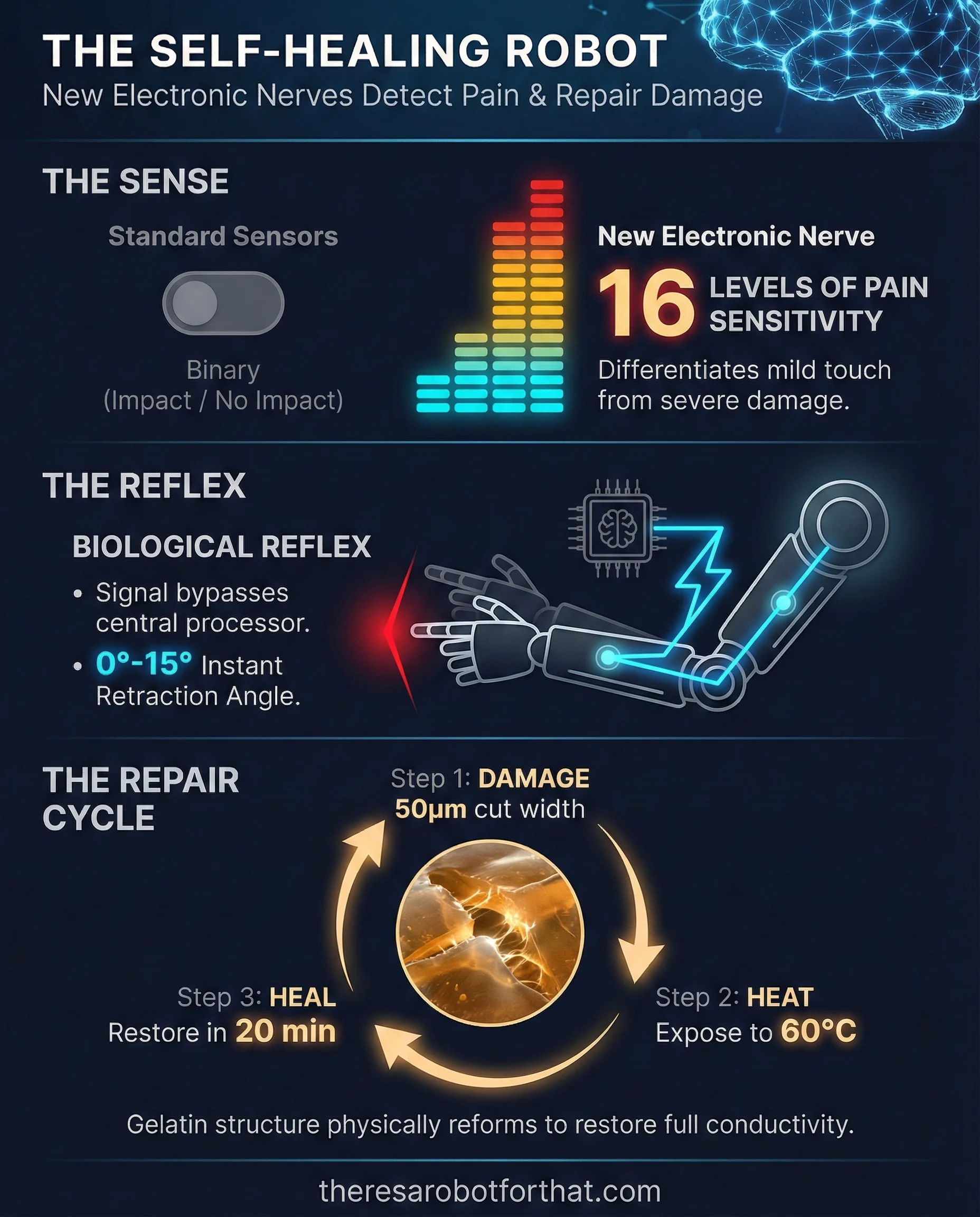
Image Source: Gemini / There's A Robot For That
Snapshot: Scientists at Northeast Normal University in China developed a self-healing electronic nerve that allows robots to detect damage intensity and trigger protective reflexes, potentially reducing maintenance costs and extending hardware lifespan in industrial applications.
Breakdown:
Takeaway: This technology is still 3-5 years from commercial deployment, but it signals a shift toward robots that protect themselves from damage rather than requiring constant human monitoring. The self-healing limitation (requiring 60°C) makes this more suitable for industrial robotics than human-adjacent applications, which narrows near-term use cases to manufacturing and warehouse environments where robots can periodically enter maintenance stations.
New VLA model unlocks 'millimeter-level' robot dexterity
Snapshot: Researchers from Peking University and Beijing Academy of AI have released RoboBrain-Dex, a vision-language-action model that achieves state-of-the-art success rates in complex dexterity tasks by training on high-precision human hand movement data.
Breakdown:
Takeaway: This research signals that dexterous manipulation—long considered robotics' hardest challenge—is progressing faster than many anticipated. Companies evaluating automation for tasks requiring fine motor control (assembly, quality inspection, delicate handling) should reassess their timelines, as the gap between human and robot dexterity is narrowing rapidly.
Other Top Robot Stories
Columbia demonstrated a humanoid robot face named Emo that synchronizes lip movements with speech across multiple languages by analyzing sound patterns rather than language meaning, addressing the uncanny valley effect that has limited acceptance of human-facing robots in customer service and hospitality applications.
Hainan released SPECNet, a vision model achieving 78% grasp success rates for sweet potato harvesting robots operating autonomously in sandy soil, field, and grassland environments, demonstrating that specialized agricultural robots can handle complex terrain where large-scale machinery struggles to operate.
Waymo announced readiness to bring fully autonomous vehicle service to New York state following Governor Hochul's support, signaling that the regulatory environment for commercial autonomous operations is expanding beyond California, Arizona, and Texas into additional major metropolitan markets.
🤖 Your robotics thought for today:
Realbotix's humanoids talked unscripted for two hours with zero cloud dependency while most enterprise AI still requires constant internet—so are we deploying conversational robots or just building fancy systems that break when WiFi drops?
Until tomorrow,
Uli


