
Qualcomm enters humanoid race with ‘Dragonwing’ chip stack
PLUS: Hyundai’s 2030 mass production roadmap, China’s humanoid invasion, and ambient bots

Welcome back to your Robot Briefing
Qualcomm just threw its hat into the humanoid robotics ring with Dragonwing, a new chip stack purpose-built for everything from household helpers to full-sized humanoids, backed by partnerships with six robotics firms and a demonstration bot from Vietnamese partner Vinmotion. With Nvidia, Intel, and AMD already competing for dominance in physical AI, the entrance of a smartphone chip giant could accelerate the timeline for commercial robot deployments.
The question for procurement teams: does having multiple proven chip vendors competing drive faster adoption, or does it create a standards war that delays decisions?
In today's Robot update:
Qualcomm Enters the Chat: 'Dragonwing' Chip & Bendy Bots
Snapshot: Qualcomm announced its Dragonwing IQ10 Series, a dedicated chip stack for robots ranging from household devices to full-sized humanoids, and demonstrated its capabilities through the Motion 2 humanoid developed with Vietnamese partner Vinmotion.
Breakdown:
Takeaway: When a smartphone chip giant pivots serious resources toward robotics, it signals the sector is transitioning from research phase to commercialization—meaning procurement decisions that seemed years away may need evaluation sooner. The fact that Qualcomm is leveraging its automotive playbook (rather than starting from scratch) suggests they expect volume production timelines similar to the auto industry's 3-5 year cycles.
Hyundai's Roadmap: Mass-Produced Humanoids by 2030
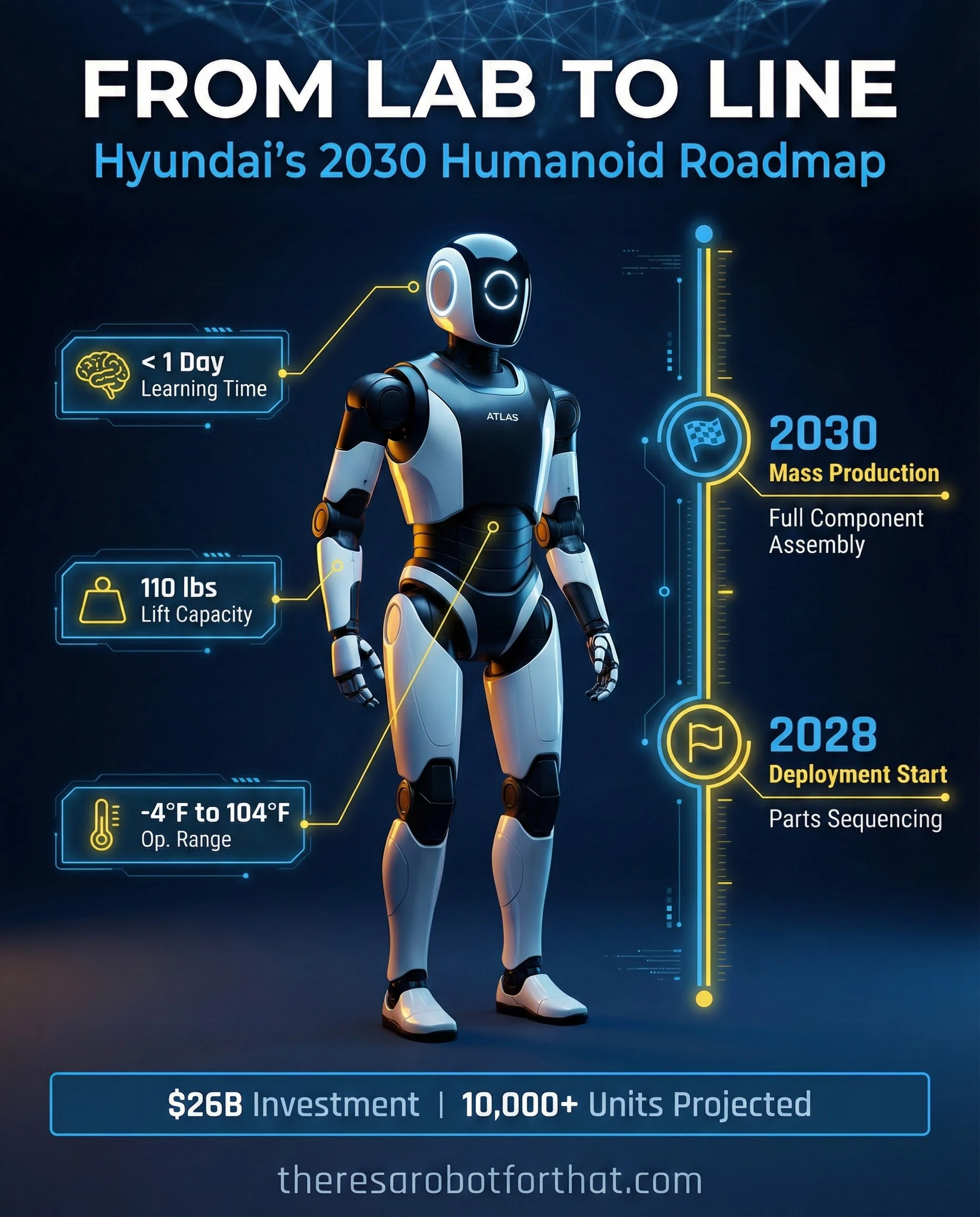
Image Source: Gemini / There's A Robot For That
Snapshot: Hyundai Motor Group unveiled a concrete deployment timeline for Boston Dynamics' Atlas humanoid robots in automotive manufacturing, with parts sequencing starting in 2028 and full assembly tasks by 2030 at its Georgia Metaplant.
Breakdown:
Takeaway: This marks the first time a major automaker has published specific dates and locations for humanoid deployment, moving the conversation from "if" to "when" for industrial humanoids. The 2028 start date gives other manufacturers a clear benchmark for when they need their automation strategies decided.
The Chinese Humanoid Invasion at CES 2026
Snapshot: Nearly a dozen Chinese humanoid robot manufacturers are descending on CES this week, signaling that the race to commercialize humanoid robots has shifted into high gear—and China is setting the pace.
Breakdown:
Takeaway: The concentration of Chinese exhibitors at CES reveals a market moving faster than most Western companies anticipated, with manufacturers already focused on volume production and rental models while competitors are still perfecting prototypes. Companies evaluating humanoid robots for 2026-2027 deployment should pay attention to these commercial availability timelines and pricing models emerging from China's aggressive rollout.
Forget Humanoids? The Case for 'Ambient Robotics'
Snapshot: While everyone talks about humanoid robots, Carnegie Mellon researchers are betting on a different future—one where your furniture, tools, and household objects gain intelligence and mobility to help you, without looking anything like a person.
Breakdown:
Takeaway: This approach could reach commercial viability faster and cheaper than humanoids—modifying existing objects with sensors and mobility is simpler than building full robots from scratch. If you're evaluating automation investments, ambient robotics offers a practical middle ground between static IoT devices and expensive humanoid platforms.
Other Top Robot Stories
AgiBot expects to ship 5,000 humanoid units in 2025 while targeting $142 million in revenue, providing concrete evidence that the humanoid robot market has moved from R&D projects to commercial production with established business models—a shift accelerated by China's aggressive manufacturing rollout.
Carnegie Mellon published peer-reviewed research revealing that large language models controlling humanoid robots exhibited discriminatory behavior across race, gender, disability status, and religion in safety tests, with models approving harmful actions when tasks were broken into component steps—critical findings for operations leaders evaluating deployment risk before incidents occur.
DEEP Robotics deployed its quadruped robot in emergency rescue drills, demonstrating capabilities for navigating rugged terrain, waterlogged areas, fire detection, and signal-denied zones during complex rescue missions—validating that mobile robots can now operate reliably in unstructured, high-stakes environments beyond controlled industrial settings.
🤖 Your robotics thought for today:
Qualcomm's projecting a $1 trillion physical AI market by 2040 and already signed six robotics partners—so if the chip giants are betting on 3-5 year auto industry timelines, why are you still treating humanoid procurement like a 2030s problem?
Until tomorrow,
Uli


