
New e-skin lets humanoids feel pain, react instantly
PLUS: China’s humanoid standards, Richtech’s CES debut, and Ukraine’s robot repair lines

Welcome back to your Robot Briefing
Electronic skin that lets humanoid robots sense pain and react reflexively—without waiting for their central processor—just moved from lab concept to published reality, thanks to a team at City University of Hong Kong.
The breakthrough addresses the core safety challenge that's kept humanoids out of unpredictable environments: can robots protect themselves and nearby humans through instinctive reactions rather than programmed responses? If reflexive self-protection becomes standard, deployment timelines for service robots in healthcare and hospitality could accelerate sharply.
In today's Robot update:
New E-Skin Lets Humanoids 'Feel' Pain and React Instantly
Snapshot: Researchers at City University of Hong Kong have developed a neuromorphic electronic skin that gives robots pain perception and instant protective reflexes, addressing a critical safety gap as humanoid robots move from factories into homes and hospitals. The team published their findings in the Proceedings of the National Academy of Sciences, demonstrating how bio-inspired sensory systems could enable safer human-robot interaction.
Breakdown:
Takeaway: This technology signals a shift from robots that simply detect touch to robots that can protect themselves and nearby humans through instinctive reactions. The combination of pain sensing, injury detection, and field-repairable components addresses three major barriers to deploying service robots in uncontrolled environments where humans are present.
China Launches National Humanoid Robot Standards Committee
Snapshot: China's Ministry of Industry and Information Technology established a 65-member committee to set national standards for humanoid robots, signaling Beijing's intent to lead the global race for commercial humanoid deployment.
Breakdown:
Takeaway: Standards bodies typically form 12-18 months before mass adoption begins, making this a concrete signal that China expects commercial humanoid deployment within the next two years. Companies evaluating humanoid pilots should watch how these standards influence global safety and interoperability requirements.
Richtech Robotics Brings Humanoid to CES
Snapshot: Richtech Robotics will demonstrate its NVIDIA-powered Dex humanoid at CES next week, showcasing logistics capabilities and real-time decision-making in a commercial setting rather than a lab environment.
Breakdown:
Takeaway: CES humanoid demonstrations have historically been concept showcases, but Richtech's existing robot deployments and NVIDIA backing suggest this demo reflects near-term commercial intent rather than pure R&D theater. Operations leaders should monitor CES announcements as leading indicators of which humanoid platforms might reach pilot-ready status in 2026.
Ukraine Scales 'War Robotics' with Automated Repair Lines
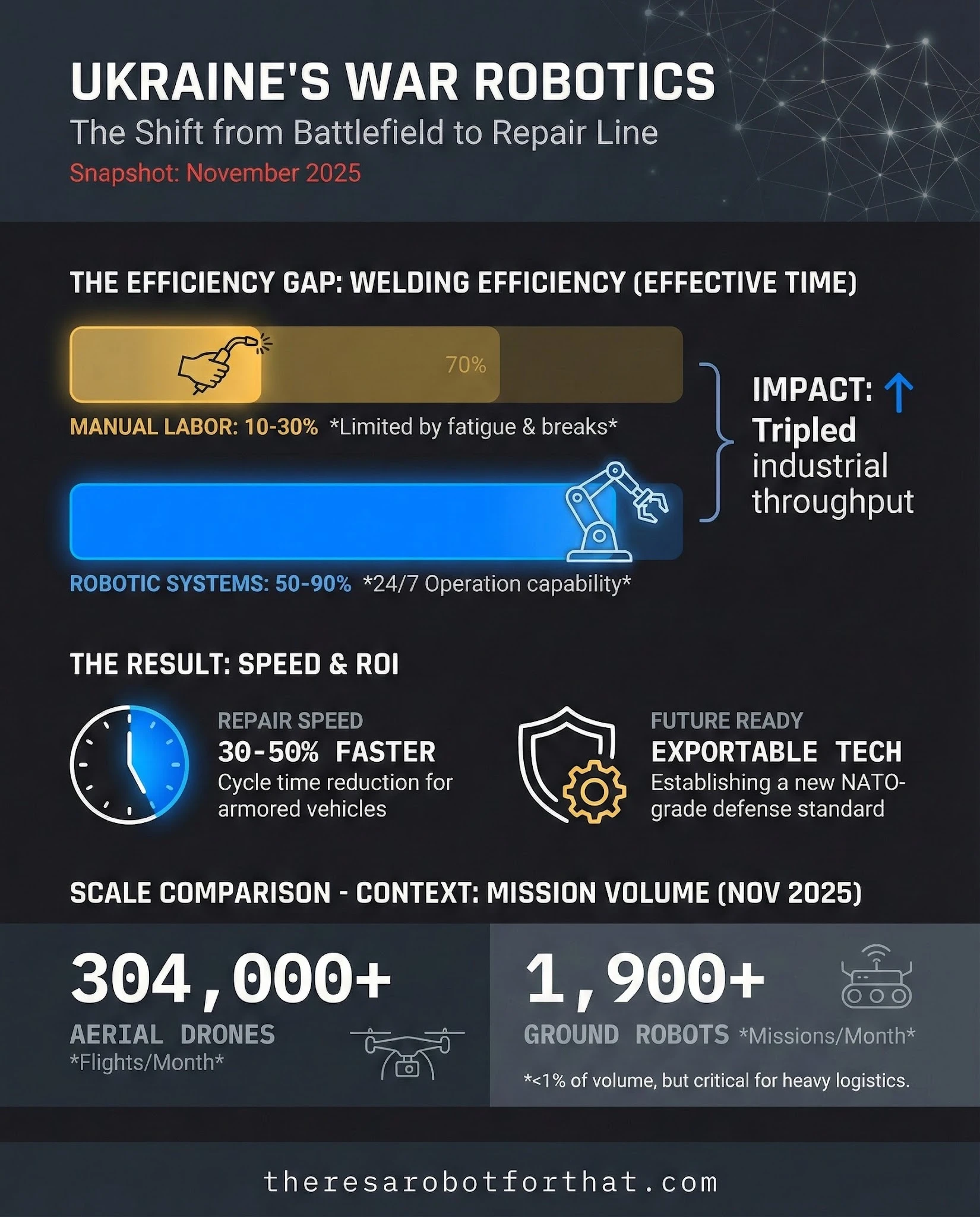
Image Source: Gemini / There's A Robot For That
Snapshot: Ukraine deployed ground robotic systems for nearly 2,000 combat missions in November while simultaneously rolling out industrial robots for automated welding and repair of heavy military equipment, revealing how warfare accelerates both mobile and stationary robotics adoption.
Breakdown:
Takeaway: High-stakes military repair operations provide the clearest real-world validation yet for industrial robotics ROI under extreme conditions—faster throughput, consistent quality, and continuous operation. Companies evaluating robotic automation for manufacturing or heavy equipment maintenance now have concrete benchmarks from an environment where downtime literally costs lives.
Other Top Robot Stories
Pudu demonstrated its D5 delivery robot climbing stairs at 1.5 meters per second in real-time footage, showcasing mobility capabilities that eliminate building access barriers for indoor logistics operations without requiring elevator infrastructure.
🤖 Your robotics thought for today:
City University's e-skin gives robots pain reflexes that bypass the brain entirely—so if we've cracked instant protective reactions, why are we still designing collaborative robots that move at half-speed around humans instead of building ones that react faster than we do?
What am I missing?
Have a great party tonight,
Uli


