
Morgan Stanley: China leads US 5-to-1 in humanoid patents
PLUS: Musk praises concert bots, Da Vinci 5 surgery, $5.8B milking market

Welcome back to your Robot Briefing
A new Morgan Stanley analysis reveals China's commanding position in humanoid robotics: 7,705 patents issued over five years versus just 1,561 in the US, translating into a supply chain advantage so significant it would triple the cost of building Tesla's Optimus without Chinese components.
The numbers force an uncomfortable question for any Western company planning humanoid deployments: can you build a viable business case when your unit economics are three times worse than competitors with access to China's manufacturing ecosystem?
In today's Robot update:
China leads US 5-to-1 in humanoid patents
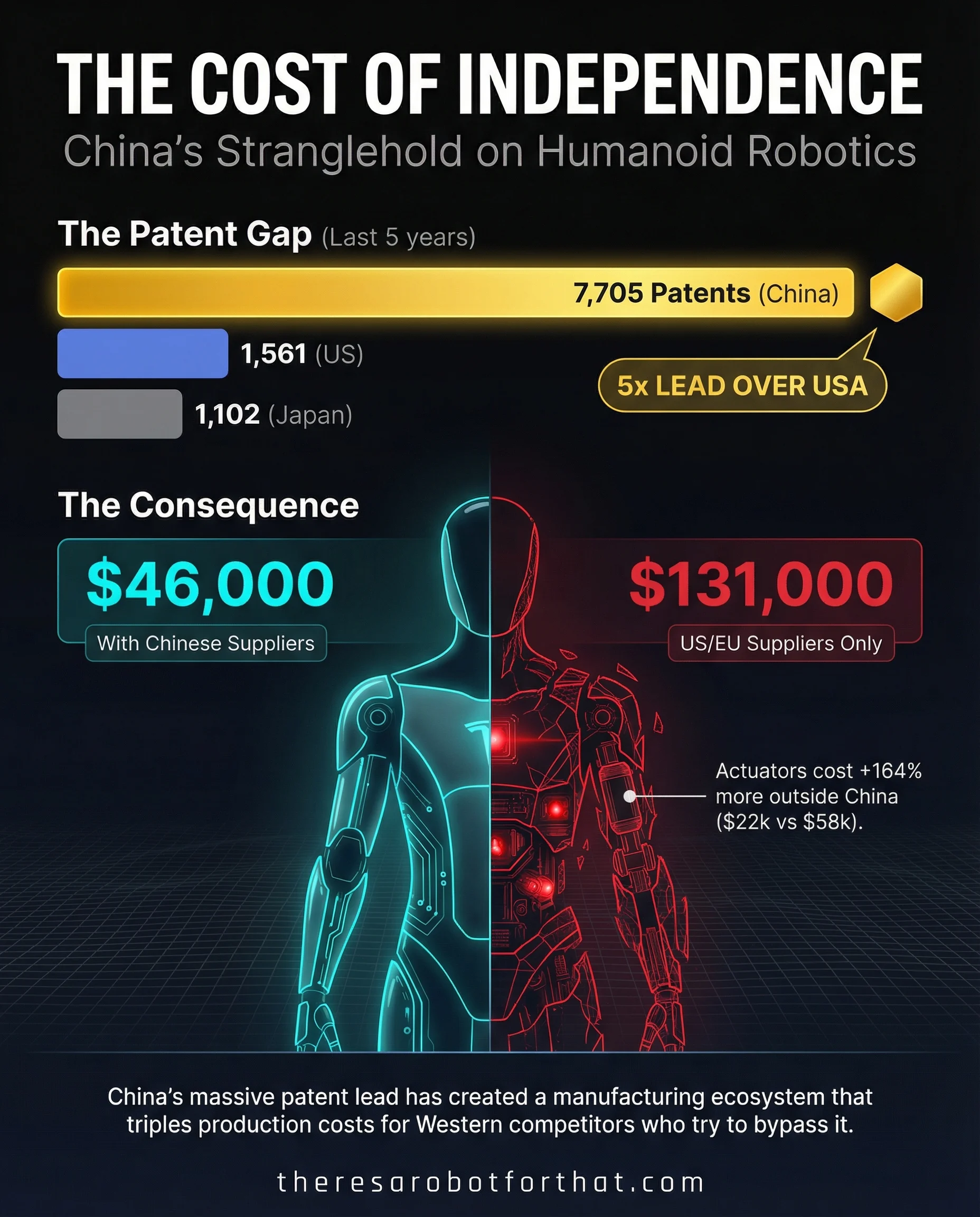
Image Source: Gemini / There's A Robot For That
Snapshot: Morgan Stanley reports that China has issued five times more humanoid robot patents than the US over the past five years, creating a massive supply chain cost advantage that Western companies can't easily replicate.
Breakdown:
Takeaway: This isn't just about patents—it's about the operational reality that any Western company building humanoids at scale will face a stark choice between cost competitiveness and supply chain independence. Companies planning humanoid deployments need to factor in either significantly higher unit costs or geopolitical supply chain risks into their business cases.
Humanoid robots perform at concert
Snapshot: Six humanoid robots performed synchronized dance routines alongside singer Wang Leehom at a live concert, demonstrating balance and coordination in an uncontrolled environment that caught Elon Musk's attention as "impressive."
Breakdown:
Takeaway: Concert performances serve as high-stakes stress tests that validate whether humanoid robots can handle dynamic, unpredictable environments beyond the controlled factory floor. Companies evaluating humanoid deployment should watch for more of these public demonstrations as leading indicators of commercial readiness.
Da Vinci 5 robot performs first public surgery in Poland
Snapshot: Poland's Wielkopolskie Oncology Centre completed its first surgeries with the 5th-generation Da Vinci surgical robot this week, marking the first public hospital deployment of the latest model in the country.
Breakdown:
Takeaway: When public hospitals in mid-sized European markets are routine buyers of generation-5 surgical robots, this technology has crossed into mainstream infrastructure. The rapid fleet expansion in Poland suggests healthcare systems are treating robotic surgery as essential capability, not optional innovation.
Milking robots market to hit $5.8B by 2029
Snapshot: Dairy farms are rapidly automating milking operations as the market races toward $5.8 billion by 2029, driven by acute labor shortages and the promise of round-the-clock productivity without adding headcount.
Breakdown:
Takeaway: This isn't experimental technology anymore—it's production-ready automation solving an immediate business problem that manufacturers face too. Any operation struggling with labor availability and shift coverage should watch how dairy farms justify ROI on six-figure robots that work 24/7.
🤖 Your robotics thought for today:
China's 7,705 humanoid patents give them a 5-to-1 advantage over the US and triple the cost advantage—so are Western robotics companies building products or just designing themselves into irrelevance?
What am I missing?
Until tomorrow,
Uli


