
Mobileye acquires humanoid maker Mentee in $900M deal
PLUS: Agibot ships 5,000 units, China’s data factories, inflatable apple pickers
Welcome back to your Robot Briefing
Mobileye is spending $900 million to acquire humanoid startup Mentee Robotics, betting it can transplant the AI 'brain' from its autonomous vehicles into bipedal robots. The deal represents one of the largest humanoid acquisitions on record and comes with a concrete commercialization roadmap: proof-of-concept deployments in 2026, series production by 2028.
The acquisition signals that major players see humanoids crossing from research curiosity to deployment-ready automation tool within the next two years. With target pricing potentially dropping to $20,000 per unit at scale, the key question for operations leaders becomes: is your automation roadmap prepared for humanoids to become viable alternatives to human labor in warehouses and factories by 2028?
In today's Robot update:
Mobileye Bets $900M on Humanoids
Snapshot: Autonomous driving giant Mobileye is acquiring humanoid startup Mentee Robotics for $900 million, aiming to transfer its self-driving 'brain' technology into bipedal robots. This marks one of the largest humanoid robotics acquisitions to date and signals that the technology is moving beyond R&D into industrial deployment.
Breakdown:
Takeaway: This acquisition provides the clearest timeline yet for when humanoid robots move from prototype to production tool. Companies planning automation strategies should watch 2026-2028 closely as the window when humanoids transition from science project to viable labor alternative in controlled industrial environments.
Agibot Ships 5,000 Units, Gets NVIDIA Nod
Snapshot: Chinese robotics firm Agibot claims to have shipped over 5,000 humanoid robots and was the only Chinese humanoid company highlighted by Jensen Huang during NVIDIA's CES keynote. With its '1 Robotic Body, 3 Intelligences' architecture, Agibot is positioning itself as a leader in mass production, challenging the perception that humanoids are still just prototypes.
Breakdown:
Takeaway: Chinese robotics firms are demonstrating faster progress on mass production than many Western operations leaders may realize, compressing the timeline for when humanoid deployment becomes a competitive necessity rather than a future consideration. Companies waiting for Western vendors to mature the market may find themselves playing catch-up to Chinese manufacturers who are already collecting real-world data at scale.
Inside China's 'Robot Data Factories'
Snapshot: China's local governments are funding facilities where human workers perform repetitive tasks like folding clothes hundreds of times daily to generate training data for humanoid robots, but researchers question whether this labor-intensive approach will actually work.
Breakdown:
Takeaway: China is making a coordinated industrial-policy bet on scaling robot training through human demonstration, similar to how it built the EV industry, but the approach's effectiveness isn't proven yet. This matters because if this data-intensive method fails while competitors succeed with simulation or other techniques, billions in government investment could be wasted and the timeline for commercially viable robots could shift significantly.
Inflatable Robots Tackle the Apple Harvest
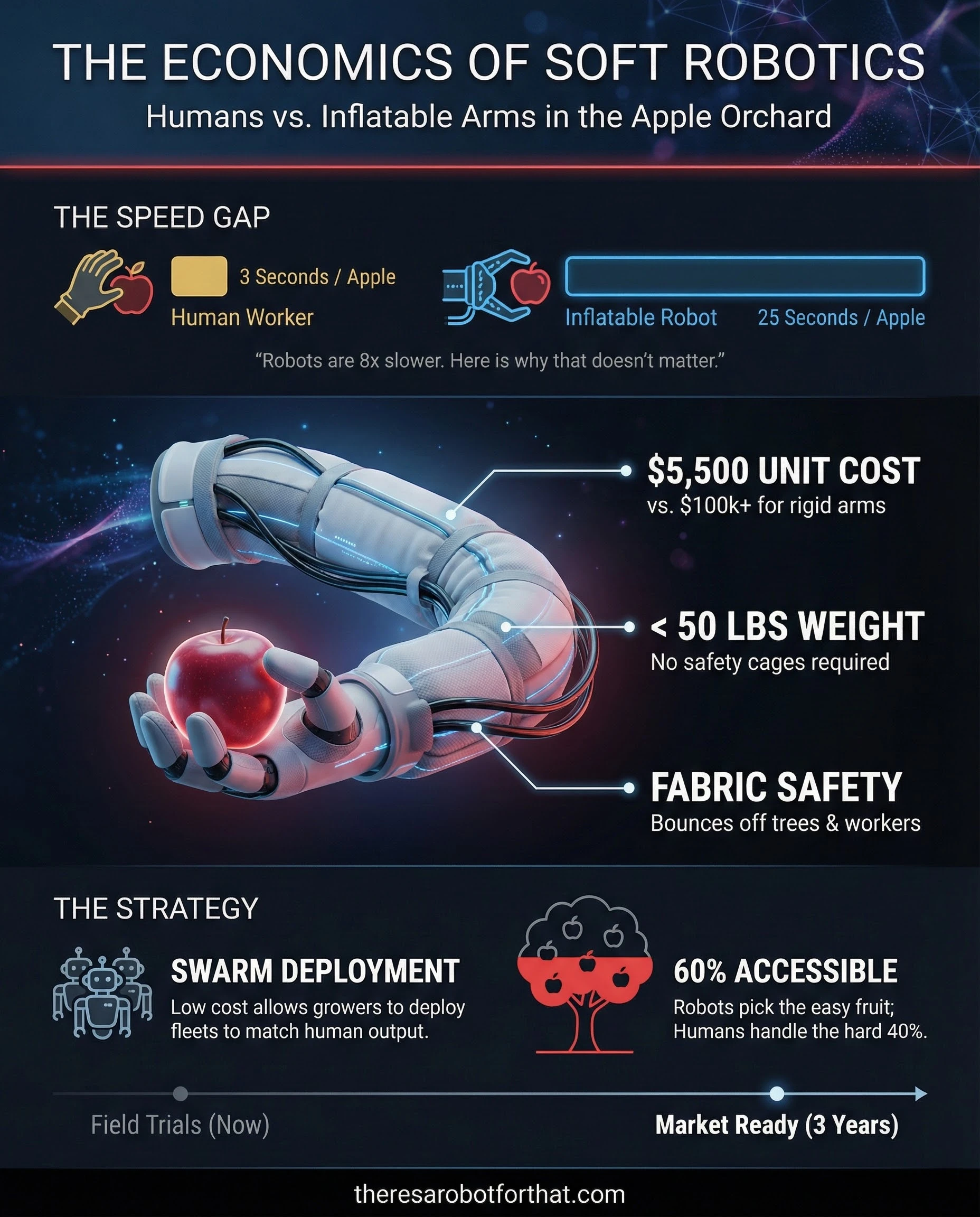
Image Source: Gemini / There's A Robot For That
Snapshot: Washington State University researchers developed a low-cost inflatable robot that picks apples for $5,500—a fraction of rigid industrial alternatives—as labor shortages threaten the state's $2+ billion apple industry.
Breakdown:
Takeaway: This marks a practical path for soft robotics in agriculture, where ultra-low unit costs enable fleet deployment rather than trying to match human speed with expensive individual machines. The 3-year commercialization window puts this in the realistic planning horizon for operations leaders evaluating automation investments.
Other Top Robot Stories
Johnson&Johnson submitted its Ottava soft tissue robotic surgery system to the FDA for de novo classification in general surgery, targeting multiple upper abdomen procedures including gastric bypass and hernia repair, with commercialization planned for 2028 as competition intensifies against Intuitive Surgical's decades-long market dominance.
QwikOS launched the world's first universal operating system and app store for open-SDK humanoid robots, now available on iOS and Android, providing developers a hardware-agnostic platform to deploy features across multiple robot brands while giving consumers a single interface to control and extend their robots without needing software development expertise.
PaXini unveiled a complete tactile infrastructure for embodied AI at CES 2026, showcasing full-body 6-axis force/torque sensing ecosystems and the DexH13 multidimensional tactile dexterous hand with 1,140 tactile processing units, alongside an omni-modality data acquisition system capable of producing 200 million data entries annually to address the industry's critical shortage of physical contact training data.
🤖 Your robotics thought for today:
Mobileye's dropping $900M on humanoids before their self-driving tech is even profitable—does that mean the robotics business case is actually clearer than autonomous vehicles, or are we watching another decade of billion-dollar bets on "almost ready" technology?
What's your take?
Until tomorrow,
Uli


