
Midea’s 6-armed robot signals 2026 price war
Why function beats form PLUS: First fully robotic microsurgery in the US

Welcome back to your Robot Briefing
China's 2026 robotics playbook is taking shape, and it prioritizes function over form: Midea's six-armed wheeled robot signals a strategic bet on practical capability and price competition rather than humanoid aesthetics. With Chinese manufacturers now producing 90% of components domestically and targeting 1 million units by 2030, Western companies face a market reset.
The question for businesses evaluating automation: will you optimize for robots that look human, or for systems that win on economics and capability?
In today's Robot update:
China's 2026 roadmap: 6-armed 'super humanoids' and price wars
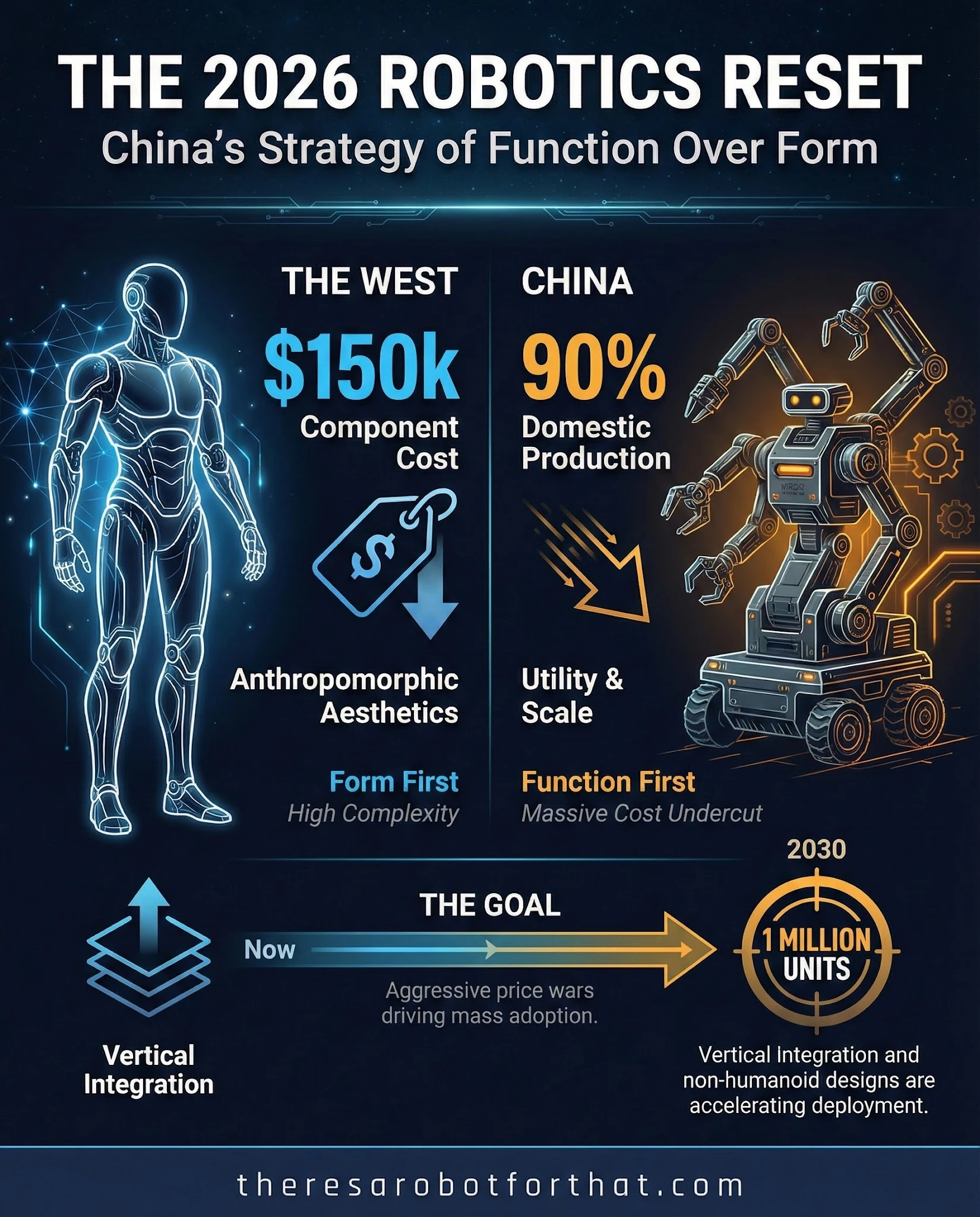
Image Source: Gemini / There's A Robot For That
Snapshot: Chinese appliance giant Midea unveiled a six-armed robot that abandons human-like form for pure function, signaling China's 2026 strategy to dominate robotics through practical designs and aggressive price competition rather than anthropomorphic aesthetics.
Breakdown:
Takeaway: The robotics price war arrives in 2026, and it won't be won by whoever builds the most human-looking robot. Companies evaluating robotics deployments should prepare for a market where Chinese manufacturers compete on cost and practical capability rather than form factor, fundamentally resetting expectations around robotics economics.
Surgical robots achieve sub-millimeter precision milestone
Snapshot: Surgeons at Tampa General Hospital completed the first fully robotic lymphovenous bypass in the U. S., connecting vessels smaller than a millimeter using the Symani Surgical System with newly FDA-cleared NanoWrist instruments. This marks a shift from robotic assistance to fully autonomous execution in microsurgery.
Breakdown:
Takeaway: The one-month timeline from installation to performing a first-in-nation procedure signals that surgical robotics is past the experimental phase for specialized applications. Hospitals investing in sub-millimeter precision platforms are gaining competitive advantages in microsurgery cases that traditional techniques struggle to address effectively.
🤖 Your robotics thought for today:
Midea's six-armed wheeled robot costs a fraction of humanoid designs but does more work—so why are we still burning cash making robots look like us instead of building them to actually beat us?
Until tomorrow,
Uli


