
Foundation building 50,000 lethal humanoids for US military
PLUS: Samsung delays home bots, FDA clears surgical robot, and shape-shifting farm robots raise $14M
Welcome back to your Robot Briefing
A Silicon Valley startup called Foundation just announced plans to build 50,000 Phantom humanoid robots by late 2027, targeting U. S. military contracts for armed combat units that can carry weapons alongside commercial factory work.
The company's CEO argues robots in warfare should be deadly, not docile, with plans to lease each unit for $100,000 annually. This marks the first major humanoid maker to explicitly embrace lethal military applications at scale. Could deploying tens of thousands of armed robots actually prevent conflicts through deterrence, or does this cross a line the industry has carefully avoided until now?
In today's Robot update:
Startup Plans 50,000 'Lethal' Humanoids for War and Work
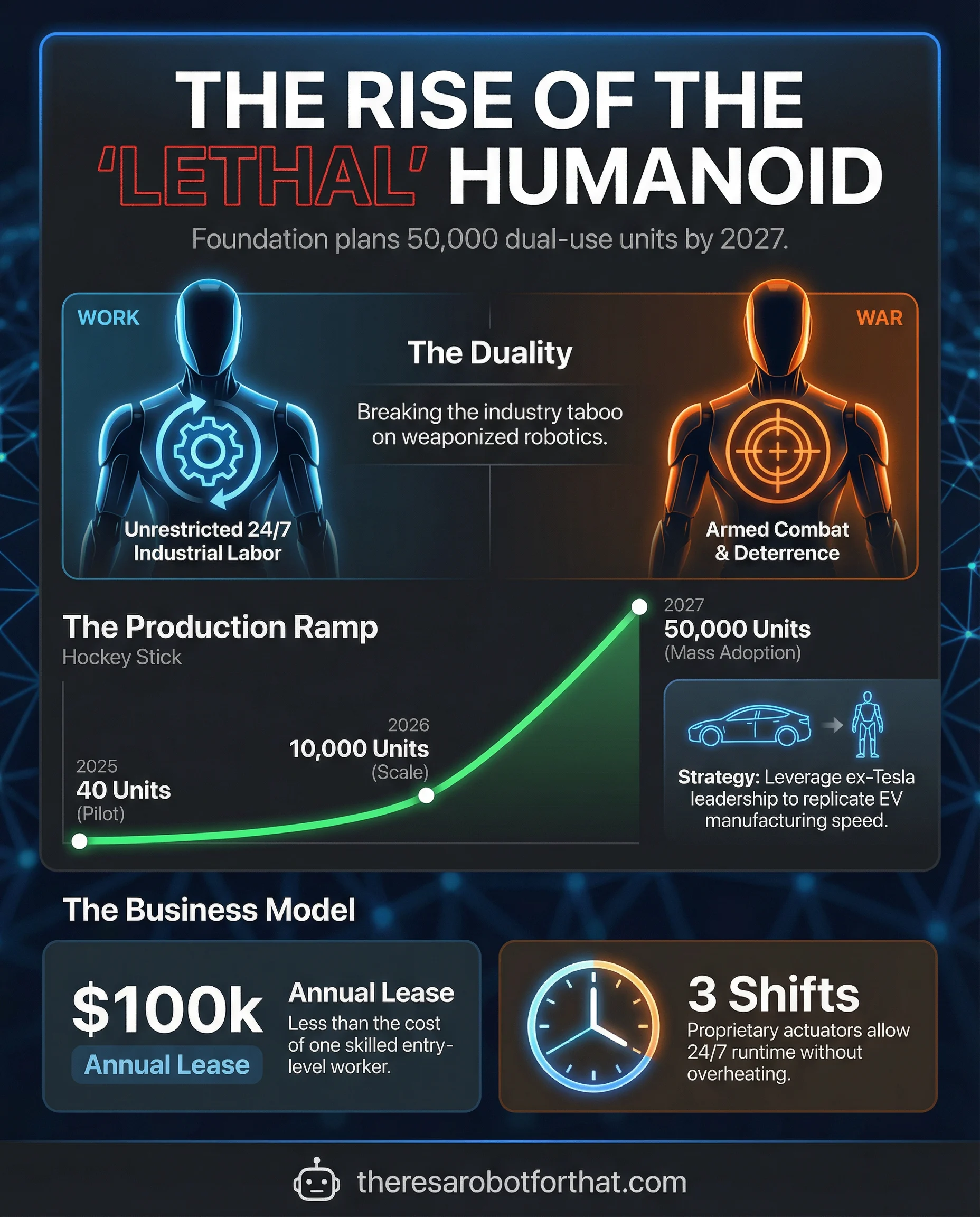
Image Source: Gemini / There's A Robot For That
Snapshot: Silicon Valley startup Foundation emerged from stealth with plans to manufacture 50,000 Phantom humanoid robots by late 2027, explicitly pursuing U. S. military contracts for robots capable of carrying weapons into combat alongside commercial factory deployments.
Breakdown:
Takeaway: Foundation breaks from the industry norm by explicitly embracing military applications, arguing that deploying 100,000 armed robots could deter conflicts by demonstrating overwhelming robotic capability. The aggressive timeline and dual-use strategy could reshape both factory automation and asymmetric warfare if they execute on manufacturing scale.
Home Bot Reality Check: Samsung Delays, 1X Pivots to Factories
Snapshot: Samsung and LG have indefinitely postponed their consumer home robots due to technical challenges, while humanoid startup 1X Technologies shifts its Neo robot from homes to factory floors until at least 2030.
Breakdown:
Takeaway: The simultaneous retreat from consumer markets by major players signals that home robots need more development time before they can reliably handle domestic chaos. Companies are choosing the safer path of factory deployments where controlled environments allow robots to prove their value before tackling the messy reality of human homes.
CMR Surgical Grabs FDA Clearance for 'Versius Plus' Robot
Snapshot: CMR Surgical secured FDA 510(k) clearance for its Versius Plus surgical robot system, featuring upgraded vLimeLite imaging technology for minimally invasive procedures. The company plans a commercial U. S. launch in 2026, starting with gallbladder removal surgeries.
Breakdown:
Takeaway: This clearance positions CMR to challenge established players in the U. S. robotic surgery market by emphasizing flexibility and operational efficiency that could appeal to resource-conscious healthcare systems. The company's focus on making robotic surgery more accessible through adaptable technology could accelerate adoption beyond major medical centers into community hospitals.
'Shape-Shifting' Ag Robots Raise $14M for Tough Terrain
Snapshot: Shenzhen-based Percisphere raised over 100 million RMB ($14M) in pre-Series A funding to scale its modular agricultural robots that automatically adjust their wheelbase and height to navigate rugged terrain.
Breakdown:
Takeaway: Percisphere's approach tackles agriculture's dual challenge of labor scarcity and environmental sustainability by making precision farming economically viable at scale. The modular design that transforms one platform into multiple specialized tools could accelerate adoption in markets where buying separate machines for each task remains prohibitively expensive.
Other Top Robot Stories
Wageningen develops conversational AI interface allowing farmers to communicate with agricultural robots using natural language, similar to ChatGPT, eliminating the need to navigate multiple apps and control systems.
Science Friday examines the gap between humanoid robot hype and reality, discussing what these machines can actually do today versus futuristic promises from companies racing to deploy them in homes and workplaces.
Waymo released updated safety data covering over 127 million fully autonomous miles driven through September 2025, representing the equivalent of more than 150 human driving lifetimes.
🤖 Your robotics thought for today:
Foundation's betting $100K/year leases will fund 50,000 armed humanoids by 2027 while Boston Dynamics won't weaponize theirs—does the military contract money make one strategy smarter or just more dangerous?
What's your take?
Until tomorrow,
Uli


