
Figure 03 enables cable-free charging via wireless power
PLUS: Microsoft’s industrial humanoid and 1X NEO launching

Welcome back to your Robot Briefing
Figure's latest humanoid can now walk up to a charging pad and power itself back up without any cables or human help. The company built a wireless charging system from scratch because nothing on the market could handle the power requirements for a full-size humanoid that needs to work multiple shifts.
As more robotics companies chase deployment at scale, the infrastructure around the robot — charging, fleet management, maintenance — may matter as much as the robot itself. Can companies justify humanoid investments if each unit still needs dedicated charging stations and custom facility modifications?
In today's Robot update:
Figure 03 Cuts the Cord with Wireless Charging
Snapshot: Figure has equipped its Figure 03 humanoid robot with wireless inductive charging that lets the robot autonomously recharge by stepping onto a charging pad, eliminating cables and enabling continuous operation throughout the day.
Breakdown:
Takeaway: Infrastructure innovations like autonomous charging are becoming key differentiators that separate lab demos from deployment-ready systems. Companies evaluating humanoid robots should now assess not just task capability but the complete operational ecosystem required for autonomous multi-shift operation.
Microsoft & Hexagon Deploy Industrial Humanoid 'AEON'
Snapshot: Microsoft has joined forces with Hexagon Robotics to deploy AEON, an industrial humanoid robot designed for inspection and maintenance tasks, powered by Azure AI and targeting automotive, aerospace, and manufacturing sectors. The partnership announcement signals that cloud giants now view industrial humanoids as commercially viable, not just research projects.
Breakdown:
Takeaway: Microsoft's direct involvement moves industrial humanoids from the "interesting concept" category into the "evaluate for 2026-2027 deployment" timeline for mid-sized manufacturers. Companies in automotive, aerospace, and logistics now have a clear enterprise-grade option backed by familiar cloud infrastructure rather than betting on startup robotics vendors.
ByteDance Cracks the Dexterity Data Problem
Snapshot: ByteDance researchers partnered with MANUS to build ByteDexter, a system that uses high-fidelity data gloves to train robots on complex manipulation tasks, boosting success rates from 45% to 85% on previously unseen objects.
Breakdown:
Takeaway: This tackles the expensive, time-consuming problem of generating training data for dexterous robots—the kind of barrier that's kept human-level manipulation in research labs rather than factory floors. Companies evaluating robotic manipulation should watch whether this data collection approach gets adopted more broadly, as it could accelerate the timeline for deploying capable systems from years to months.
Domestic robots are finally coming home in 2026
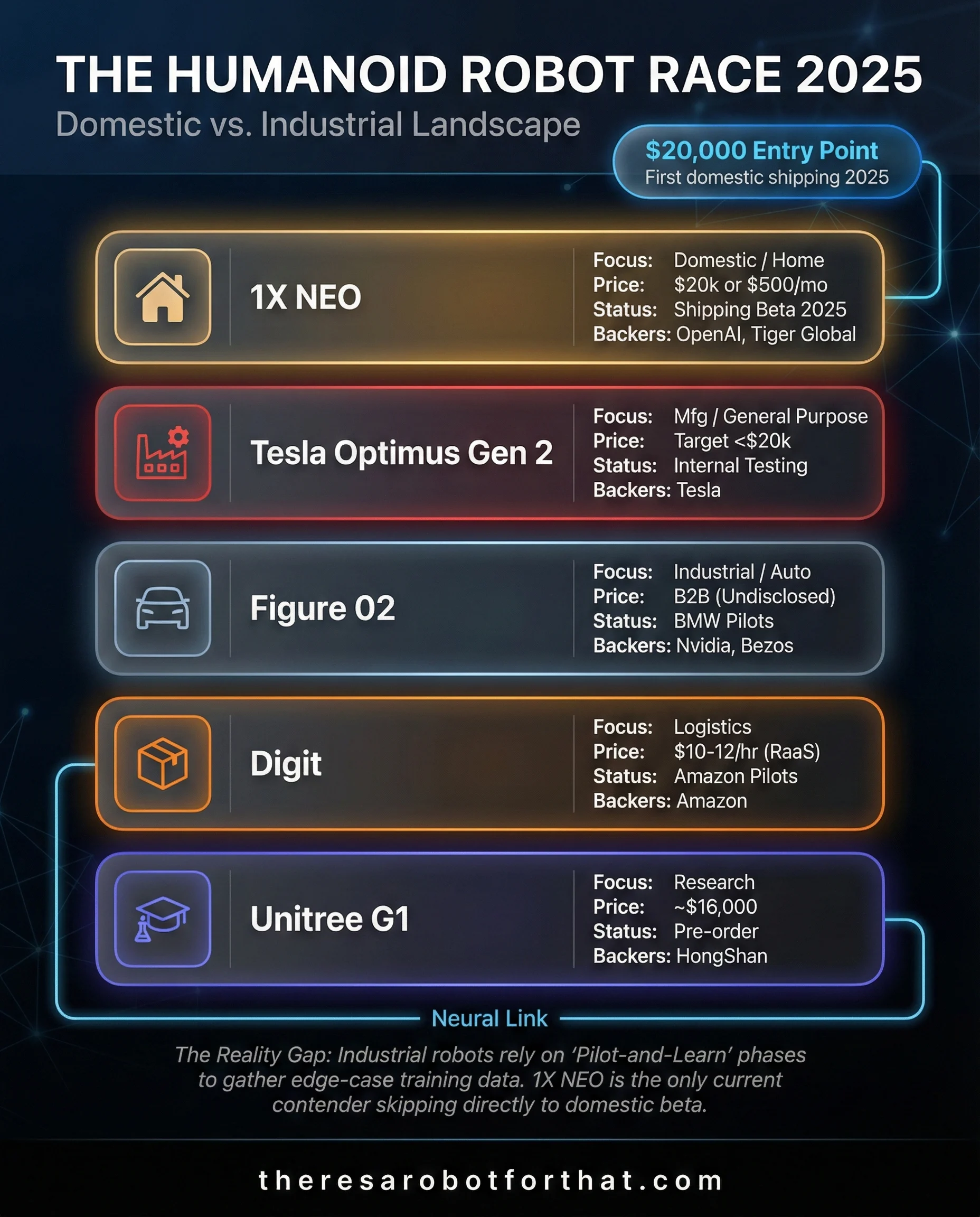
Image Source: Gemini / There's A Robot For That
Snapshot: 1X's NEO humanoid is launching to customers this year at $20,000, marking the first wave of multi-purpose domestic robots actually shipping to homes—finally putting a price and timeline on technology that's been promised for decades.
Breakdown:
Takeaway: This shifts the timeline from "someday" to "now" for companies with capital to deploy early-stage automation, but the heavy reliance on human teleoperation means this is still a pilot-and-learn phase rather than plug-and-play readiness. Smart operations leaders should track how these first deployments perform over the next 12-18 months before committing budgets.
Other Top Robot Stories
WIRobotics showcased its WIM S wearable walking-assist robot and ALLEX humanoid at CES 2026, drawing attention for having supplied wearable robots to consumers for three years before most competitors entered the market, with active discussions underway with NVIDIA, Meta, and Amazon regarding technical collaboration on humanoid applications.
Astute projects the global digital surgery technologies market will surge from $712.9 million in 2024 to $6.48 billion by 2033 at a 27.4% CAGR, driven by AI integration, robotics, and AR/VR technologies that are transforming surgical precision and training across healthcare systems worldwide.
Dyna presented its approach to general-purpose foundation models for physical tasks at CES 2026, with CEO Lindon Gao discussing how the company is scaling diverse manipulation capabilities to commercial deployment while their robot autonomously folded laundry in the background during the interview."
🤖 Your robotics thought for today:
Figure 03 autonomously docks itself for wireless charging throughout the day while most warehouse robots still need humans to swap batteries or plug in cables—so are we designing automation systems or just expensive supervised equipment?
Until tomorrow,
Uli


