
‘Dark factories’ cut operating costs by 60%
PLUS: Japan’s physical AI deficit, Unitree clarifies viral kick, GITAI’s moon rover

Welcome back to your Robot Briefing
Manufacturers are now building "dark factories" stripped of lighting, climate control, and human workspaces—facilities designed exclusively for robots that slash operating costs by up to 60% while running 24/7. As robot labor costs drop from $10 per hour today to a projected 25 cents within a decade, these robot-first facilities eliminate the 30-40% of floor space currently wasted on human needs.
The economics are brutal: companies that wait to retrofit existing factories will face permanent cost disadvantages against competitors building for robots from day one. With China already investing $13.8 billion and projecting 59 million humanoid units by 2050, how quickly can Western manufacturers transition before the gap becomes insurmountable?
In today's Robot update:
The Rise of the "Dark Factory"
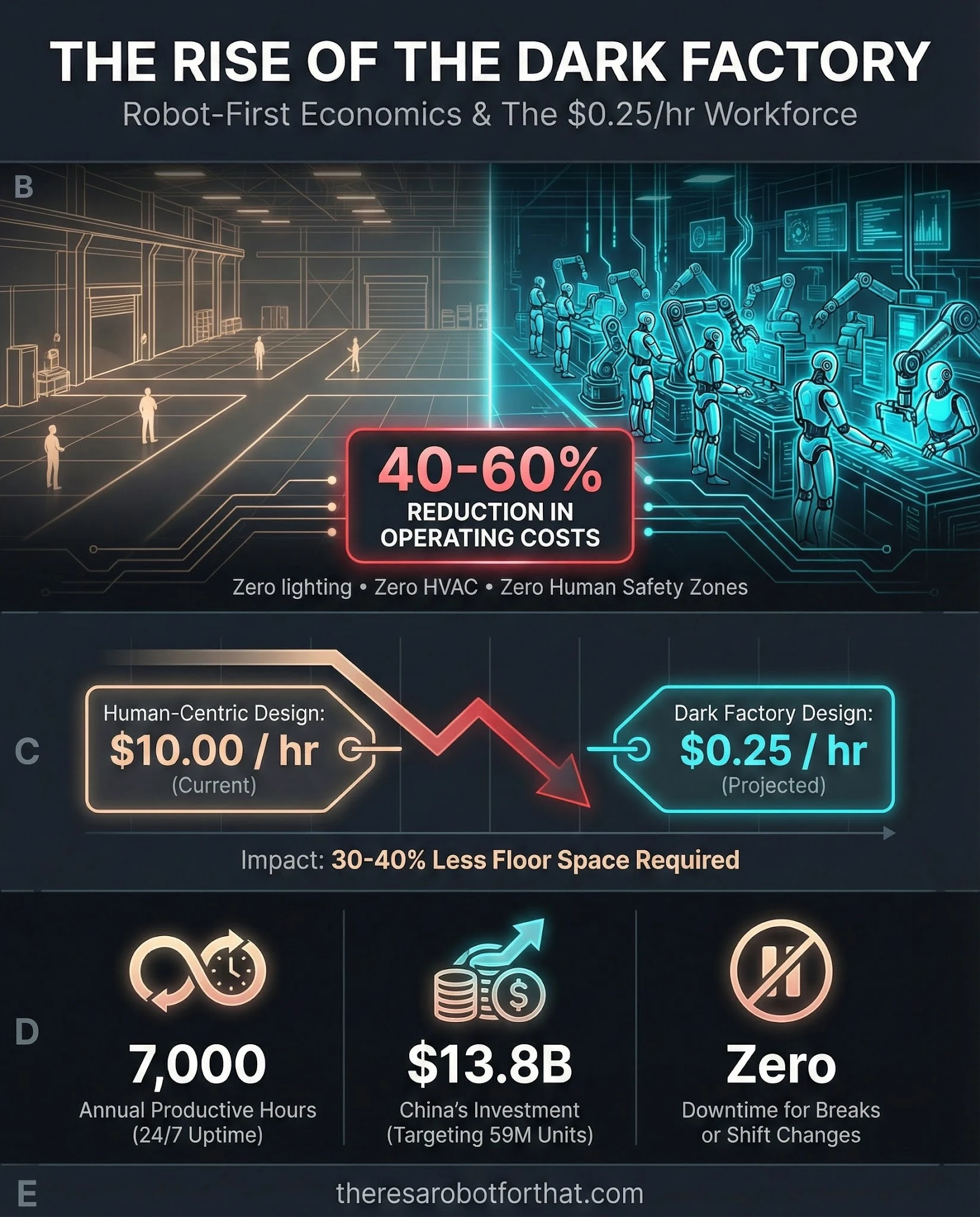
Image Source: Gemini / There's A Robot For That
Snapshot: Manufacturing experts argue facilities designed exclusively for humanoid robots—eliminating lighting, climate control, and human workspaces—can cut operating costs by 40-60% while enabling 24/7 production that's impossible in human-centric environments.
Breakdown:
Takeaway: The question isn't whether to build robot-optimized facilities but how quickly your company can transition before competitors gain an insurmountable cost advantage. Companies that retrofit existing human-centric factories will face structural cost disadvantages against those who design for robots from the ground up.
Japan Fights to Avert "Digital Defeat"
Snapshot: Japan's government warns of an impending "digital defeat" as the nation's 38% share of global industrial robot production masks a critical weakness: its companies lack the AI software and data infrastructure that U. S. and Chinese competitors are using to dominate physical AI.
Breakdown:
Takeaway: This isn't just Japan's problem—it's a preview of what happens when hardware leaders underinvest in the software and data infrastructure that increasingly drives robotics value. Operations executives evaluating robotics vendors should ask pointed questions about their AI capabilities and data ecosystem, not just their mechanical specifications.
Unitree Debunks Viral "Robot Kick"
Snapshot: A viral video showing a Unitree G1 robot kicking an engineer drew commentary from Elon Musk and Tesla's Cybertruck chief engineer, but the incident reveals more about current teleoperation technology than rogue robots.
Breakdown:
Takeaway: This incident highlights a critical distinction business leaders must understand: most impressive humanoid robot demonstrations today rely on teleoperation (human control) rather than autonomous decision-making, which affects both deployment timelines and safety protocols. Companies evaluating humanoid robots need to assess whether vendors are selling teleoperation capabilities or true autonomy, as the infrastructure and risk profiles differ substantially.
GITAI Demos Centaur Rover for Moon Ops
Snapshot: Space robotics startup GITAI demonstrated a centaur-style rover combining wheeled mobility with dexterous robotic hands to collect lunar regolith samples in a simulated moon environment. This marks another step toward autonomous surface operations that could eventually inform terrestrial industrial applications.
Breakdown:
Takeaway: Lunar robotics serves as a proving ground for autonomous manipulation in extreme conditions, offering insights into when similar capabilities might scale to Earth-based industrial settings. Companies mastering unstructured environment autonomy in space will likely have advantages when these technologies transfer to warehouses, construction sites, and hazardous industrial environments.
Other Top Robot Stories
DEEP Robotics enables intelligent patrol operations across industrial parks and public facilities using physical AI, offering automated surveillance that enhances safety and operational consistency without human fatigue limitations or scheduling constraints.
NVIDIA emerges as a key player in robotics foundation models, positioning the GPU giant to provide the AI infrastructure layer that could become as critical to humanoid deployment as their chips are to data centers today.
Agriculture robots are projected to grow from a $12.2 billion market this year to $139.4 billion by 2035 at a 24.78% CAGR, driven by labor shortages and the need to feed 10 billion people by 2050, with milking robots currently dominating market share while UAVs show the fastest growth trajectory.
Humanoid demonstrated its HMND 01 robot attempting to gift wrap presents with bows and tinsel, highlighting the iterative learning process required to teach humanoids fine motor tasks that humans take for granted—a reminder that dexterity development remains the key bottleneck before these machines handle real-world manipulation at scale.
🤖 Your robotics thought for today:
If cutting lights and HVAC from factories saves 40-60% on costs while China's already building dark facilities for their projected 59 million humanoids, why are Western manufacturers still renovating buildings designed for human comfort instead of robot productivity?
What am I missing?
Until tomorrow,
Uli


