
CATL achieves world’s first scale deployment of humanoids
PLUS: RealMan open-sources robot dataset, China’s robot bubble fears, and Moon Surgical adds Nvidia AI
Welcome back to your Robot Briefing
CATL just crossed a manufacturing milestone that everyone's been waiting for: humanoid robots working at scale on battery production lines at their Zhongzhou facility, hitting a 99% success rate on high-voltage testing tasks. After years of demos and prototypes, this deployment proves humanoids can handle complex, dangerous work with consistency that matches human experts.
The real question: is this the tipping point where embodied AI moves from experimental to essential across manufacturing?
In today's Robot update:
CATL Achieves World's First Scale Deployment of Humanoids
Snapshot: Battery giant CATL has successfully deployed 'Moz' humanoid robots on its production lines at the Zhongzhou facility, marking the world's first large-scale implementation of humanoid robots in battery pack manufacturing with a 99% success rate.
Breakdown:
Takeaway: This deployment demonstrates that humanoid robots can now handle complex, high-risk manufacturing tasks at scale with reliability that matches or exceeds human performance. The success validates the practical application of embodied AI in production environments where precision, safety, and adaptability are critical requirements.
RealMan Open-Sources Large-Scale Robot Training Dataset
Snapshot: RealMan Robotics released RealSource, a comprehensive multi-modal dataset captured from 10 real-world scenarios to help developers train embodied AI models. The dataset provides complete perception-decision-execution data including RGB images, joint angles, force sensing, and action commands.
Breakdown:
Takeaway: This open-source release addresses a critical shortage of real-world robot training data that currently limits embodied AI development. RealMan plans to expand the dataset with additional scenarios and modalities while building an ecosystem that connects research teams with industrial deployment needs.
Is China's Robot Boom Becoming a Bubble?
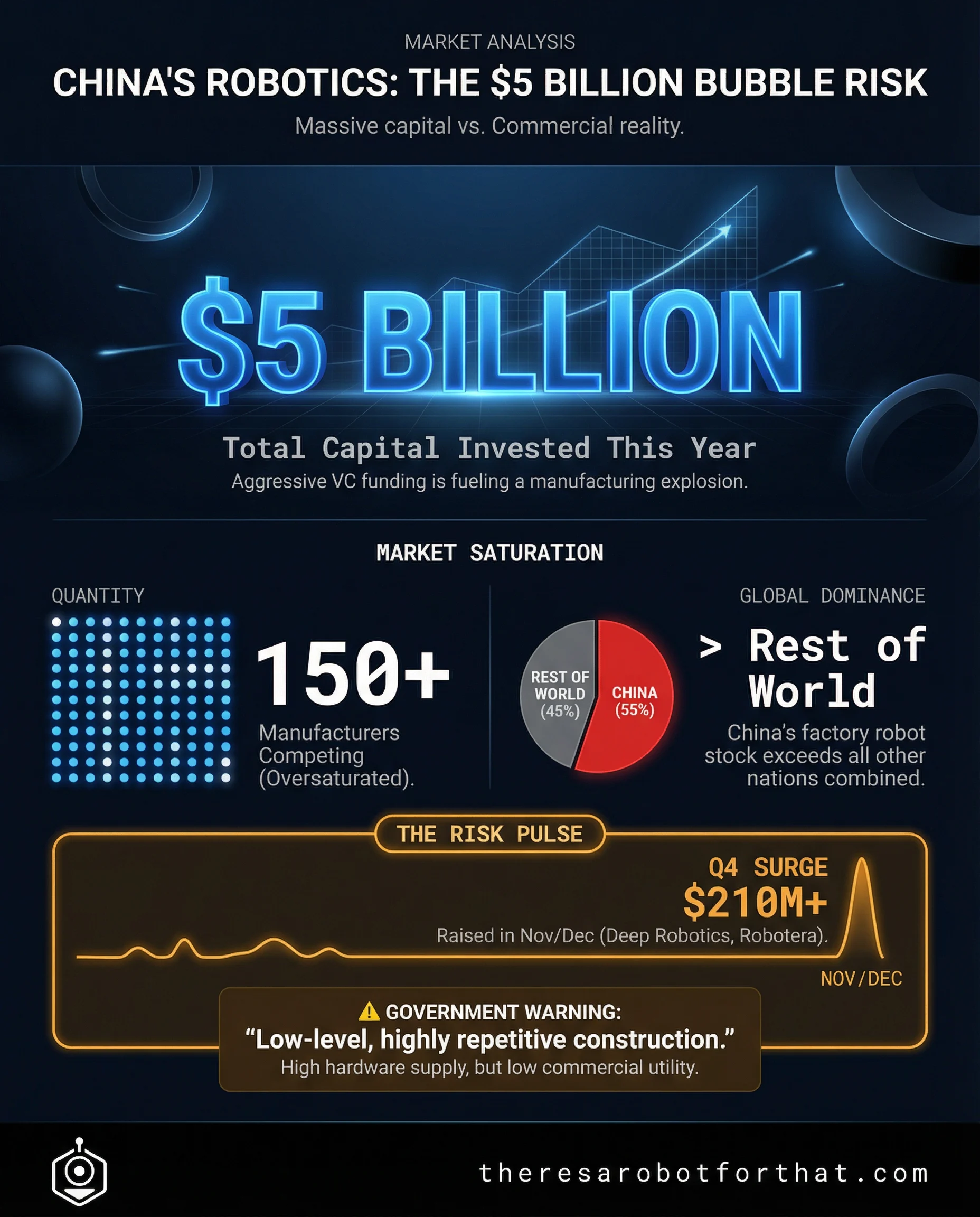
Image Source: Gemini / There's A Robot For That
Snapshot: Beijing has issued warnings about potential oversaturation in China's robotics sector as more than 150 manufacturers compete for market share, yet venture funding continues to pour in with recent rounds totaling over $210M across multiple startups.
Breakdown:
Takeaway: China's robotics sector mirrors its electric vehicle playbook with aggressive early adoption and manufacturing scale advantages, but sustainability depends on bridging the gap between hardware capabilities and real-world use cases. The tension between government caution and investor enthusiasm will likely define which of the emerging robotics startups survive the inevitable market consolidation.
Moon Surgical Adds 5G and Cloud AI to Maestro Robots
Snapshot: Moon Surgical has updated its Maestro robotic system with 5G and Wi-Fi connectivity, enabling real-time cloud-based AI analytics powered by Nvidia's graphics processing units.
Breakdown:
Takeaway: Cloud connectivity transforms Maestro from a surgical tool into a digital backbone for operating rooms, enabling continuous learning and predictive coordination. The combination of real-time AI and automated workflows addresses the administrative burden that surgical teams face before and after procedures.
Other Top Robot Stories
Hangzhou deployed its 1.8-meter tall humanoid traffic officer Hangxing No. 1 at a major intersection, where the AI-powered robot directs vehicles, identifies helmet-less riders and jaywalkers, and maintains a 99% connection success rate while issuing polite verbal warnings to rule-breakers.
XCath completed three robot-assisted brain aneurysm procedures in Panama using its EVR robotic system, marking only the second time surgical robots have been used for intracranial neurovascular intervention while demonstrating the potential for remote stroke treatment that brings care to patients rather than patients to specialized centers.
Researchers published findings showing children prefer robots with moderate human-like features for educational tasks rather than maximum human resemblance, suggesting the optimal amount of anthropomorphism varies by application as designers navigate the balance between utility and the uncanny valley effect.
🤖 Your robotics thought for today:
CATL's Moz handles high-voltage testing with 99% success while tripling human output—so why are manufacturers still designing production lines around human limitations instead of rebuilding them for robot strengths?
What am I missing?
Enjoy your weekend,
Uli


