
Boston Dynamics to debut next-gen Atlas at CES
PLUS: Humanoids enter chip factories, rover changes its own tires

Welcome back to your Robot Briefing
Boston Dynamics is bringing its next-generation Atlas humanoid to CES in January, with Hyundai pushing commercialization strategy front and center at the world's biggest consumer tech show. Choosing a mainstream product launch venue over a robotics conference signals a decisive move from R&D spectacle to market-ready hardware.
The question for operations teams: if Boston Dynamics believes commercialization timelines are now measured in quarters rather than years, how soon should companies start budgeting for humanoid pilots?
In today's Robot update:
Hyundai to unveil next-gen Atlas at CES
Snapshot: Hyundai Motor Group confirms Boston Dynamics will debut a next-generation Atlas humanoid robot at CES in January, with a focus on outlining commercialization strategies for AI robotics.
Breakdown:
Takeaway: The venue choice and commercialization focus suggest humanoid robots are transitioning from lab curiosity to products companies can actually purchase within 12-24 months. Operations leaders should start evaluating use cases now, as the window between "impressive demo" and "available for pilot programs" is closing faster than expected.
Humanoids enter chip factories in global first
Snapshot: Italian robotics firm Oversonic has signed a deal with semiconductor giant STMicroelectronics to deploy humanoid robots in chip fabrication plants globally, with the first unit already operating in Malta's advanced packaging facility.
Breakdown:
Takeaway: Semiconductor fabs don't gamble on unproven technology in live production environments, making this a strong signal that humanoids have crossed the threshold from pilot projects to real industrial deployment. The fact that a $10B+ chip manufacturer is willing to integrate humanoids into precision manufacturing suggests the technology is ready for mainstream industrial adoption sooner than most executives expect.
Space rover changes its own tires autonomously
Snapshot: GITAI has demonstrated a lunar and Mars rover that autonomously changes its own tires without any human crew support, addressing a critical challenge for long-duration space missions where repair infrastructure doesn't exist.
Breakdown:
Takeaway: Autonomous self-repair capabilities remain a key bottleneck for deploying robots in environments where human technicians can't easily intervene. Space applications often preview capabilities that eventually become economically viable for industrial use cases where downtime costs are high and access is limited.
Humanoid market to hit $9T as China fears bubble
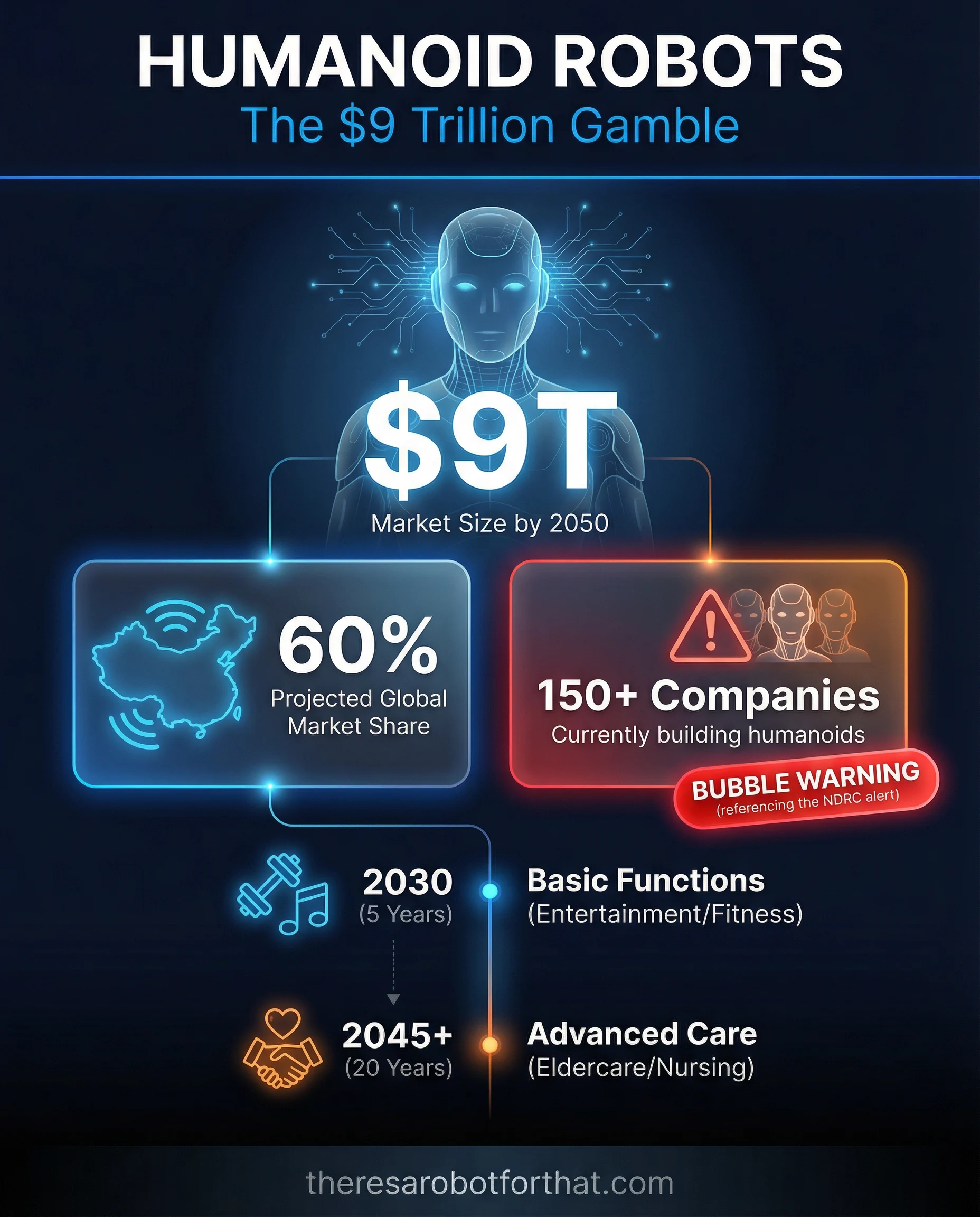
Image Source: There's A Robot For That
Snapshot: A new RBC report projects the humanoid market could reach $9 trillion by 2050, though the Chinese government is now warning of a domestic 'bubble' with over 150 companies flooding the sector.
Breakdown:
Takeaway: The tension between trillion-dollar projections and bubble warnings signals we're in the hype phase where capital floods in faster than real applications emerge. Smart operators should watch deployment numbers and customer retention at early movers like Tesla and Chinese manufacturers rather than market size predictions.
Other Top Robot Stories
Figure faces a lawsuit from former safety engineer Robert Gruendel alleging the company's Figure 02 humanoid tested strong enough to fracture a human skull, raising questions about disclosure requirements for humanoid robot capabilities as the technology moves toward commercial deployment.
Europol warns that AI-powered care robots could be hijacked by cybercriminals and turned into surveillance devices or used to groom vulnerable people, with the EU police agency's 48-page report outlining plausible scenarios where compromised household robots become security threats within the next decade.
Investor Howard Marks questions whether AI and humanoid robot valuations reflect a bubble, noting that while the technologies will likely transform industries as railways and the internet did, investors typically fund innovation at inflated prices and then lose capital when returns disappoint, leaving operations leaders to benefit from the infrastructure others paid to build.
🎄Your robotics thought for today:
Before we take a brief pause over the Christmas holidays, I want to thank all of you for being part of this community—your engagement and curiosity about robotics make this newsletter worthwhile, and I'm looking forward to bringing you more insights in the new year.
Merry Christmas,
Uli


