
Boston Dynamics’ Atlas gets a Google DeepMind brain
Gemini AI integration PLUS: First surgical humanoid, Unitree’s flying kicks, autonomous mowers
Welcome back to your Robot Briefing
Google DeepMind is giving Boston Dynamics' Atlas humanoid a major AI upgrade, swapping pre-programmed routines for Gemini-powered reasoning that can adapt to different tasks on the fly.
With Hyundai committing to manufacture 30,000 units annually by 2028, the question isn't whether humanoids are technically impressive anymore—it's whether this partnership finally delivers the economics that make factory-floor deployment viable at scale.
In today's Robot update:
Boston Dynamics Gets a Brain: Partners with Google DeepMind
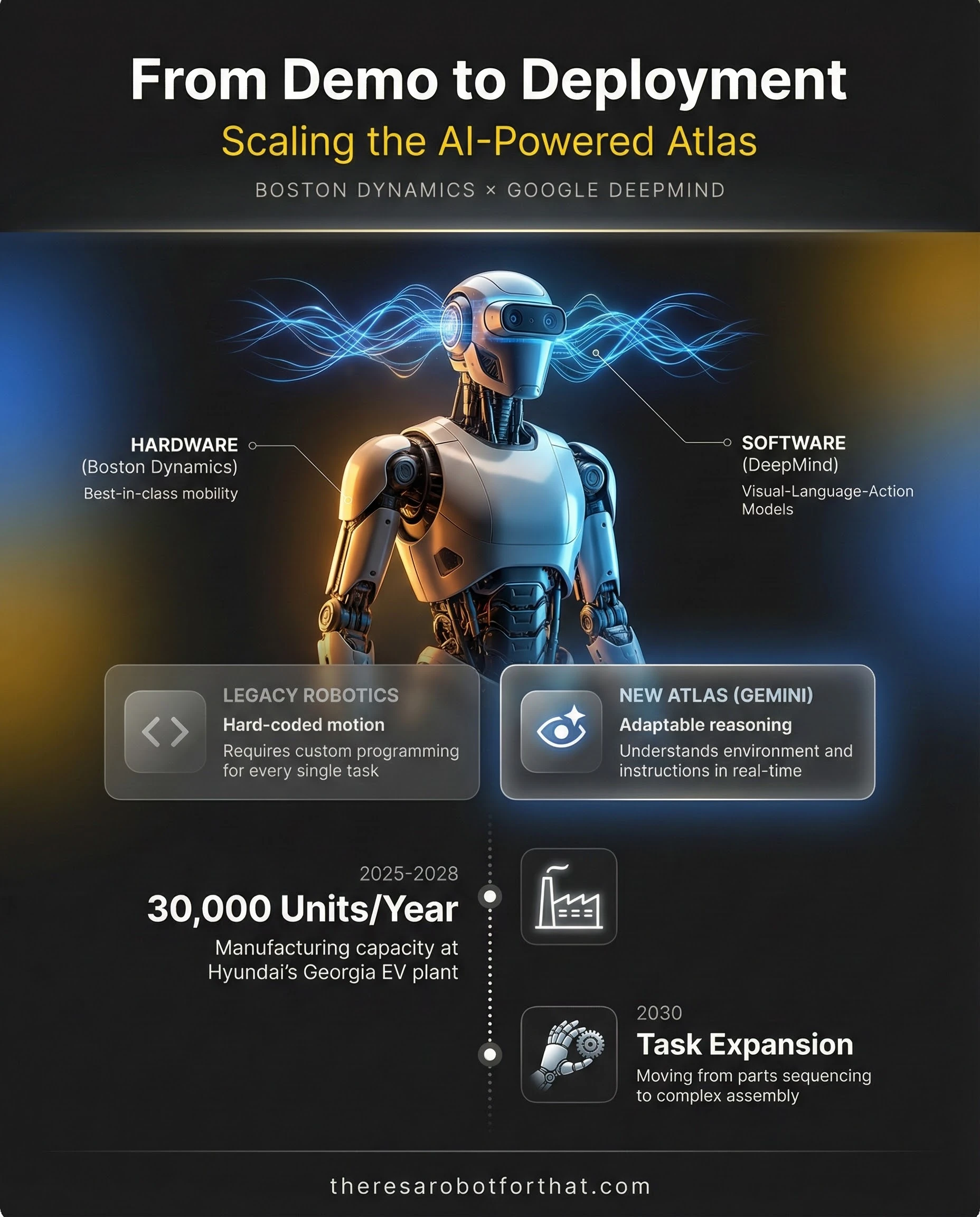
Image Source: Gemini / There's A Robot For That
Snapshot: Boston Dynamics has partnered with Google DeepMind to integrate Gemini AI foundation models into its Atlas humanoid, replacing hard-coded movements with adaptable reasoning capabilities that could finally make general-purpose humanoids economically viable for manufacturing.
Breakdown:
Takeaway: This marks a critical transition from robotics demonstrations to commercial commitments, with a Tier 1 automaker placing production-scale bets on humanoid deployment within three years. The partnership signals that major manufacturers now view AI-powered humanoids as near-term solutions rather than distant possibilities, compressing the timeline for when mid-sized operations should evaluate automation strategies.
World's First 'Surgical Humanoid' Debuts at CES
Snapshot: LEM Surgical unveiled Dynamis, a dual-arm robotic system that mimics human surgeon dexterity and is already FDA-cleared and performing spinal procedures at a Las Vegas hospital—making it the first commercially deployed "surgical humanoid."
Breakdown:
Takeaway: Unlike most medical technology at CES, this isn't a prototype—it's clearing regulatory hurdles and operating in real surgical environments today. Companies evaluating robotic automation should note that AI-powered surgical systems have moved from research labs to routine clinical deployment faster than most predicted.
Unitree's H2 Humanoid Stuns with Flying Kicks
Snapshot: Unitree released footage of its H2 humanoid performing backflips and flying kicks, but the real story for operations leaders is what's underneath: dexterous hands and teleoperation systems designed for factory floors, not just viral videos.
Breakdown:
Takeaway: Teleoperation changes the deployment math by letting companies deploy humanoids for useful work now while AI catches up. The athletic demos grab headlines, but the manipulative capability and remote control infrastructure signal these robots are moving from lab curiosities to operational tools on a 12-24 month timeline.
Forget Humanoids, the Robot Lawnmowers Are Here
Snapshot: While humanoid robots dominate headlines at CES 2026, robotic lawnmowers from Worx, Segway, and KEENON represent automation that's actually ready to deploy today.
Breakdown:
Takeaway: This technology has crossed the chasm from experimental to proven, with European market validation and price points that make business cases straightforward for facility management and property services. Companies evaluating automation should look past the humanoid hype at mature solutions already mowing lawns, cleaning floors, and delivering materials today.
Other Top Robot Stories
Mercedes-Benz took a stake in humanoid robotics maker Apptronik and is testing its robots at German factories, signaling that automotive manufacturers beyond Hyundai are placing commercial bets on humanoid deployment timelines within the next few years.
Waymo requires human intervention from remote operations centers and gig workers to handle stranded vehicles and confusing traffic situations, challenging claims of "fully autonomous" operation and revealing that today's robotaxis still depend heavily on human support to function at scale.
Pudu's conquered the Canton Tower Run Up with its D5 quadruped robot taking first place in the quadruped category, demonstrating elite mobility and mechanical endurance by scaling one of the world's tallest landmarks in a competitive vertical race format.
🤖 Your robotics thought for today:
Hyundai's manufacturing 30,000 Atlas units annually by 2028 with Gemini brains that adapt without custom programming—so if a Tier 1 automaker is betting on general-purpose humanoids in three years, why are mid-sized manufacturers still designing workflows around the assumption that robots need specialists to reprogram every task?
Until tomorrow,
Uli


