
New electronic skin lets robots feel physical pain
PLUS: XPeng targets 1,000 humanoids in '26, unions draw red lines, and a robot with warm skin

Welcome back to your Robot Briefing
XPeng is pushing to deliver 1,000 humanoid robots by late 2026 at $175,000 each, but a weekend demonstration ended with its Iron robot faceplanting in front of crowds at a Shenzhen mall. The company strapped the robot to a safety frame for the next day's demos.
When your flagship product can't stand still reliably, can you really scale to commercial production in 18 months? The gap between controlled lab environments and unpredictable real-world conditions remains the defining challenge for companies betting on humanoid deployment timelines.
In today's Robot update:
Robots Can Now 'Feel' Pain
Snapshot: Researchers at TU Munich developed electronic skin that lets robots distinguish between ordinary touch and potentially damaging force, triggering protective reflexes within milliseconds.
Breakdown:
Takeaway: This represents a meaningful step toward safer human-robot collaboration, but companies should view it as early-stage research rather than near-term deployment opportunity. The path from controlled lab tests to factory floors requires solving fundamental engineering challenges around durability, coverage, and cost that could take years to resolve.
XPeng's Iron: 1,000 Units in '26 Despite Demo Flop
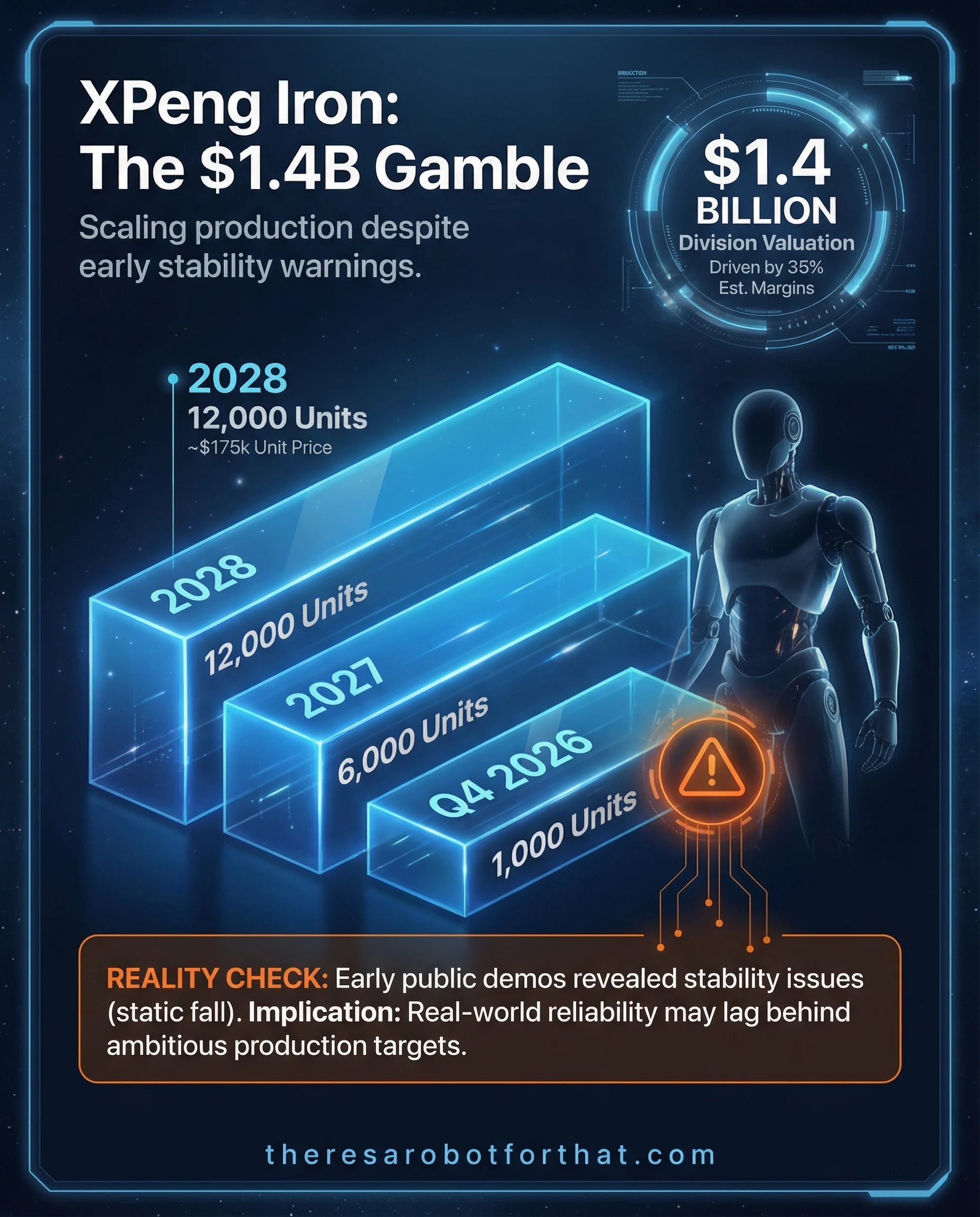
Image Source: There's A Robot For That
Snapshot: Chinese EV maker XPeng aims to begin mass production of Iron humanoid robots by late 2026 at an estimated $150,0000 per unit, even as a weekend demo ended with the robot faceplanting in front of hundreds at a Shenzhen mall.
Breakdown:
Takeaway: XPeng's aggressive production targets signal serious commercial intent, but the viral fall underscores a harsh reality: humanoid robots still can't reliably handle unpredictable real-world conditions. Companies evaluating humanoid deployment should plan for 2027-2028 timelines, not 2026, regardless of manufacturer promises.
Unions Draw Red Lines for Robot Workers
Snapshot: Labor opposition to factory automation is escalating beyond rhetoric into contract demands and strike threats, creating a new barrier companies must navigate before deploying humanoid robots.
Breakdown:
Takeaway: The timeline for humanoid robot deployment just got more complex, as labor agreements and strike threats could delay implementations by months or years regardless of technical readiness. Companies evaluating automation need to factor in negotiation time and potential work stoppages, not just hardware costs and capabilities.
The Robot With Warm, Human-Like Skin
Snapshot: Chinese robotics startup DroidUP unveiled Moya, a bionic robot with hyper-realistic facial features and skin heated to human body temperature , tackling what founder Li Qingdu calls the "cold machine" problem in social robotics.
Breakdown:
Takeaway: This signals a clear split in robotics investment between industrial automation (where human-likeness doesn't matter) and customer-facing applications (where it increasingly does). Companies planning service robot deployments should watch whether warm skin and facial expressions actually improve customer acceptance rates, since that data will determine if this added complexity delivers ROI.
Other Top Robot Stories
Tesla developed a world simulator model that trains Optimus humanoids in closed-loop virtual environments by generating next-frame predictions from policy network actions, allowing the company to test edge cases and failure modes without real-world deployment risks—a methodology that could accelerate robotics validation timelines across the industry.
Boston Dynamics retired its research version of the electric Atlas humanoid as the enterprise platform transitions to commercial deployment, marking the end of the prototype that pushed bipedal robotics capabilities forward and the beginning of scaled production focused on industrial customers.
Intuitive Surgical generates more revenue from instruments and accessories ($1.6 billion per quarter) than from selling Da Vinci surgical systems ($785 million), creating an annuity-like business model where each robot placement becomes a recurring income stream that grows with procedure volume—a blueprint worth studying for companies evaluating robotics-as-a-service strategies.
🤖 Your robotics thought for today:
TU Munich's robots now reflexively pull back from damaging force in milliseconds without central processing, but we still cordon off collaborative robots like they're industrial hazards—so are safety regulations protecting workers or just codifying yesterday's liability assumptions?
Until tomorrow,
Uli


