
Neura Robotics hits €4B valuation from Amazon, Qualcomm
PLUS: UBTech's humanoid sales surge 23-fold, AI that interprets live surgery, and China's robot dog wolf packs

Welcome back to your Robot Briefing
Amazon and Qualcomm just poured approximately €1 billion into German startup Neura Robotics at a €4 billion valuation. It's one of the largest single checks written for European robotics, and it signals that Silicon Valley giants see the continent as more than a regulatory bottleneck.
But can Europe actually compete with China's manufacturing speed and America's AI infrastructure? With BMW already testing Swedish-made humanoids on factory floors, the question isn't whether Europe can build robots — it's whether they can scale them fast enough to matter.
In today's Robot update:
German robotics startup lands €1B from Amazon and Qualcomm at €4B valuation
Snapshot: Neura Robotics, a German humanoid robot maker, raised approximately €1 billion from Amazon and Qualcomm at a €4 billion valuation — a signal that major tech players are making serious capital bets on European robotics capabilities. Swedish robotics company Hexagon is already testing humanoids at BMW's industrial facilities, suggesting early commercial traction beyond just fundraising headlines.
Breakdown:
Takeaway: The participation of Amazon and Qualcomm — strategic buyers and infrastructure providers, not just financial investors — indicates belief in near-term commercial deployment rather than speculative R&D. For operations leaders, this validates that humanoid robotics procurement conversations are shifting from "if" to "which vendor and when," particularly in automotive and warehousing sectors where these companies operate.
UBTech's humanoid robot sales surge 23-fold as China scales production
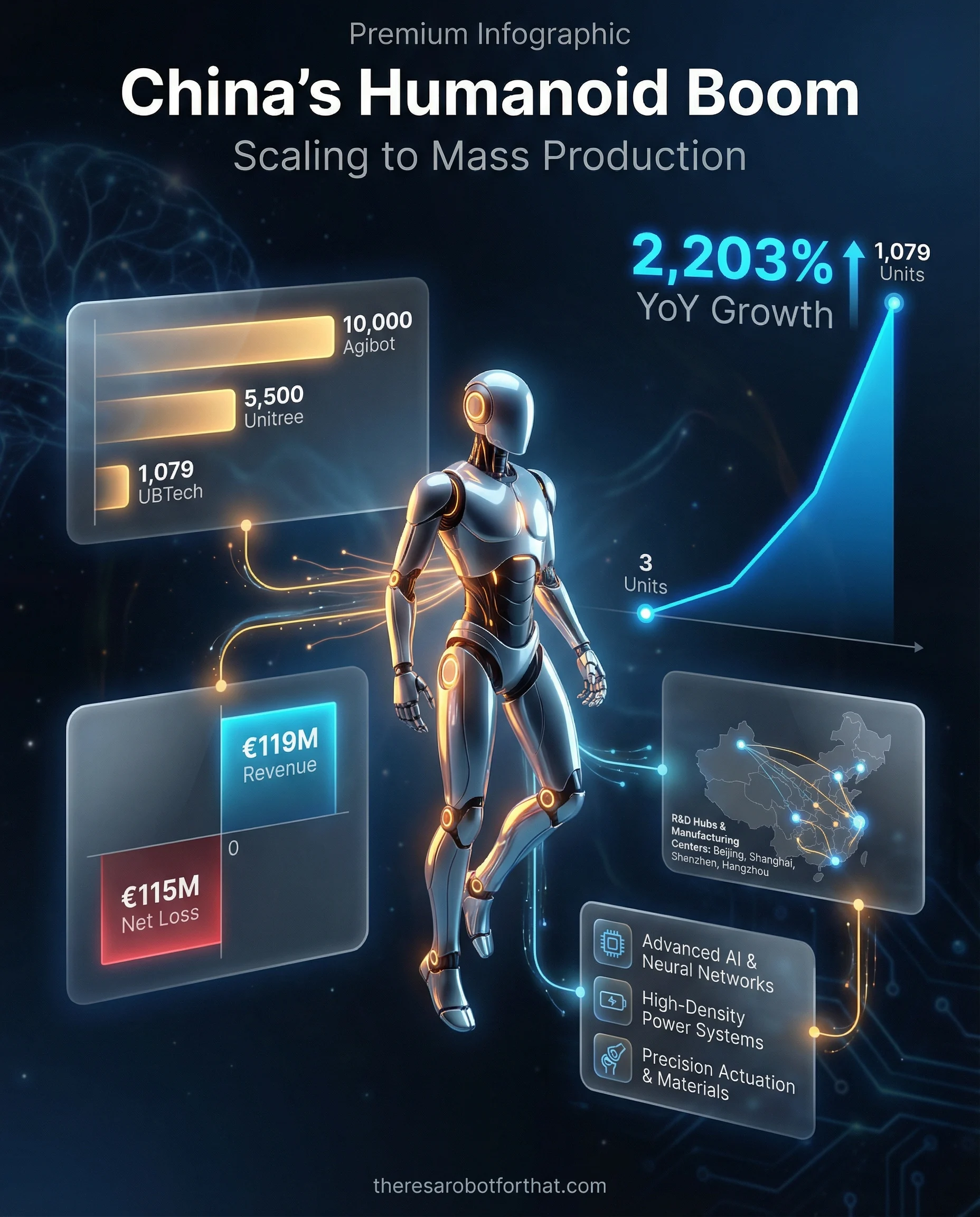
Image Source: There's A Robot For That
Snapshot: Hong Kong-listed UBTech sold 1,079 full-size humanoid robots in 2025 — up from just three units the prior year — generating €119M in revenue from humanoids alone. The numbers provide rare visibility into actual commercial traction: real units shipped, real revenue recognized, and a clear signal that Chinese manufacturers are moving from prototypes to volume production.
Breakdown:
Takeaway: The shift from single-digit to four-digit unit sales in one year shows Chinese manufacturers have solved production scalability, not just R&D. Operations leaders should treat 2027 as the year humanoid robots transition from "interesting technology" to "available vendor quotes," particularly for high-volume repetitive tasks where Chinese pricing and production speed create competitive pressure.
Tata Elxsi brings AI interpretation to surgical robotics
Snapshot: Tata Elxsi is developing AI systems that analyze live surgical video feeds to identify anatomical structures during procedures, moving robotic surgery beyond execution-only systems like da Vinci. The shift represents AI adding contextual awareness to robotics — the robot understands what it's looking at, not just where the surgeon's hand is moving.
Breakdown:
Takeaway: This represents the industrial pattern operations leaders should watch: robots evolving from "doing what they're told" to "understanding what they're doing." While surgical robotics may seem distant from manufacturing or logistics, the underlying capability — AI adding contextual judgment to physical systems — has direct implications for quality control, inventory management, and any operation where robots need to adapt to variable conditions rather than follow fixed routines.
China's robot dog 'wolf packs' operate as one using shared AI brain
Snapshot: China's PLA demonstrated robot dog squads operating as a coordinated "wolf pack" using a shared sensing network, conducting autonomous urban clearing operations during simulated combat scenarios. The robots function as a single networked unit — making joint decisions, integrating with drones for air-ground coordination, and operating via voice commands, tactical gloves, or rifle-mounted controls.
Breakdown:
Takeaway: The shift from individual robots to networked "wolf packs" with shared intelligence signals where all multi-robot deployments are heading — not just military ones. Warehouse operators and logistics companies running multiple robots should watch how coordinated swarm behavior develops, because the underlying technology of shared sensing and autonomous task allocation will transfer directly from military to industrial applications within a few years.
Other Top Robot Stories
IntBot deployed an AI humanoid named Jose at San Jose Mineta Airport's Terminal B for a four-month pilot, where the Sunnyvale-based company's robot greets passengers, answers questions in over 50 languages, and provides local attraction information.
ANYbotics integrated its four-legged autonomous robots directly into SAP's enterprise resource planning software, turning mobile units into industrial IoT data nodes that can inspect hazardous facilities continuously while feeding sensor data straight into backend business systems.
🤖 Your robotics thought for today:
UBTech went from 3 units to 1,079 in one year. That's not a pilot program — that's a supply chain that works. Meanwhile Neura just raised a billion euros and still has to prove they can ship at volume. I'm less interested in the funding headlines than the delivery timelines.
Enjoy your weekend,
Uli


