
MirrorMe’s Bolt humanoid sprints at record 22 mph
PLUS: Waymo raises $16B, Korea’s humanoid battery bet, and AI learns surgery from 150 demos

Welcome back to your Robot Briefing
A Chinese startup just set a new benchmark for humanoid robotics: MirrorMe's Bolt recorded a 22 mph sprint in real-world conditions, establishing itself as the fastest full-size humanoid ever demonstrated. The 175cm robot matched Olympic-level pace on a treadmill, outrunning its human creator.
Speed translates directly to dynamic stability and real-time control—core capabilities for industrial environments where humanoids need to navigate unpredictably. The question facing automation leaders: are these athletic breakthroughs moving humanoids from lab curiosities to deployable tools faster than expected?
In today's Robot update:
Bolt: The 22 MPH Humanoid
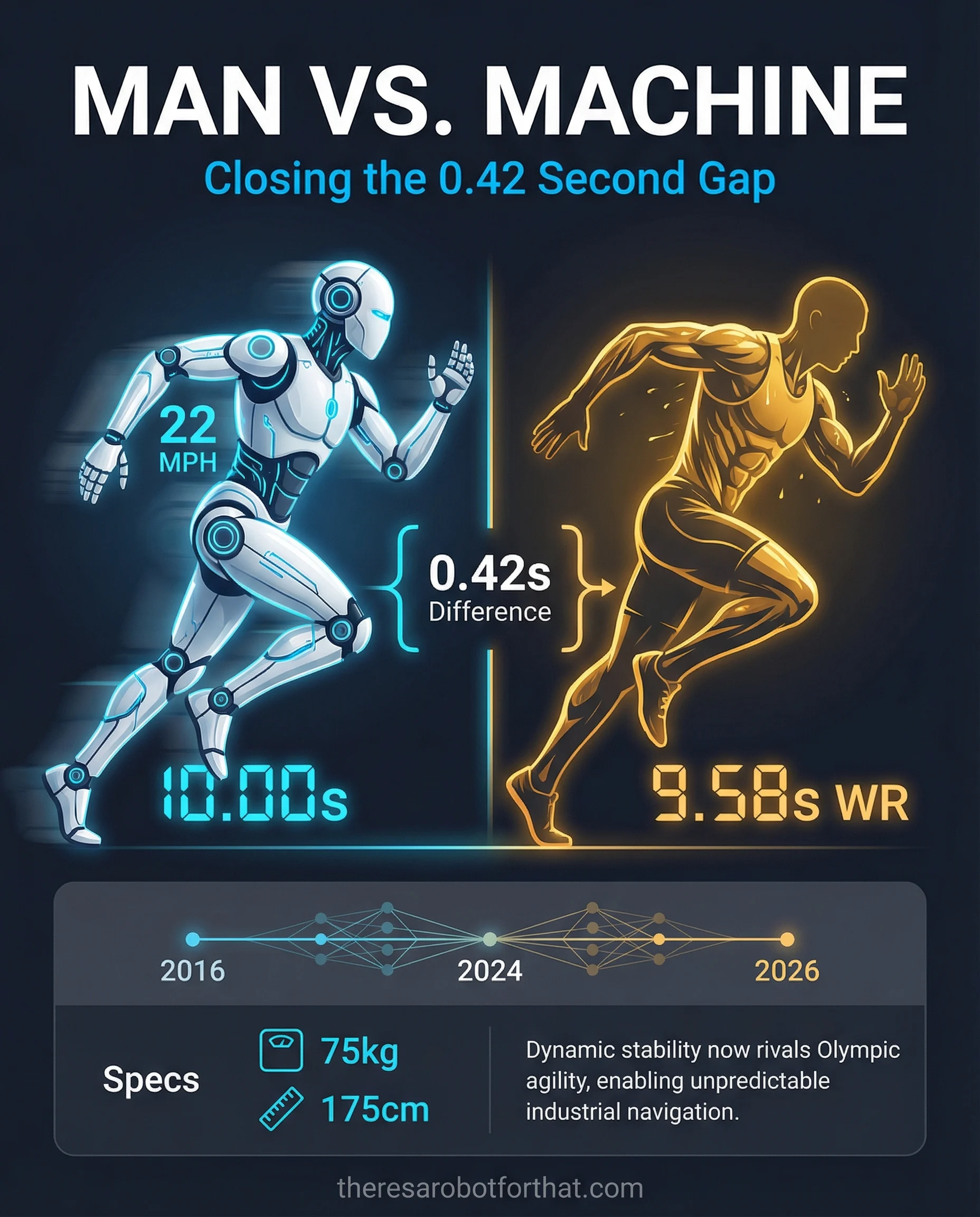
Image Source: There's A Robot For That
Snapshot: Chinese robotics startup MirrorMe unveiled Bolt, a humanoid robot that hit 10 meters per second (22 mph) in real-world testing—making it the world's fastest full-size humanoid on record.
Breakdown:
Takeaway: Speed isn't just about racing—it's a proxy for dynamic stability, real-time control, and the kind of athletic capability that translates to navigating complex industrial environments. Companies serious about humanoid deployment should track whether these mobility breakthroughs translate into practical applications within the next 12-18 months.
Waymo's $16 Billion War Chest
Snapshot: Waymo closed a $16 billion funding round at a $126 billion valuation, marking the largest investment yet in autonomous mobility and signaling that investors see robotaxis as commercially viable at scale.
Breakdown:
Takeaway: This isn't just about robotaxis—it's a signal that autonomous systems have crossed the commercial viability threshold, with implications for any business operating vehicle fleets or logistics networks. Companies evaluating automation strategies should note that the technology risk has shifted from "will it work?" to "when do we need to adapt our operations?"
Korea's Battery Bet on Humanoids
Snapshot: South Korean battery giants LG Energy Solution, Samsung SDI, and SK On are pivoting to supply humanoid robots after losing EV market share to cheaper Chinese competitors. The shift leverages Korea's strength in high-nickel and solid-state batteries—exactly what power-hungry humanoids from Tesla and Boston Dynamics need.
Breakdown:
Takeaway: This isn't just about batteries—it's a leading indicator that humanoid commercialization has moved from prototypes to supply chain positioning. When battery makers invest in specialized production lines with 2-3 year timelines, they're betting on near-term volume deployments that operations leaders should start planning for.
Learning Surgery from 150 Demos
Snapshot: Researchers from Technical University of Dresden developed an AI system that teaches surgical robots complex tissue manipulation tasks with fewer than 150 demonstrations—a 99% reduction from the 16,000+ examples typically required.
Breakdown:
Takeaway: This represents a fundamental shift in the economics of surgical automation—reducing training data requirements by 99% transforms surgical robotics from a research curiosity into something hospitals might actually deploy at scale. The zero-shot tissue transfer suggests we're 2-3 years from seeing these systems in operating rooms, not the 5-10 year timeline most executives have been planning around.
Other Top Robot Stories
Cyngn accelerates commercial deployment of autonomous forklifts by building a high-fidelity simulation environment with NVIDIA Isaac Sim, enabling larger virtual fleets and complex scenario testing that previously required physical prototypes—addressing a key barrier to scaling warehouse automation beyond pilot programs.
Medtronic secured FDA clearance for its Hugo robotic-assisted surgery system in urological procedures, bringing a modular alternative to Intuitive's market-dominant da Vinci platform with moveable arm carts and an open console design that lets surgeons maintain visual contact with operating room staff during procedures.
Xpeng's Iron stumbled during a public demonstration at a Shenzhen shopping mall, losing balance while standing still and falling backwards after completing a smooth catwalk—highlighting the gap between controlled lab performance and the unpredictable conditions humanoids face in real-world commercial deployments.
DroidUp unveiled Moya in Shanghai, a 165 cm humanoid designed to replicate human micro-expressions and maintain body temperature between 32-36°C, positioning it among the most lifelike robots currently under development as companies explore whether highly realistic designs can cross the uncanny valley rather than avoid it.
🤖 Your robotics thought for today:
A farmer updates her weeding robot's vision in 3 minutes on an iPad. No engineer. No vendor call.
Meanwhile, a $500M distribution center is still waiting 6 weeks for the same thing.
The foundation model moment hit agriculture first. Warehouses are next — whether they're ready or not.
Until tomorrow,
Uli


