
Google absorbs Intrinsic to accelerate Physical AI
PLUS: Encord lands $60M, Nvidia’s video-to-robot model, and winter harvest dogs

Welcome back to your Robot Briefing
Google just reversed course on its robotics strategy, pulling Intrinsic—the industrial automation software spinoff it launched five years ago—back into core operations to merge with its Gemini AI platform. The move signals that tech giants now see physical AI as ready for commercial deployment, not moonshot experimentation.
For companies mapping out their automation roadmap, this raises a critical question: when major platforms consolidate rather than spin off, does that create more stable vendor partnerships, or does it mean you're now negotiating with divisions that could be reorganized at any moment?
In today's Robot update:
Google absorbs Intrinsic to bet big on 'Physical AI'
Snapshot: Google is folding its robotics software spinoff Intrinsic back into core operations, combining its industrial robot programming platform with Gemini AI models to push "Physical AI" from lab to factory floor.
Breakdown:
Takeaway: When tech giants consolidate experimental robotics units back into core operations, it's a strong signal they see near-term revenue opportunities rather than distant research projects. Manufacturing leaders should expect these platforms to become standard procurement conversations within 18-24 months, not a distant future concern.
Encord lands $60M to fuel the 'Physical AI' data boom
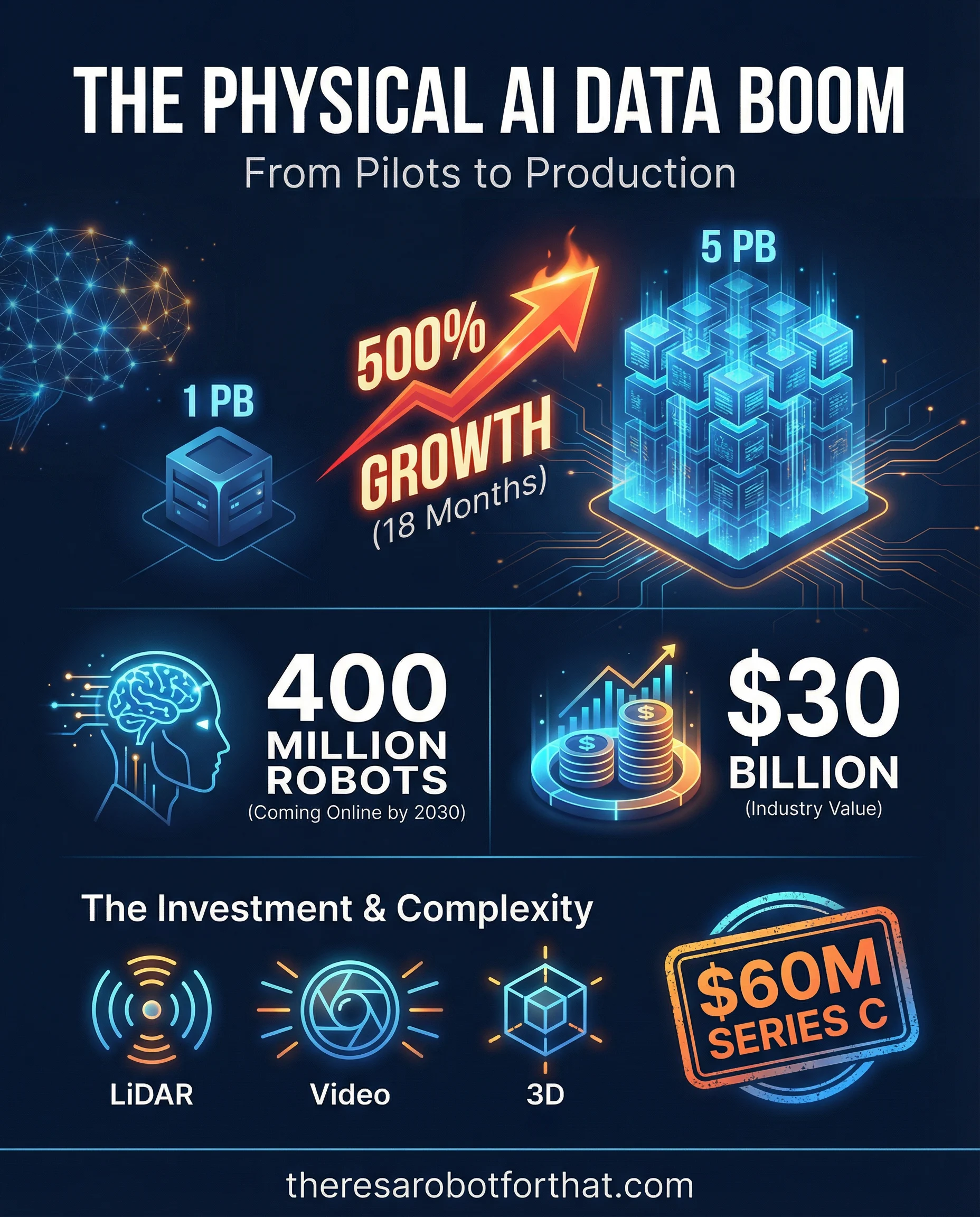
Image Source: There's A Robot For That
Snapshot: Data infrastructure startup Encord closed $60M in Series C funding to build the critical data curation and management layer needed to train the next generation of robots, drones, and autonomous vehicles.
Breakdown:
Takeaway: The robotics deployment bottleneck has shifted from model capability to data infrastructure—companies that can efficiently curate and manage proprietary sensor data will deploy faster than competitors still wrestling with legacy tools. For operations leaders evaluating automation vendors, ask not just about their models, but about their data pipelines and how they handle the continuous learning loop after deployment.
NVIDIA's EgoScale turns human video into robot skills
Snapshot: NVIDIA researchers unveiled EgoScale, a Visual-Language-Action model that trains robots using thousands of hours of egocentric human video instead of expensive robot teleoperation data. This approach could dramatically reduce the cost barrier for companies deploying humanoid manipulation systems.
Breakdown:
Takeaway: This development directly addresses the data collection bottleneck that has kept humanoid manipulation costs high and limited deployment scale. Companies evaluating humanoid investments now have a clearer path to training robots without building massive teleoperation infrastructures first.
Robot dogs tackle the 'last mile' of winter harvest
Snapshot: Deep Robotics deployed its quadruped robots to navigate muddy, narrow ridges in Fuling, China, autonomously transporting heavy baskets of mustard tubers that traditional machinery couldn't reach.
Breakdown:
Takeaway: This deployment signals that legged robots have crossed from research projects into practical commercial use for unstructured terrain where traditional automation fails. Companies facing similar "last mile" logistics challenges in construction, mining, or facilities maintenance should watch how quickly agricultural adoption scales and what cost-per-task metrics emerge from these early deployments.
Other Top Robot Stories
Foundation pitched armed humanoid robots to Trump administration officials for battlefield deployment after securing $18M in military contracts with the Army, Air Force, and Navy, arguing America must pursue weaponized robots because China faces no moral constraints on combat automation.
Weave deployed Physical Intelligence's π0.6 model on its Isaac robot at Sea Breeze in San Francisco, autonomously folding t-shirts, long-sleeves, pants, and shorts with minimal interventions in new environments, demonstrating practical laundry automation moving from lab to commercial operation.
AGIBOT launched its full humanoid robot portfolio at a Munich event and signed a strategic partnership with global auto parts leader Minth Group to accelerate localized production and large-scale deployment across European manufacturing, logistics, and inspection applications.
🤖 Your robotics thought for today:
Google just folded Intrinsic back in-house after five years and partnered with Foxconn because "Physical AI" moved from moonshot to revenue opportunity—so if tech giants are consolidating their bets now, why are most manufacturers still treating robotic automation platforms like a 2026 evaluation instead of a procurement decision you make this quarter?
Enjoy jour weekend,
Uli


