
Generalist's GEN-1 hits 99% success rate
PLUS: US humanoid robots rely on Chinese parts, people filming chores train home robots, and Japan's labor crisis accelerates robot deployment

Welcome back to your Robot Briefing
Generalist AI just released GEN-1, a robotics model hitting 99% success rates on tasks where previous systems could only manage 64% — and it does it three times faster. The company claims some applications are now ready for real-world commercial use.
If a startup can triple performance with just one hour of training data per task, what does that timeline mean for factories still debating whether to automate? The gap between lab demos and production floors may be closing faster than most procurement cycles can keep up.
In today's Robot update:
Generalist's GEN-1 model hits 99% success rate — three times faster than existing systems
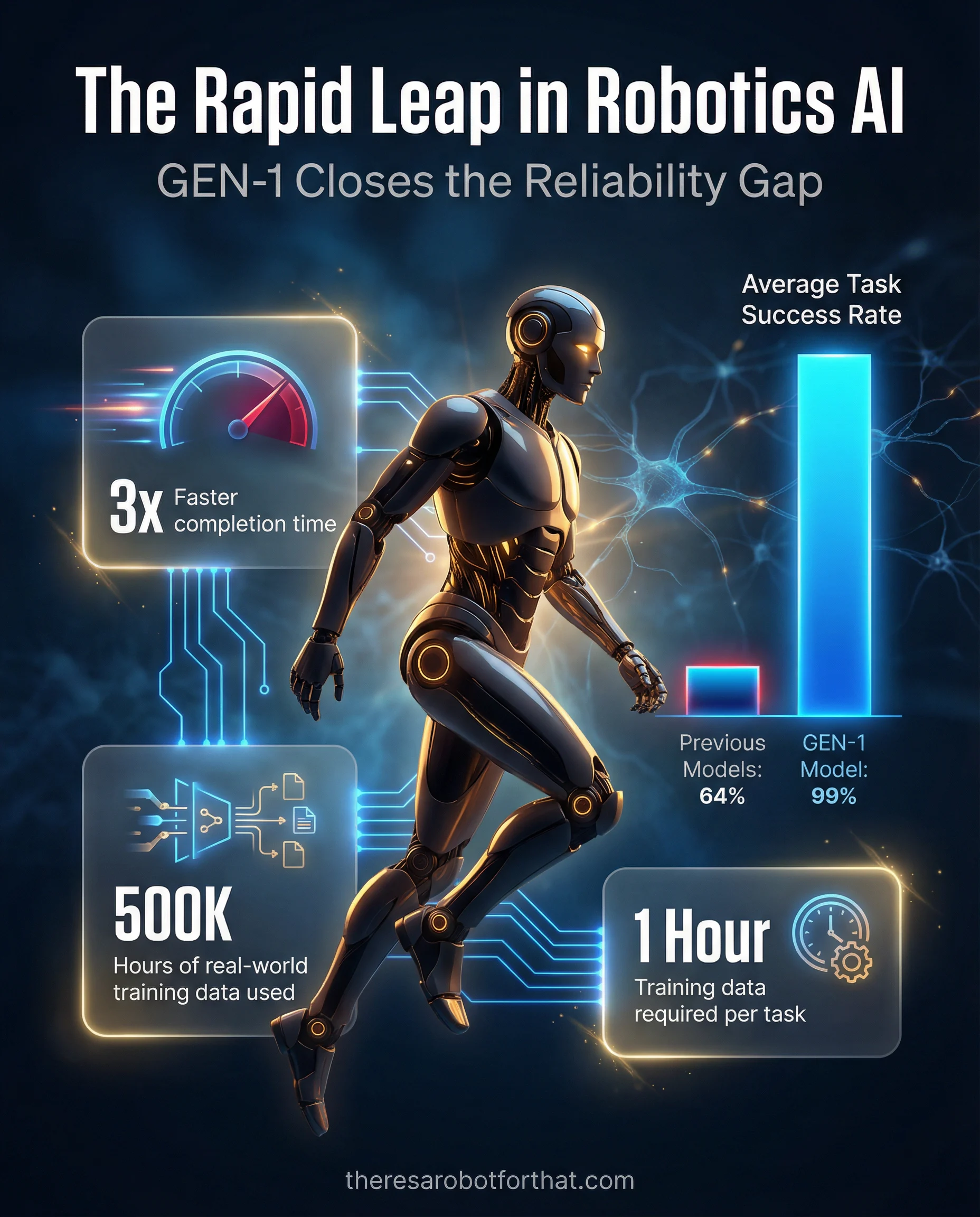
Image Source: There's A Robot For That
Snapshot: Generalist AI released GEN-1, a robotics AI model claiming 99% average success rates on tasks where previous models achieved 64%, completing work roughly three times faster while requiring only one hour of robot training data per result. The company says some tasks now cross the threshold needed for commercial deployment.
Breakdown:
Takeaway: The jump from 64% to 99% success rates in five months signals that robotics AI is moving faster than most planning cycles assume—tasks that seemed years away may be commercially viable within quarters. For operations leaders, this compression of timelines means pilot programs initiated today could face obsolescence before generating ROI if they're not built on adaptable, learning-based systems.
Under the hood of US humanoid robots: Chinese components power Disney, Tesla, and beyond
Snapshot: Major US robotics projects including Disney's Olaf humanoid and Tesla's Optimus rely heavily on Chinese manufacturers for motors, sensors, and mechanical components, revealing deep supply chain dependencies in what both Washington and Beijing consider a strategically sensitive industry. Tesla is building a China-based supplier team in preparation for Optimus mass production in the coming years.
Breakdown:
Takeaway: The supply chain reality undermines the narrative that Western companies can develop humanoid robots independently—even America's most prominent robotics projects are structurally dependent on Chinese component manufacturers. Operations leaders evaluating robotics vendors should ask explicit questions about component sourcing and supply chain resilience, particularly if geopolitical risk factors into their procurement decisions.
How filming your chores became a job training tomorrow's home robots
Snapshot: Robotics startups are hiring thousands of remote workers to film themselves doing household tasks while wearing head-mounted cameras, creating the massive "egocentric data" datasets needed to train general-purpose humanoid robots for home deployment. Micro1, a Palo Alto startup, employed about 4,000 "robotics generalists" as of March 2026, filming at least 10 hours of video weekly.
Breakdown:
Takeaway: The emergence of data collection as a bottleneck—requiring thousands of humans filming mundane tasks—suggests general-purpose home robots remain further out than warehouse or factory applications with more controlled environments. Companies with structured, repetitive tasks in predictable settings will see viable robotics solutions years before industries requiring the environmental adaptability that home deployment demands.
Japan turns demographic crisis into robotics testing ground as investors pour in
Snapshot: Japan's severe labor shortage is accelerating physical AI deployment from experimental pilots into actual warehouse, factory, and service jobs, attracting backing from Salesforce Ventures, Toyota's Woven Capital, and Global Brain for startups filling positions that lack human workers. The country is deploying robots into real roles because there's literally nobody else to do the job.
Breakdown:
Takeaway: Japan offers a preview of what happens when labor economics—not technology readiness—drives adoption decisions, compressing the typical pilot-to-production timeline by years. Operations leaders should monitor which specific tasks Japanese companies successfully automate, as these represent the highest-probability near-term use cases regardless of whether demographic pressure exists in their own markets.
Other Top Robot Stories
Anvil raised $5.5M in seed funding to build a "Legos for robots" platform that slashes custom robot development time from six months to weeks, targeting physical AI teams at companies that lack Tesla-scale hardware resources.
Fagor formed Primus Robotics as a 50-50 joint venture with Funditec Intelligence to develop Europe's first industrial humanoid robots combining AI-driven autonomy with Mondragon Corp's advanced manufacturing capabilities for precision-critical environments.
Monarch collapsed after burning through $240 million and vacating its California headquarters, with testers reporting the AI-powered autonomous tractors "totally failed" despite a half-billion-dollar valuation and backing from Nvidia.
IDTechEx forecasts the global humanoid robot market will reach $30 billion by 2036 as the industry shifts from trade show demonstrations to structured pilot deployments in automotive manufacturing and logistics, with cost reductions and supply chain stabilization enabling commercial viability.
🤖 Your robotics thought for today:
Generalist went from 64% to 99% success rates in five months. That's not incremental progress — that's a planning problem. If you're running a two-year automation feasibility study, the technology you're evaluating today might be obsolete before you finish the paperwork.
I'm watching how fast procurement cycles can actually move.
Until Wednesday,
Uli


