
Ford’s humanoid trial beats targets by 60%
PLUS: Unitree ships 5,500 units, J&J challenges da Vinci

Welcome back to your Robot Briefing
Ford just validated the humanoid business case with hard numbers: a UK startup's robot hit 97% reliability and crushed productivity targets by 60% during a six-week trial at their Cologne plant, handling real automotive manufacturing tasks. The timeline is what matters most here—Ford went from first conversation to live factory deployment in six weeks, and now both companies are planning production trials.
For operations teams still treating humanoid automation as a 2030 planning exercise, is this the signal that procurement timelines just collapsed from 'eventually' to 'next quarter'?
In today's Robot update:
Ford humanoid trial beats targets by 60%
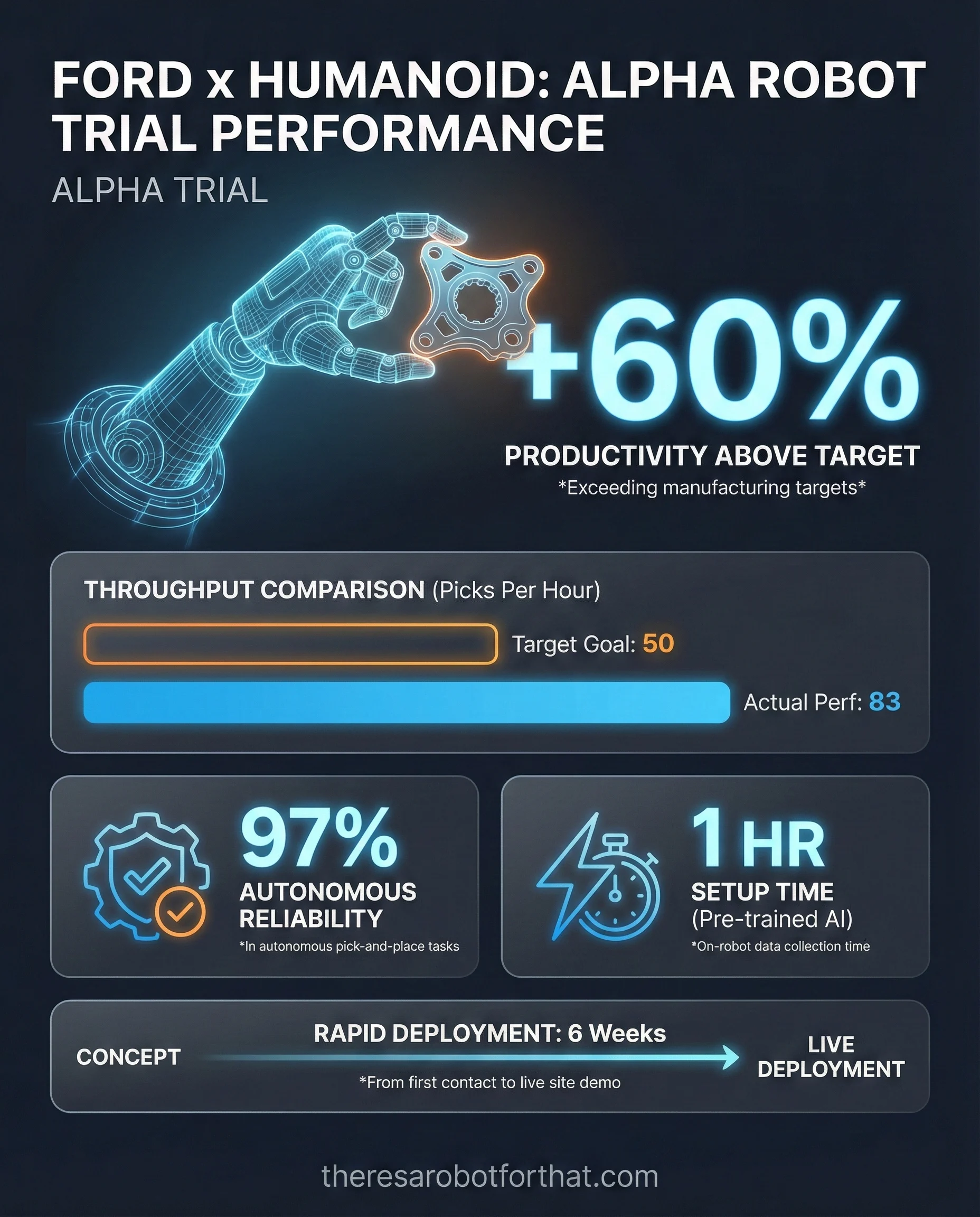
Image Source: Gemini / There's A Robot For That
Snapshot: A humanoid robot from UK company Humanoid completed a six-week trial at Ford's Cologne plant, achieving 97% reliability and exceeding productivity targets by 60% in real automotive manufacturing workflows.
Breakdown:
Takeaway: This isn't a lab demo or a controlled pilot—it's a major automaker validating humanoid economics in real factory conditions with concrete ROI data. The six-week timeline from conversation to deployment and 60% productivity overperformance suggest the window for evaluating humanoid automation has compressed dramatically from 'someday' to 'this fiscal year.'
China's humanoid surge: Unitree ships 5,500 units as XPeng starts production
Snapshot: While Western robotics firms refine prototypes and run factory pilots, Chinese manufacturer Unitree reportedly shipped over 5,500 humanoid robots in 2025, and EV maker XPeng just rolled its first humanoid off an automotive-grade production line.
Breakdown:
Takeaway: The manufacturing maturity gap is widening fast—Chinese firms are transitioning from prototype to product while Western companies perfect their demos. When businesses start budgeting for humanoid deployments in 2027-2028, the most affordable production-ready units will likely come from Shenzhen and Hangzhou, not Silicon Valley.
J&J challenges da Vinci monopoly with OTTAVA robot FDA submission
Snapshot: Johnson & Johnson submitted its OTTAVA robotic surgical system to the FDA for De Novo classification, officially launching its bid to compete with Intuitive Surgical's dominant da Vinci platform in the multi-billion dollar soft tissue surgery market.
Breakdown:
Takeaway: This moves robotic surgery from a single-vendor market to a competitive landscape, which historically drives down costs and accelerates hospital adoption. Operations leaders evaluating automation investments should expect pricing pressure on robotic surgical systems within 24-36 months as J&J and other challengers push for market share.
Battlefield innovation: Ukraine drops ground robots from drones to breach lines
Snapshot: Ukrainian soldiers are using aerial drones to airlift and drop ground robots directly into combat zones, a tactic that surprised even the manufacturer and bypasses terrain obstacles that slow traditional deployment.
Breakdown:
Takeaway: This signals how quickly defense technology evolves when users have direct lines to manufacturers and immediate operational pressure to innovate. Companies selling into high-stakes environments should expect their products to be used in ways they never designed for, making rapid iteration cycles and customer feedback loops essential competitive advantages.
Other Top Robot Stories
LimX Dynamics demonstrated what it calls the world's first scalable autonomous deployment system for its Oli humanoid, enabling out-of-the-box multi-robot coordination without extensive setup—a capability that could accelerate factory floor deployments by reducing the integration time that currently slows industrial adoption.
MANUS integrated its 25-degree-of-freedom data gloves with Beijing Academy of Artificial Intelligence's embodied AI platform, achieving a 30% improvement in human demonstration data collection efficiency through drift-free, occlusion-resistant hand pose tracking—infrastructure that helps scale the training datasets humanoid developers need to improve manipulation capabilities.
Allen Control Systems showcased a robotic system firing an M240 machine gun at fast-moving drones, highlighting the rapid evolution of autonomous defense systems where precision targeting and rapid response capabilities are pushing robotics into high-stakes military applications that will likely influence commercial development timelines and regulatory frameworks.
🤖 Your robotics thought for today:
Ford's humanoid beat productivity targets by 60% and went from first conversation to factory floor in six weeks—so if a century-old automaker can deploy faster than most software pilots, what's your VP of Operations actually waiting for?
Until tomorrow,
Uli


