
Figure’s Helix 02 achieves end-to-end full-body autonomy
PLUS: A $50k humanoid butler, Vention raises $110M, and robots in space
Welcome back to your Robot Briefing
Figure AI's new Helix 02 neural network just completed a 61-action kitchen sequence—walking, loading a dishwasher, closing drawers—entirely on its own, replacing over 100,000 lines of hand-coded software with a single end-to-end AI system. This marks the longest autonomous humanoid task ever recorded, eliminating the brittle code handoffs that previously made robots stumble when conditions changed.
The question for operations leaders: if a single neural network can handle real-world variability in a kitchen, how quickly can this transfer to factory floors and warehouses?
In today's Robot update:
Figure's 'Helix 02' Achieves Full-Body Autonomy
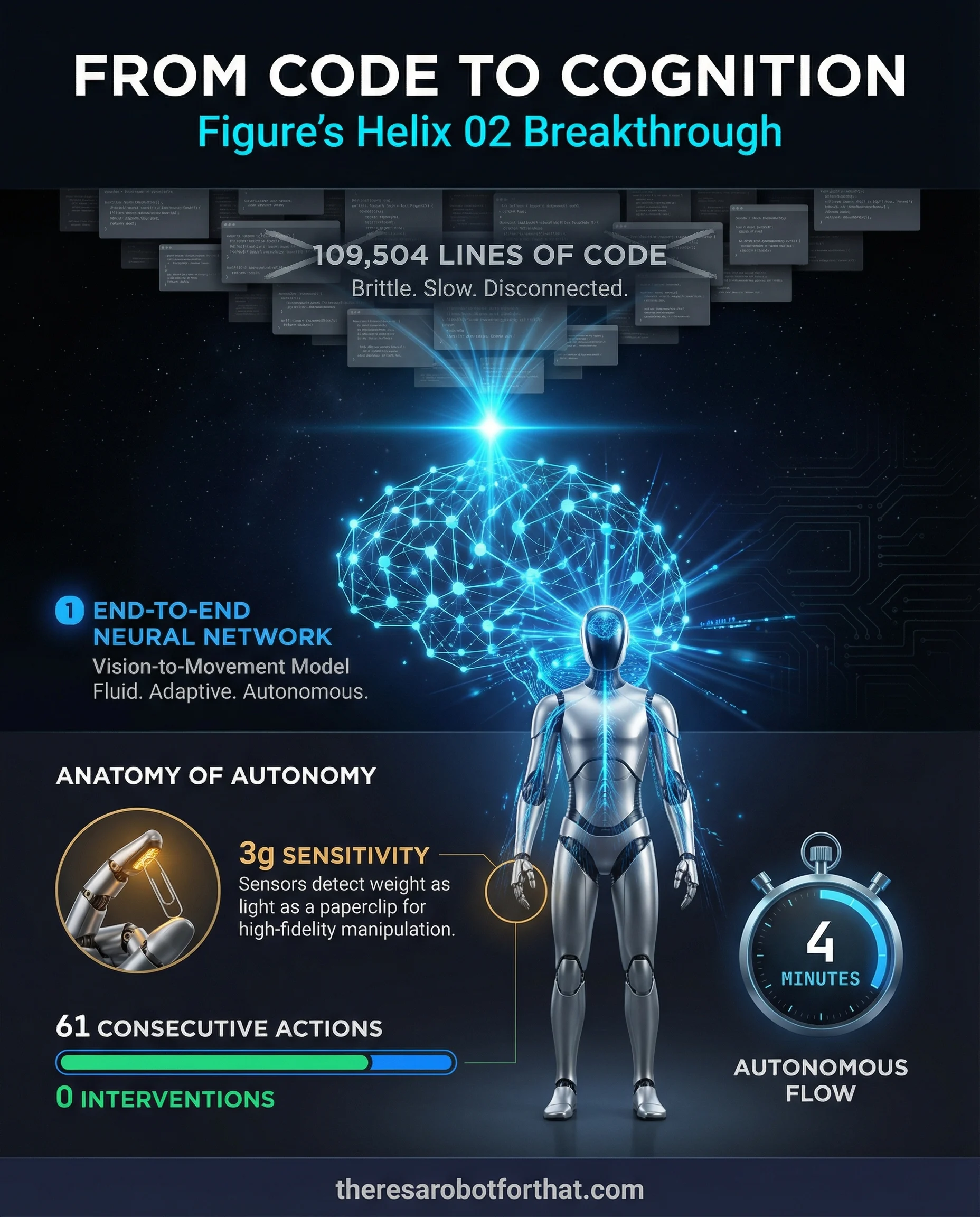
Image Source: There's A Robot For That
Snapshot: Figure AI unveiled Helix 02, a neural network breakthrough that lets its humanoid robot autonomously complete a 4-minute kitchen task—loading and unloading a dishwasher—using a single end-to-end system that directly connects what the robot sees to how it moves.
Breakdown:
Takeaway: This shifts humanoid robotics from choreographed demos to handling real-world variability, bringing the technology meaningfully closer to commercial viability. Operations leaders should watch whether Figure can replicate this performance across different environments and tasks—that's the signal it's ready for pilot deployments.
Meet Sprout: The $50k Humanoid Butler
Snapshot: Startup Fauna launched Sprout, a child-sized humanoid priced at $50,000 for service roles in hotels and retail, with Disney and Boston Dynamics already signed as early customers.
Breakdown:
Takeaway: The service industry is emerging as a viable first market for humanoids, potentially ahead of manufacturing deployment timelines. For companies in hospitality or retail wondering when robotics becomes relevant, the answer is shifting from "eventually" to "pilots are happening now at accessible price points."
Vention Bags $110M for 'Physical AI' Platform
Snapshot: Manufacturing automation platform Vention raised $110M to scale what it calls "Physical AI" — software that lets companies design and deploy factory automation without traditional integration cycles. The funding signals that enterprise manufacturers are moving from pilots to platform-wide adoption.
Breakdown:
Takeaway: The shift from project-based to platform-wide deployments suggests manufacturing automation is reaching an inflection point where it operates more like enterprise software than custom engineering. Companies evaluating automation strategies now face a choice: continue with traditional integrators or adopt platforms that promise faster, standardized deployments.
Robots Head to the Final Frontier
Snapshot: Space robotics deployments signal that autonomous robots have matured enough to handle extreme environments independently, suggesting the technology is ready for demanding industrial applications on Earth. GITAI demonstrates its autonomous servicing robot on the International Space Station, while China's Engine AI announces plans to develop a humanoid astronaut for future missions.
Breakdown:
Takeaway: Space robotics serves as the ultimate stress test for autonomous systems—robots that can make independent decisions in hostile environments demonstrate capability levels that make terrestrial industrial deployments significantly less risky. The timeline for deploying autonomous robots in manufacturing, logistics, and field service operations is compressing as space missions prove the technology works without constant human oversight.
Other Top Robot Stories
MicroPort achieved a global commercialization milestone with 100 orders for its Toumai surgical robot system, signaling that Chinese medical robotics manufacturers are moving beyond domestic markets to compete internationally as hospitals seek lower-cost alternatives to established platforms.
Analysts project the agricultural robotics market will reach $57.18 billion by 2030, growing at 22% CAGR from $25.85 billion in 2026, driven by precision farming adoption, autonomous systems, and indoor robotic farming expansion that addresses persistent labor shortages across commercial agriculture.
Researchers found that AI systems including humanoid robots frequently fail to boost productivity at scale because performance degrades outside ideal conditions, with MIT studies showing stronger gains only in highly structured, predictable environments rather than the variable conditions most commercial deployments face.
China accelerates its physical AI push with Beijing's initiative targeting 90% AI integration across the economy by 2030, leveraging lower development costs and supply chain advantages to challenge Western robotics leadership while companies like XPeng and Agibot ship thousands of humanoid units commercially.
OpenAI seeks US manufacturing partners to secure domestic supply chains for advanced robotics components including gearboxes, motors, and power electronics, marking a strategic shift toward vertical integration as the AI leader moves deeper into physical embodiment alongside its software platforms.
🤖 Your robotics thought for today:
What takes longer:
Training a neural network to replace 109,504 lines of code: ~1,000 hours
Getting procurement to approve a humanoid pilot: 18 months
One is a solved problem. The other is your bottleneck.
Until tomorrow,
Uli


