
Faraday Future pivots to robots with $2,500 quadruped
PLUS: Startup eyes $200M, China’s warm robot, and inflatable ag-tech

Welcome back to your Robot Briefing
Faraday Future, the electric vehicle maker better known for production delays than deliveries, just entered the robotics market with a $2,499 quadruped and two humanoids priced under $35K.
The company promises late February shipments and claims over 1,200 pre-orders, though the deposits come from partners receiving compensation for "co-creation activities." The move highlights how accessible robotics manufacturing has become, but raises a harder question: when barriers to entry drop this low, how should buyers distinguish between viable automation partners and opportunistic pivots?
In today's Robot update:
Faraday Future Pivots to Robots with $2,500 Quadruped & Humanoids
Snapshot: Struggling EV maker Faraday Future launched three robot series at the NADA Show in Las Vegas, with a quadruped starting at $2,499 and two humanoids priced at $19,990 and $34,990, targeting late February deliveries.
Breakdown:
Takeaway: This announcement signals how low barriers to entry have become in robotics manufacturing, but the business model raises questions about execution capability. For companies evaluating robotics vendors, FF's aggressive pricing shows where the market floor might be heading, but their delivery track record and compensated pre-order structure suggest waiting for proof of actual deployments before taking this seriously.
Startup 'Humanoid' Unveils Hive-Mind Brain & Eyes $200M Raise
Snapshot: London-based robotics startup Humanoid is in talks to raise $200 million in Series A funding while unveiling KinetIQ, an AI system that acts as a shared brain to coordinate different types of robots across warehouses, stores, and eventually homes.
Breakdown:
Takeaway: The funding momentum signals investors believe fleet coordination software might be the faster path to commercial robotics revenue than perfecting individual humanoid hardware. Companies evaluating automation should watch whether this industrial-first, fleet-based approach delivers results sooner than the standalone humanoid robots dominating headlines.
China's 'Moya' Robot Has Warm Skin and Micro-Expressions
Snapshot: Shanghai robotics startup DroidUp unveiled Moya, a humanoid designed to close the gap between humans and machines through realistic appearance, warm skin, and facial expressions—taking a different path than Western competitors focused on industrial tasks.
Breakdown:
Takeaway: Moya signals a clear fork in humanoid strategy—China is pursuing human-realistic service robots while most Western companies build visibly mechanical workers for warehouses. The question for businesses isn't just whether to adopt humanoids, but which type of interaction model fits their operational needs.
Agricultural Robotics Get a Boost: Soft Arms & National Policy
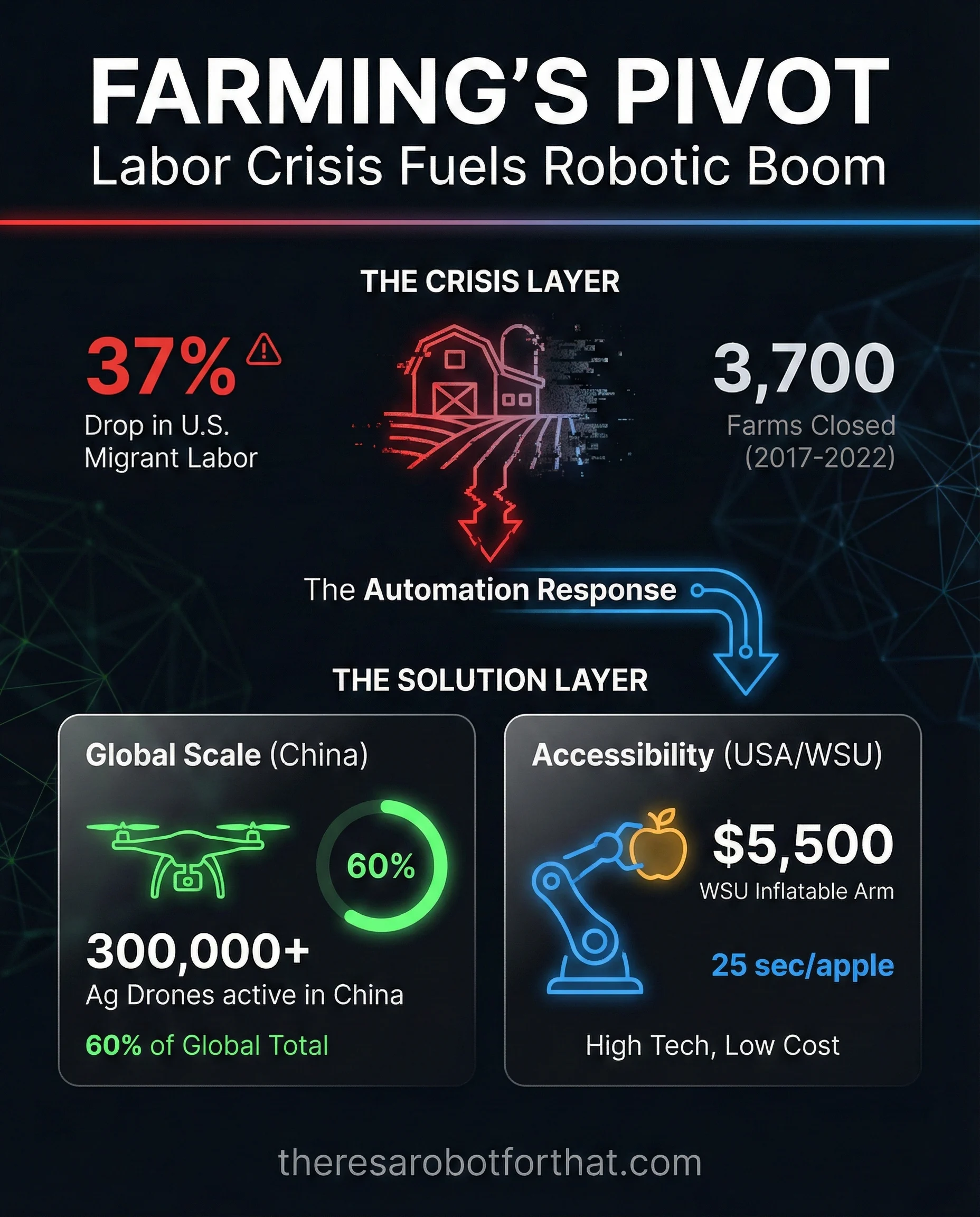
Image Source: There's A Robot For That
Snapshot: Agricultural robotics are moving from lab prototypes to field deployment, as Washington State University develops a $5,500 inflatable robot arm for apple picking while China elevates drones and robots to national agricultural policy priority for the first time.
Breakdown:
Takeaway: Agricultural robotics have crossed into the practical deployment phase, with solutions hitting viable price points under $10K and the world's largest agricultural market creating explicit policy support. Industries adjacent to agriculture—food processing, logistics, warehouse operations—should watch closely as these field-tested automation approaches will migrate to their operations within 18-24 months.
Other Top Robot Stories
Beijing raised more than $100 million in first-round funding for X-Humanoid, the national robotics innovation center developing the Tiangong humanoid robot and Huisi Kaiwu embodied AI platform, backed by state-linked funds including the Beijing Robotics Industry Development Investment Fund alongside strategic investors Baidu and Kyland Technology.
🤖 Your robotics thought for today:
Faraday Future's selling a $2,500 quadruped with compensated pre-orders and aims to deliver humanoids in weeks despite zero robotics track record—so does their move prove the manufacturing barrier collapsed or just that demo-phase vaporware now comes with a credit card form?
Have a great weekend,
Uli


