
Eastworld Labs launches 'human-free' businesses with 30+ robots
PLUS: Waymo hits 200M miles, ZaiNar’s $100M raise

Welcome back to your Robot Briefing
Eastworld Labs is betting entrepreneurs will soon launch autonomous franchises with clicks instead of contractors—using AI agents for operations and a fleet of 30+ Unitree G1 humanoid robots to handle the physical work in a 10,000-square-foot facility in Kuala Lumpur. The model bridges to full autonomy through teleoperation from lower-wage countries, collecting the data needed to go hands-free within 12-18 months.
If the accelerator model works, does physical automation become as accessible as cloud infrastructure—and does that shift the timeline for companies still planning pilot programs?
In today's Robot update:
Eastworld Labs launches 'human-free' businesses with 30+ robots
Snapshot: Virtuals Protocol launched Eastworld Labs, an accelerator designed to make launching physical businesses as easy as spinning up software—using AI agents for operations and a fleet of 30+ humanoid robots for physical work. The bet is that entrepreneurs will soon launch autonomous franchises with clicks, not contractors.
Breakdown:
Takeaway: This signals the robotics deployment model is shifting from single-purpose demos to multi-use platforms that startups can access without massive capital outlays. The teleoperation bridge strategy suggests commercially viable physical automation is 12-18 months away for specific verticals, not 3-5 years.
Waymo crosses 200 million autonomous miles
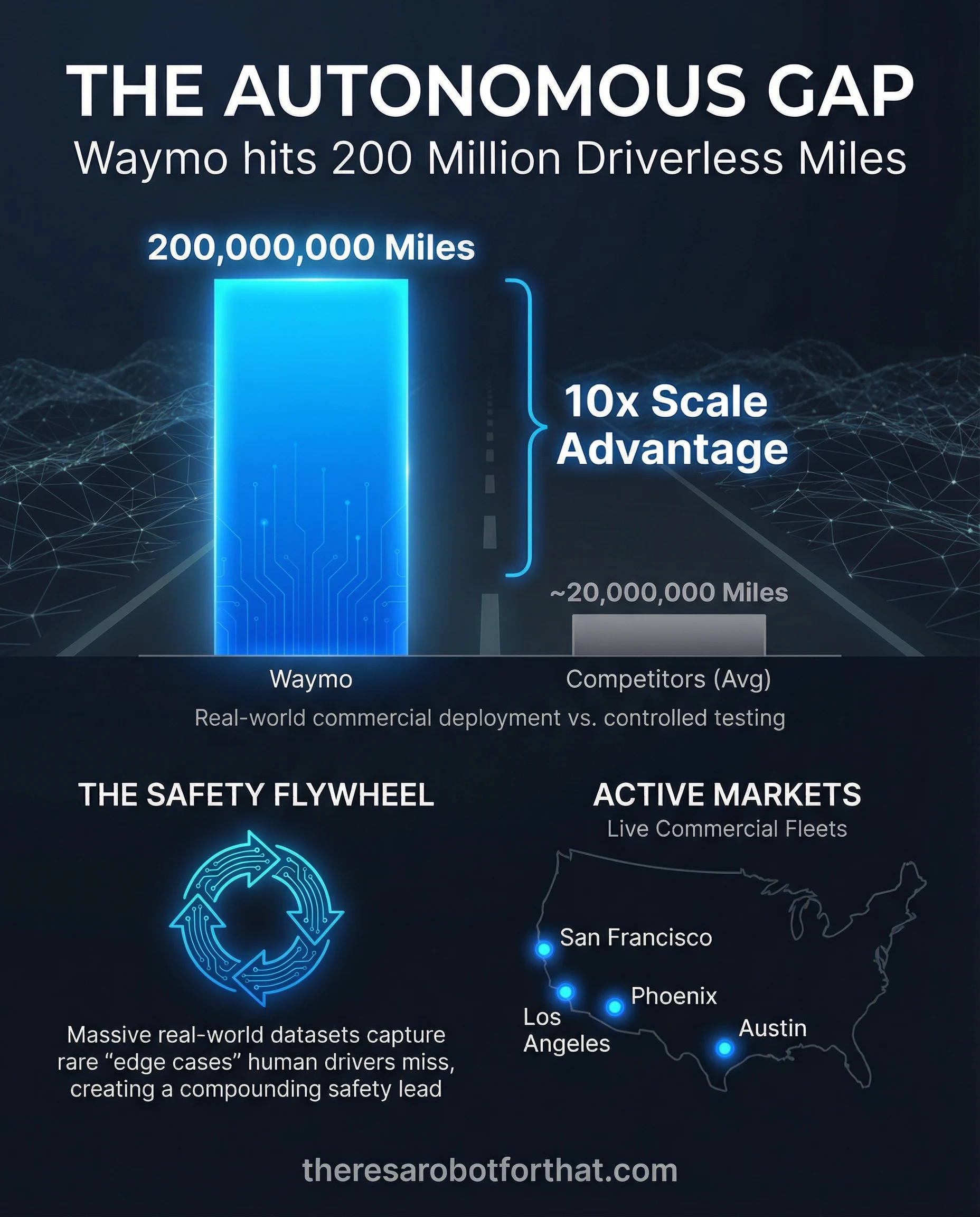
Image Source: There's A Robot For That
Snapshot: Waymo announced it has driven over 200 million autonomous miles with no human driver behind the wheel, marking a significant lead in operational scale and safety data that few competitors can match.
Breakdown:
Takeaway: The widening gap in operational scale suggests autonomous technology is splitting into leaders with massive real-world deployment and everyone else still testing. Companies evaluating autonomous vehicle partnerships should recognize that the window to work with proven, scale-tested providers is narrowing as the technology leaders pull further ahead.
ZaiNar raises $100M to solve robotics' positioning 'data problem'
Snapshot: ZaiNar emerged from stealth with $100 million in funding to deploy a positioning platform that turns existing 5G and Wi-Fi networks into sub-meter tracking systems for mobile robots, eliminating the need for expensive hardware installations that have slowed warehouse and logistics automation.
Breakdown:
Takeaway: The shift from proprietary positioning hardware to software that leverages existing infrastructure changes the economics of deploying fleets of mobile robots in complex indoor environments. Companies evaluating warehouse automation or autonomous material handling can now consider solutions that previously required prohibitively expensive facility modifications.
Japan's 'All-Star' Team Targets 2027 Mass Production
Snapshot: Leading Japanese companies including Renesas Electronics, Murata Manufacturing, and Sumitomo Heavy Industries have formed the Kyoto Humanoid Association to develop domestic humanoid robots, targeting mass production by 2027 as a coordinated response to Japan's labor shortage crisis.
Breakdown:
Takeaway: When a manufacturing powerhouse organizes its top electronics and robotics companies around a 2027 production target, that's a credible timeline signal for the humanoid labor replacement market. This national industrial policy response to demographic labor shortages suggests businesses should be evaluating humanoid readiness on a 2-3 year horizon, not a distant future scenario.
Other Top Robot Stories
Humanoid robotics companies raised over $6.1 billion in 2025, with roughly 87% to 90% of the 13,000 humanoid robots shipped globally coming from Chinese manufacturers as the sector moves from experimental demos to commercial scale across 140+ domestic companies.
T-Mobile positioned its network infrastructure as the foundation for Physical AI systems that require real-time coordination, introducing the concept of kinetic tokens that trigger physical actions and partnering with Nokia, Ericsson, and NVIDIA to ensure 6G networks can simultaneously handle wireless traffic and AI workloads at the edge.
MANUS integrated its motion-capture gloves as a native teleoperation device in NVIDIA Isaac Lab for high-quality human demonstration data collection in simulation, enabling researchers to generate training data for dexterous manipulation tasks without requiring physical robot hardware.
🤖 Your robotics thought for today:
Virtuals just dropped $2M on 30 Unitree humanoids so startups can launch autonomous restaurants in Kuala Lumpur without buying hardware, but most retailers are still writing three-year business cases to justify one robot pilot—so does access-over-ownership flip the adoption math, or are we watching VCs subsidize experiments that fold when teleoperation costs hit?
Until tomorrow,
Uli


